Wide Grip Lat Pull-Down vs. Narrow Grip Lat Pull-Down: Which One Wins?
Do you find this title a little puzzling? If you search the internet casually, you will find that 'lat pull-down with narrow grip and wide grip' is often discussed. Sometimes articles say that wide grip lat pull-down stimulates the back muscles more effectively, and sometimes they say that narrow grip lat pull-down can better build a thick back.
The reason why there are so many contradictory views on the internet is because of 'denying the truth'.
This article will tell you thatthese two methods have no difference for back muscles
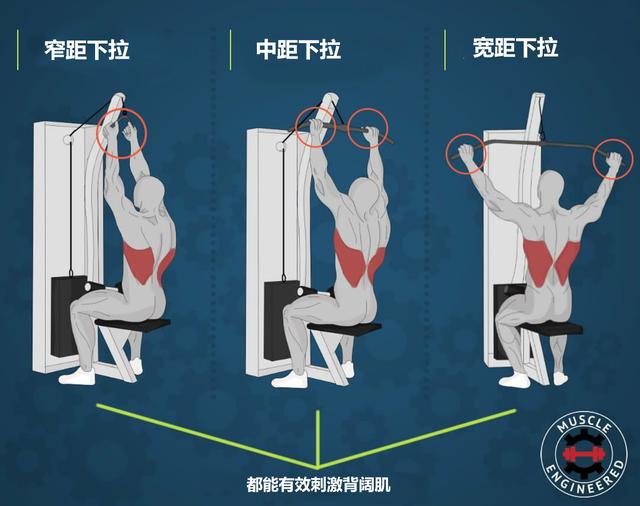
The bottom map comes from muscleengineered
lat pull-down
this training has a very low difficulty of getting startedalmost every fitness beginner will 'do it without a teacher'Why?This action comes from one of humanity's oldest postures – climbing. That is, as long as you know how to climb, you don't need a coach to give too much guidance on pulling down.
Then why are there differences between wide grip and narrow grip?
First is people's experience of training with pull-ups, which is much more complex than lat pull-down. Second is borrowing from the wide and narrow grip of bench press, but the angle of force for back muscles and latissimus dorsi is different (it can be simply understood as thinking that the chest muscles move left and right, and the latissimus dorsi muscles move up and down, so it cannot be directly applied). Third, inEarly studies did point out that a supinated grip plus a wide grip stimulates the back muscles best, but they didn't explain it because the supinated grip or wide grip resulted in the best stimulation of the back muscles.
In 2010, exercise scientist Lusk et al.compared the effects of supinated wide grip, supinated narrow grip, reverse supinated wide grip and reverse supinated narrow grip on the back musclesThe research conclusion pointed out thatwhether it is a narrow grip or a wide grip, as long as you choose a supinated grip, you can maximize the activation of the latissimus dorsi 1
Later in 2014, another exercise scientist Andersen pointed out thatthe middle grip is somewhat better than narrow grip and wide grip, but the best grip width is one to two times the distance between the shoulders. That is, when doing lat pull-down, no matter what the grip width is (1~2 times the shoulder width), it can effectively stimulate the back muscles, and the difference in muscle stimulation between them is not worth counting 2.

We know that there are only differences between supinated and reverse supinated grips.
We know that when doing pull-ups or lat pull-down, supinated and reverse supinated grips have great differences. We often use reverse supinated grips 'cheating' because reverse supinated grips also activate the arm and shoulder muscles, so we can pull up a larger weight.
Examples of rotational strength cannot be underestimated, such as forearm flexions and reverse arm extensions, such as the mixed grip of deadlifts, such as traditional push-ups and Arnold push-ups.Rotational force cannot be underestimated.
's question
Lat pull-down not only trains the latissimus dorsi, but also trains the biceps and other muscle groups of the back. So, does the advantage of a wide grip come out?
Again, in Andersen's study, he also noticed that the activation degree of the latissimus dorsi, trapezoid muscle and teres major in the three grips was similar. In general, these three grips have similar activation degrees for different muscle groups.
Further more, you can analyze the movement from the concentric and eccentric stages in detail.In the concentric phase of lat pull-down, using a narrow grip and (compared to a wide grip) activates the biceps to a slightly higher degree. In the eccentric phase of lat pull-down, using a wide grip (compared to a narrow grip) has a better stimulation effect on the latissimus dorsi and teres major 2.
But these relative advantages are not obvious, so he finally suggested using a grip width of one to two times the shoulder width, which can effectively stimulate the back muscles 2.

Use a triangular handle to do lat pull-down, which is equivalent to a seated row.
Using a tool to make the grip extremely narrow will cause what? Everyone should be familiar with the triangular handle, some people will put it on the pull-down machine, claiming that this movement range is larger and more effectively stimulates muscles. But please, is this lat pull-down?
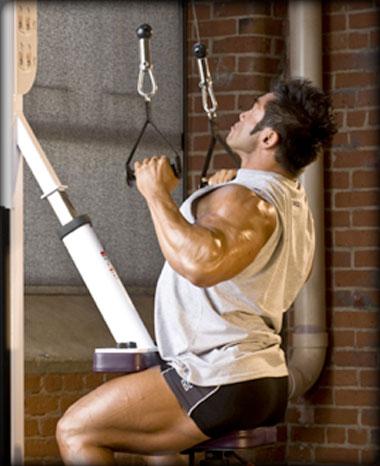
Double triangular handle lat pull-down, pay attention to the grip posture.
We know that single-arm training and double-arm training can be focused on upper body training. If lat pull-down is the prelude of pull-ups, then using a triangular handle tends to be more inclined to double-arm training. The grip with opposite palms will involve more forearm and chest muscles.
The conclusion can be drawn
Based on the above analysis, the conclusion is thatIf you want to stimulate the latissimus dorsi, then no matter what grip you use, it can more effectively stimulate the latissimus dorsi.
In fact, everyone will have their own training experience and insights, and it is difficult to change a person's thinking. The reason for this ongoing argument is that some people use 'lat pull-down training the upper body effectively' as a last line of defense. Therefore,To achieve the best upper body training effect, people try to use different lat pull-down grips and grips, in order to build a stronger upper body (or back).
Finally, if you want to experience more dynamic lat pull-down training, you can use wrist straps to assist, the grip will change from narrow to wide, so that you can carry out a more complete upper body training.
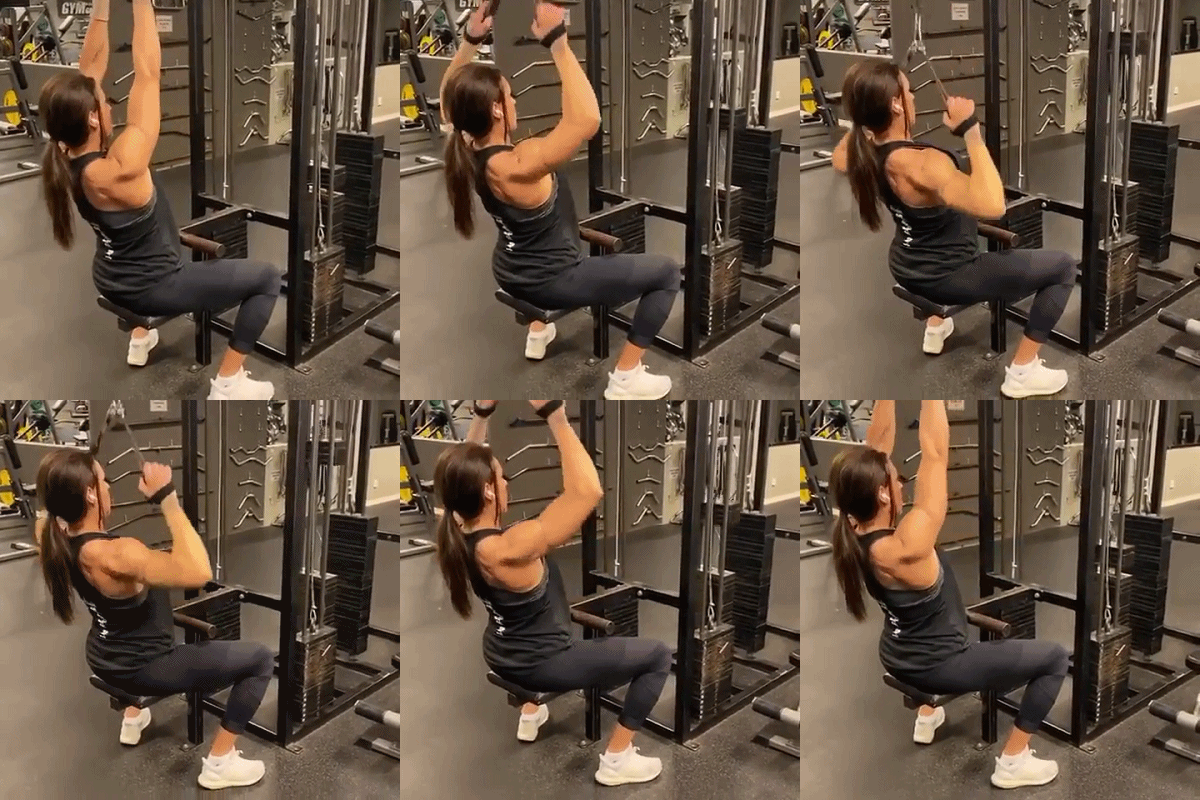
I hope this article is helpful and reduce some arguments in the gym. This is the Fitness Hole, welcome to communicate together.
References:
1https://www.ncbi.nlm.nih.gov/pubmed/20543740
2https://www.ncbi.nlm.nih.gov/pubmed/24662157