Highland Yak –
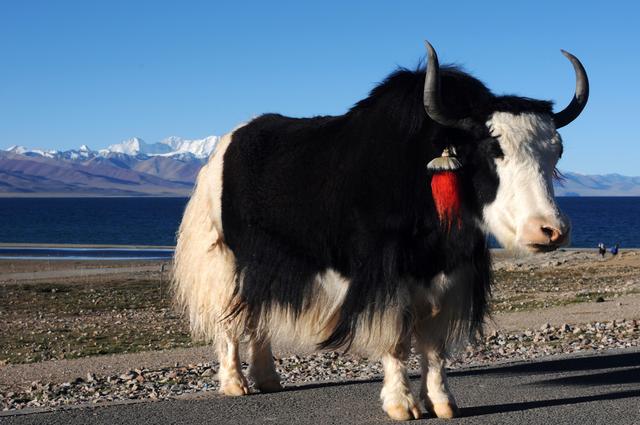
Bos mutus or Bos grunniens, commonly known as the wild yak, belongs to the phylum Chordata, subphylum Vertebrata, class Mammalia, order Artiodactyla, suborder Ruminantia, and family Bovidae. It is a rare and precious cattle breed centered on the Qinghai-Tibet Plateau and its surrounding high-altitude, sub-high-altitude cold and dry areas. It is a herbivorous, fodder cattle breed. The wild yak is able to adapt to cold climate and is the highest-living mammal (excluding humans). It is distributed in the Qinghai-Tibet Plateau at altitudes above 3000 meters. The Tibetan word for yak is 'ya ke', and the world's common name is 'yak', which is the transliteration of the Tibetan word.
The entire yak is valuable, and the Tibetan people's life, food, clothing, housing, and burning, farming, and raising all depend on it. People drink yak milk, eat yak beef, burn yak dung for fuel, its hair can be used to make clothes or tents, its skin is a good material for making leather. It can be used for farming and also as a transport tool on the plateau, providing milk, meat, hair, labor, and fuel to the local herdsmen, it is an important livestock species for the Qinghai-Tibet Plateau herdsmen's life and economy, and it is an important livestock species in the Qinghai-Tibet Plateau livestock economy.
There are nearly 1.6 million yaks worldwide, with more than 1.5 million in China, which accounts for more than 95% of the world's yak population, accounting for 1/6 of China's cattle population.
The primitive yak lived as early as 3.3 million years ago in the late Pleistocene. It was widely distributed in the northeast of the Eurasian continent. Later, due to plate movement and climate change, it migrated south to the Qinghai-Tibet Plateau, and adapted to the cold climate and continued to evolve into the modern yak.
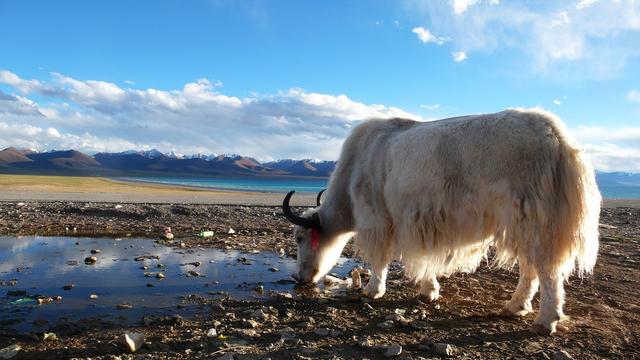
The yak has a warm and cold-resistant body shape, with a compact body, short neck and small ears, thin skin with a small surface area; it has very little sweating function, and its hair length, fineness, and changes with the seasons are all dense and long, suitable for cold and humid climates. It has a large chest, developed heart and lungs, thick tracheal tube, large red blood cells, high hemoglobin content, fast breathing and pulse, adapting to the hypoxic environment. Its mouth is wide and flexible, able to nibble on short grass; its hooves are solid and have soft pads, its temperament is docile, has quick reaction, the established conditional reflexes are well-established, it is easy to train; it has strong disease resistance, strong resistance to adversity, strong gregariousness, wide diet, tolerance to hunger and thirst, tolerance to rough feeding management conditions.
The yak can adapt to altitudes of 3200-4800 meters, with an atmospheric pressure of 68420.85-55435.28Pa, an oxygen partial pressure of 14505.43-11679.01Pa, and a dissolved oxygen content of 14.9%-11.44%, adapting to the hypoxic environment. Its chest is developed, and the heart and lungs are well-developed, protecting the chest, abdominal cavity, external genitalia, mammary glands, and joints from freezing. It is measured that in the grassland of the Qinghai-Tibet Plateau, with a grass area of 3800 meters, the yak can be fed 9.5 hours a day, eating 27.86±1.42kg of fresh grass.
The yak also has the ability to recognize the route, it is good at walking on steep and dangerous roads, snow mountains and swamps, it can cross rivers and rapids, and it can choose the route to avoid traps. It can be used as a guide for tourists.
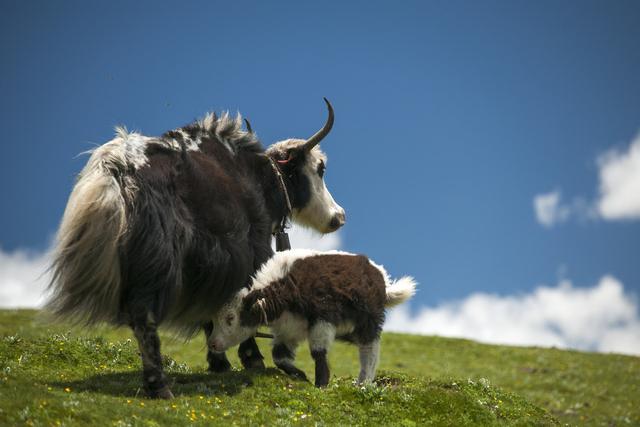
Wild yaks live in alpine grasslands, shrubs, deserts and other areas at altitudes of 4000-5000 meters, adapting to the environment, resistant to wind and snow, and has a sensitive sense of smell. They usually live in groups, and eat at dawn and dusk. They generally ovulate and mate in September-January, with a gestation period of about 9 months, and one calf is born, and the calf is weaned at 2-3 years old, and sexually matures at 3-4 years old.
The wild yak is a typical cold-resistant animal of China's Qinghai-Tibet Plateau. It is distributed in the south of Xinjiang, Qinghai, Tibet, the northwest of Gansu and the west of Sichuan. It lives in high-altitude grasslands, high-mountain peaks, mountain valleys, high-altitude deserts and other environments with few people, and can reach altitudes of 3000-6000 meters in summer, and even reach altitudes of 5000-6000 meters in winter. The wild yak has the ability to endure hardship, cold, hunger, and thirst, and has a strong ability to adapt to the high-altitude grassland environment, so many other hoofed animals and domestic animals cannot utilize and reach the dense vegetation and high-altitude grasslands it can reach.
The wild yak lives in different places in different seasons, gathers in the lakeside plains in winter, and goes to the vicinity of the snow line in the autumn and summer, where it breeds and reproduces. The wild yak is fierce in nature, and people generally do not dare to disturb it. When angered, it will rush towards it at ten times its strength, and sometimes it will knock over cars. More than 90% of the yaks in China account for most of them growing in the Tibetan Plateau.
The breeding season of wild yaks is in September, the gestation period is about 260 days, and one calf is born each time, and the calf is weaned at 1 year old, and sexually matures at 3-4 years old. The wild yak's lifespan is more than 23 years.
Adult height: male 129.2 cm, female 110.9 cm; adult weight: male 443.4 kg, female 256.7 kg; maturity age: 12 months; adaptation age: 2 years; average single yield: 274 kg; fat content: 6.37%-7.2%; adaptation: adapts to high altitude, cold-resistant, rough-fed, hardship-resistant.