Are Most Career Planning Psychological Tests Fraudulent?
This time we have experienced from what time is the most appropriate to discuss the issue of career planning, our opinions are from high school, and as for how to carry out career planning, that is the topic we will elaborate on today.
As the saying goes, know yourself, know your enemy, and you will never be defeated in battle. A qualified career development planner must have a general understanding of various disciplines, even various majors, and the recent developments, and also have a clear understanding of the goals of career planning – typically, these are secondary school students.
And we know how to understand students is also diverse, in addition to daily face-to-face communication, relying on the results of psychology is also a necessary means. Therefore, today we will first introduce several psychological tests and scales that we often use.
Holland Career Interest Self-Assessment
Holland Career Interest Self-Assessment (Self-Directed Search) was compiled by American career guidance expert John Holland based on his extensive career counseling experience and his career type theory. The earliest version of Holland’s Interest Self-Assessment appeared in 1958, and it has been continuously improved and perfected over the years. In 1991, it was translated and introduced into China by the teachers of Hubei Normal University.
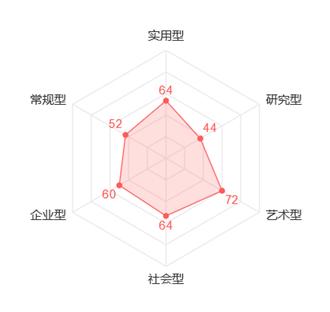
Illustration: The iconic radar chart of the Holland test
Interestingly, in addition to the late 1980s when some foreign-funded companies entered China, the earliest domestic use of the Holland test was also carried out by the Ministry of Organization and Personnel, such as the People’s Liberation Army Air Force Medical University.
The core idea of the Holland test is to divide people's interests into six directions. Everyone's experience during their growth is unique, and the self-personality shaped in the end is also unique. The ability requirements of different occupations are also different. Based on the corresponding ability and personal interest, we can easily understand the possible social positions that may be suitable for us or may be of interest to us.
In our daily use, the greatest value of the Holland test is to help us determine the possible career interests of students. Now, high school students, especially those in high school, are just getting started, and their ages are generally 15-16 years old. Children in this age group have some social experience, but their own experience is relatively limited. At the same time, they are not very concerned about employment and the workplace, and they have unrealistic ideas about the future of their careers. In addition, parents have unintentionally ignored the cultivation of children’s interests since junior high school.
Therefore, many children’s interests are formed after high school. However, the current system requires us to make decisions about our future development direction in high school. This is somewhat contradictory. Therefore, we should encourage children to develop their own interests, and we should also appropriately estimate the possible development direction of the children. And to make this estimation accurate and reliable, we must have a clear understanding of the children’s existing interests.
Myers-Briggs Type Indicator (MBTI) Career Assessment
The MBTI personality theory is based on the psychological type theory of Carl Jung, after Carl Jung passed away, it has been developed and improved by his successors, and has become the MBTI career personality test today. In China, MBTI was first translated and introduced by the Fourth Military Medical University in 1997, primarily for screening and measuring the psychological indicators of pilots.

Illustration: A typical MBTI test result
According to the MBTI theory, we summarize and extract four key elements from the complex personality characteristics – drive, information collection, decision-making style, and lifestyle, and classify them into simple two-part categories for analysis and judgment, so as to distinguish different personality types. Through MBTI testing, we can easily obtain a lot of characteristics of the children’s personality: whether they are introverted or extroverted, whether their decision-making mode is rational or perceptual, and whether their lifestyle tends to be planned or random. This provides a lot of help for us to judge the ways children get along with people, the performance of children in school when parents are not paying attention, and so on.
It is worth noting that the formation of MBTI career personality test is relatively early, and it has been developed today, so there must be some places that are considered inappropriate. However, because MBTI testing has a long history, and a lot of data, we can get a lot of reference data. For example, according to the research of the People’s Liberation Army Air Force Medical University, in China, if the MBTI is divided into two categories, namely, extroverted, sensation-feeling, thinking and judging, the scores are obviously higher. This shows that MBTI theory has a certain degree of credibility and can be used as a reference. At the same time, if a child’s MBTI score is also biased towards extroverted, sensation-feeling, thinking and judging, it indicates that he may have the psychological qualities needed to be an excellent pilot.
Smart Composition Assessment
Howard Gardner’s Multiple Intelligences assessment, proposed in 1983, is constructed based on the theory of multiple intelligences. Generally, the main purpose of incorporating this assessment is to determine whether students have competitive abilities in areas other than memory, calculation, and other traditional intelligence indicators.
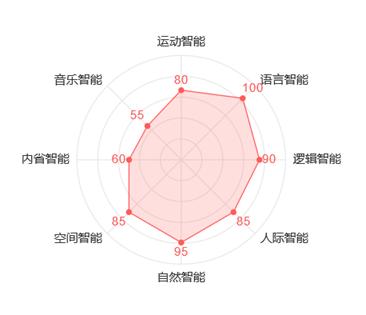
Illustration: The theory of multiple intelligences points out that human intelligence should be considered at least in eight dimensions.
In fact, this theory is easy to understand: some children are good at mathematics, some are good at English, and some are not good at mathematics and English, but they are particularly good at drawing. Can we say that this child is smarter? Not necessarily. Traditionally, when we evaluate a child’s “brain power,” we focus too much on memory, recitation, and inference and calculation. We ignore the child’s ability in other areas. This is what the theory of multiple intelligences wants to change.
For different children, the same amount of time invested in different subjects may not yield the same results. This doesn’t need us to emphasize. It is believed that every subject in our learning should not be abandoned.
Above is the sharing we brought to you today.