Geese and Swans 'Battle' at Beikouhe River Wetland Park
Qinghai News Network·Daxi Qinghai Client News: In recent years, with the increased efforts of the government to protect ecological environments, the ecological environment of Xining has been continuously improving. Today, Xining's Beikouhe River is open for viewing and experiencing, with windows revealing lush greenery, and the surrounding living environment is becoming increasingly better, with parks becoming more beautiful, bringing people great joy.
Since March, the Beikouhe Wetland Park has successively flown in a large number of migratory birds, including tufted duck, Mandarin duck, red-billed duck, green-headed duck, gull, egret, and dozens of other species. The birds are playing and dancing in the water, forming a unique landscape, attracting many citizens to take photos and keep them as souvenirs.
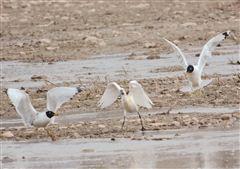
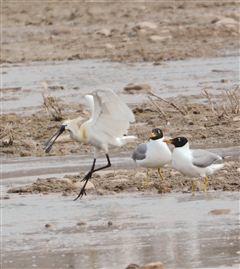
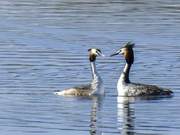
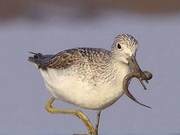
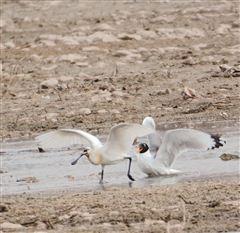
Among the group of gulls, the only white egret is particularly conspicuous. The gulls rush to catch the white egret in the river to catch fish, to wait and snatch, without effort; the white egret is focused on catching fish in the water, and the gulls quietly watch beside it. When the white egret catches fish, the gulls immediately rush over to grab food, sometimes soaring into the air to chase and fight, and the competition is intense, the atmosphere is tense, and it's like a martial arts movie, wonderful and fascinating. This 'battle' between gulls and egrets was perfectly 'captured' by photographer Liu Dehuan.
It is reported that the white egret is a national second-level protected animal, which was listed in the China Red Book of Endangered Animals since 1996. It has a long, straight, and broad beak like a pipa, hence the name 'white egret'. White egrets breed in the Eurasian continent and southwestern Africa, in Africa, the Indian Peninsula, Northeast China, North China, Northwest China, Southeast China and Southeast Asia for winter. White egrets have long feet, black, and bare legs below the tibia. In summer, the whole body is white, with a long, filamentous crest on the back of the head, orange-yellow on the forehead, and an orange-yellow neck ring below the forehead. In winter, the plumage is similar to that in summer, with a white whole body and no crest on the back of the head, and no orange-yellow neck ring on the lower neck.
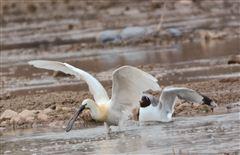
Photo/ Liu Dehuan