Spectacular Scene! Large Numbers of Wild White-Lipped Deer Chase and Play on Snowy Mountains in Sichuan's Ganzi Tibetan Plateau
On March 7th, reporters from Red Star News learned from the publicity departments of the CPC Committee of Shi Que County, Ganzi Tibetan Autonomous Region, that on March 5th, a large number of wild white-lipped deer were seen chasing and playing on snowy mountains in the True Da Nature Reserve in Ganzi Tibetan Autonomous Region, Sichuan Province.
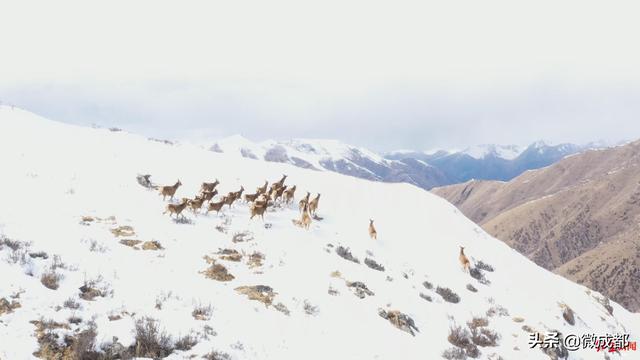
↑Wild white-lipped deer group chasing and playing on snowy mountains.
White-lipped deer are a national Level I key protected animal, with a body size similar to that of a red deer, with a body length of about 2 meters and a weight of about 250 kilograms. Adult male deer antlers can reach 1 meter long, with 4-6 branches, and females have no antlers. The body is yellowish-brown, with a pale brown rump spot, and no black dorsal line and white spots. The fur is coarse and hard, a typical high-altitude animal, and its habitat is at an altitude of 3000-5000 meters, adapting to high-altitude climates, and is one of the rare wild animals only found in the Qinghai-Tibetan Plateau.
According to statistics, the southwestern part of Shi Que County is one of the areas with the largest population and density of white-lipped deer distributed on the Qinghai-Tibetan Plateau. In the True Da God Deer Valley Ecological Protection Zone in Shi Que True Da Township, the population of white-lipped deer is about 14000 heads, and the population density reaches 7.35-8.81 heads per square kilometer. In Shi Que and Bai Yu counties of Ganzi, there are about 45000 white-lipped deer, accounting for one-third of the national population.
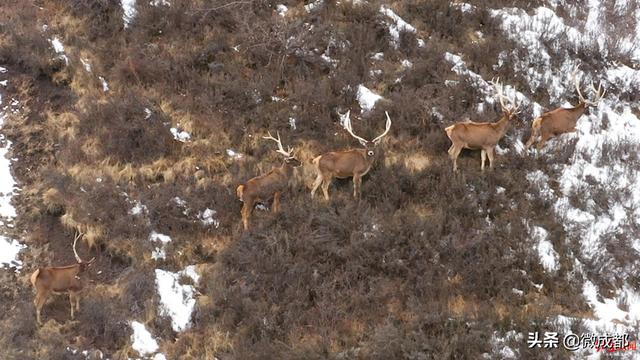
↑Wild white-lipped deer.
In recent years, Ganzi has vigorously implemented ecological civilization construction, and biodiversity has been effectively protected. 38 forest ecological protection areas, 8 forest parks, 17 wetland parks and 1 international important wetland have been established. Fresh River, Lake Huahua Sea and Salurili Mountain have been named 'China's Most Beautiful Forests', and multiple places have created forest towns, forest health tourism and forest scientific education bases, creating a forest ecosystem tourism industry, and wild plants and animals are constantly increasing. Snow leopards, Asian golden cats, rock sheep, red deer, stone chicken and wild boars have increased significantly in number.
Xiao Hai Han Red Star News reporter Jiang Lin
Photo by Qin Jinxiang
Source: Red Star News