Encyclopedia of Biodiversity: Head of State Silkmoth – A Cool ‘Flower Thief’ on Lushui Beach
Today, we're going to introduce you toJointed Animals · Head of State Silkmoth.
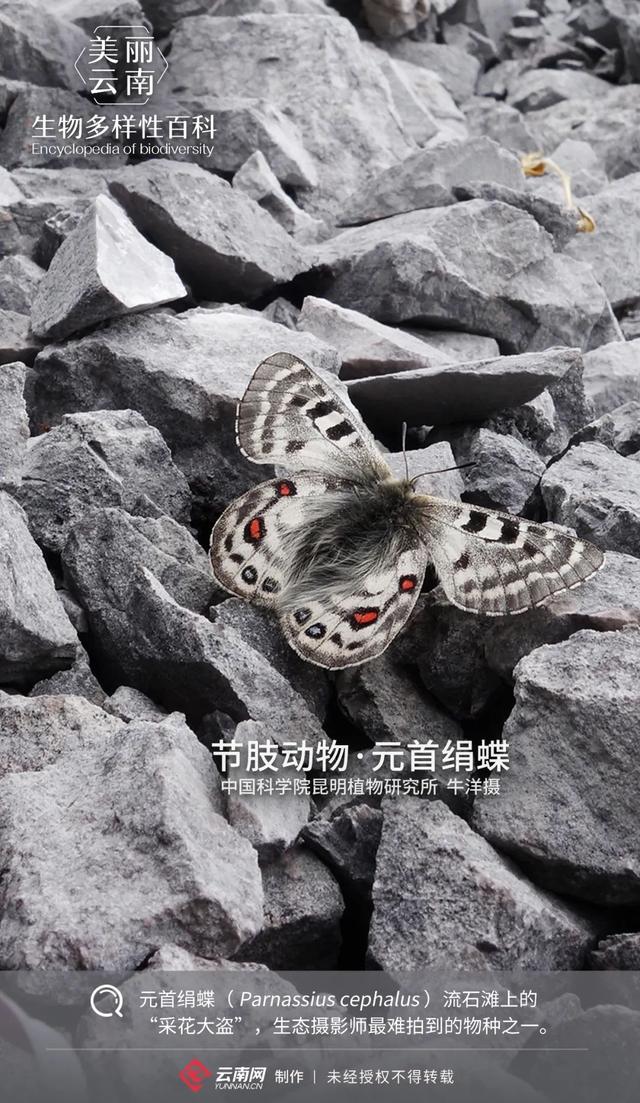
Head of State Silkmoth
Parnassius cephalus
Jointed animals, Arthropoda, Insecta, Papilioniformes, Ptiliopterygidae, Ptiliopteryginae. Adults appear in 7-8 months, and they mainly inhabit high-altitude areas above 3000m. The main distribution in China is in Yunnan, Gansu, Qinghai, Sichuan, Tibet, etc. The photo was taken in Shangri-La.
The Head of State Silkmoth was photographed on Litsehan Beach at an altitude of 3800 meters, which can be considered a 'low-altitude' area for this species. Many photographers have seen their shadows on Litsehan Beach at altitudes of 4500 meters or even higher.
The Head of State Silkmoth's colors are very similar to its living environment, with a low-key gray-white color and red spots on the hind wings. The thick hairs on the body help them keep warm. The Head of State Silkmoth has four stages in its life: egg, larva, pupa, and adult. Adults lay eggs on specific cold-climate plants or adjacent rocks, and when the larvae hatch, they can eat plant stems and leaves.
Silkmoths are very rare butterflies. There are 30 known species of Silkmoths in China, accounting for 2/3 of the world's Silkmoth species. They are also one of the insects with the highest recorded distribution altitudes in the world, and their highest activity limit can reach altitudes of more than 5000 meters, which is an unattainable height for most insects.
Because of its harsh living environment, the Silkmoth is very fond of sunshine. Whenever it rains or is cloudy, it avoids it. Once it encounters sunshine, the Silkmoth likes to lie on a rock to bask in the sun. It is difficult to find Silkmoths, and it is difficult to determine their movement trajectory, so they are called the most difficult species to photograph by ecological photographers.
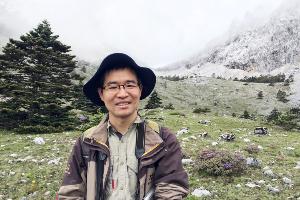
Niu Yang, a plant science doctor and currently a Vice Researcher at the Institute of Botany, Chinese Academy of Sciences, is engaged in the evolutionary ecology research of high-altitude plants. In his spare time, he loves natural photography and hopes to express the beauty of nature through science and art.
Coordination: Lian Hui Ling
Text Compilation: Tian Yuan
Poster Design: Zheng Bin Yun