Short-Lived Insects of the Insect World, Adult Lifespans Less Than One Day, Some Only Live for One Hour
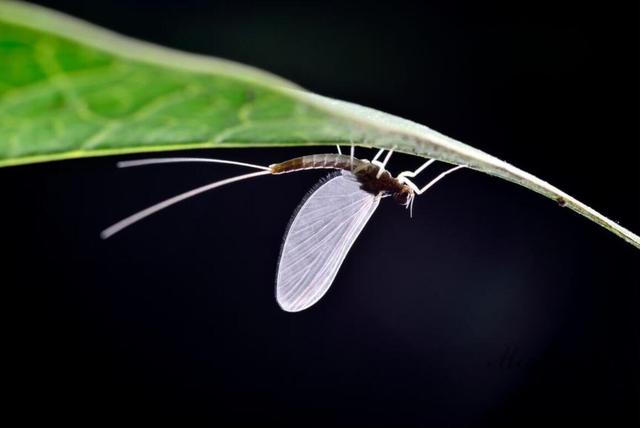
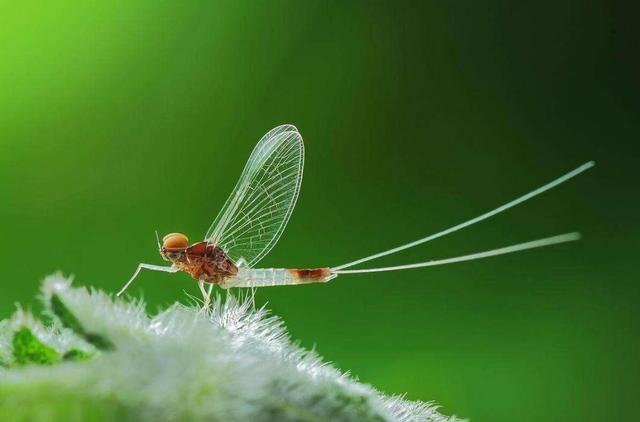
In the summer, many distorted small animals are often seen on the stones or in the grass along the river. They have three pairs of legs and two or three long, thin hairs on their tail. The rear part of the long body has two rows of small plates, which are the respiratory organs, also known as gill tubes. Some of these small animals are indeed young mayflies. Poetry often says that mayflies are born to live and die. This is because this insect lives and dies shortly after growing wings, and even less than a day. According to observation, it flies in the air for only one hour before it disappears. This is for the fully winged adult. Don't mistakenly think that the life of a mayfly is so short. Many of them live in the water for two or three years before growing wings, so they are not particularly short-lived.
The Swimming Swimmer
Some animals have short juvenile periods, long prime periods, and short death periods; some have short prime periods and long death periods. Human life is also similar. Mayflies have a very long juvenile period in the water, grow wings, and fly away to die shortly thereafter. The many aspects of the mayfly larvae's body are adapted to their lives. In the so-called 'abdomen' for seven segments, some or all of the back has delicate gill tubes used to absorb oxygen from the water. The tail end can also help with breathing. In general, oxygen enters the internal air tubes, and then reaches all parts of the body through the division of the air tubes. The gill tubes are sometimes covered with a cover, or by the neighboring bristles are entangled, to protect them from mud and debris. Some fast-moving larvae have a 'streamlined' body like that of many aquatic animals such as fish. By having such a shape, the larvae can swim with less resistance. When they stop against the current, they can also reduce the resistance of the water.
Their legs have hooks that can hold on to the stones. The flatness of their body and the speed of the water are also similar. Only very flat mayfly larvae can live in fast-flowing rivers. There is a kind of mayfly that lives in rapids, specializing in doing almost impossible things, just like animals often do. Its gills are flat and extend sideways, attached to the stone in an egg-shaped large suction cup shape, which is very similar to the hat shell. The suction method of the mayfly larvae living in the mountain rapids is the best example. For example, there is a common mayfly in America called Six-jaw Mayfly, which lives in the bottom of rivers and lakes. Its habits are different from the previous kind, its front legs are flat and shaped like shovels, its jaw is extended outwards and has a very large tooth-like shape. It uses these two tools alternately to dig and shovel to open a tunnel like a water mole.
From larva to metamorphosis
Many species of aquatic insect larvae specialize in feeding on the extremely small floating organisms in the water, they use different and clever methods to catch food. Some species of aquatic insect larvae have a fan-like movement to stir the water beside their mouth, making the water form a whirlpool to suck in tiny food. Some snails use silk to make a delicate small net to catch small organisms and eat them. 'Pregnant Mayfly' larvae can swim almost as fast as fish. It uses its middle foot and hind feet to stick to the stone, 'extends its front feet and opens them into a pair of long hairs on the edges, like a basket, to receive food sent from the water.' Many other mayfly larvae simply eat the microscopic plants attached to the rocks. Some climb the stems of underwater plants and eat as they climb. They mostly eat plants and eat decaying plant and animal carcasses and debris.
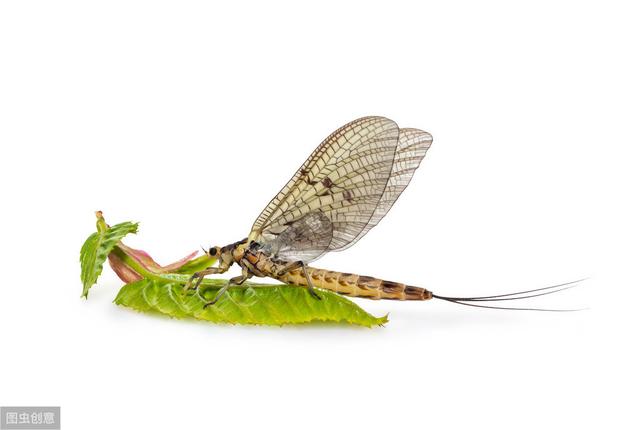
Larvae live in the water for weeks, months or years, shedding their skin repeatedly. Then, after a major change, they float to the surface and quickly emerge from the broken shell with their wings. The shell takes less than 10 seconds to split, and the mayfly has already flown away. If you are lucky enough to find a recently separated mayfly larva floating in the water, put it in your sleeve and observe it carefully, you will see that there is a remnant of its mouth there, it struggles to remove this gray outer layer before it is truly fully grown. This last molt before the final molt is called 'resting stop' by insect scientists, the short resting stop of young mayflies is only a few minutes, the larger one can be extended for two days. Regardless of the speed, the outcome is the same, it will produce a beautiful, colorful and flexible winged insect.
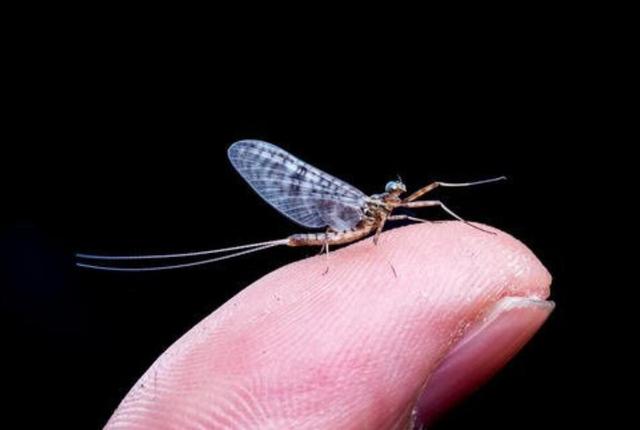
A short life
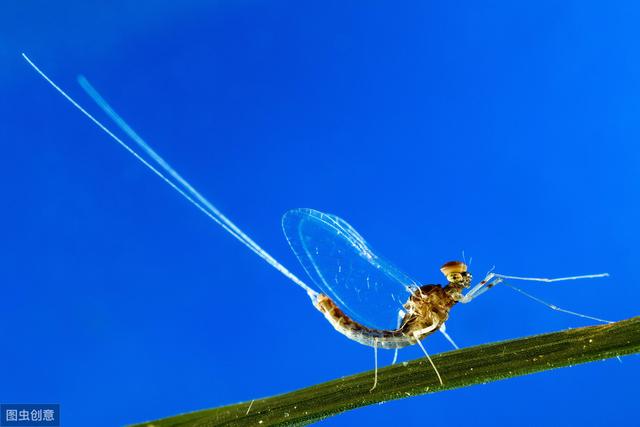
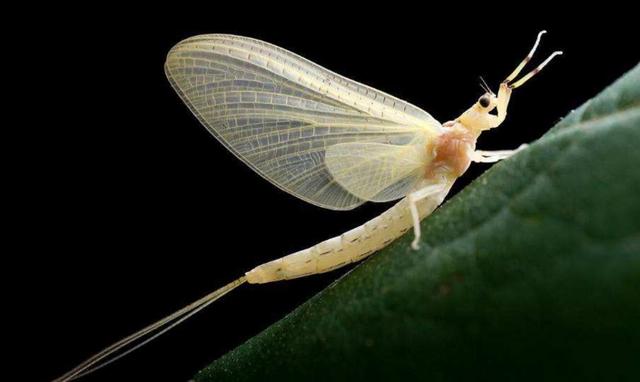
In summer, adult male mayflies fly in large groups, each species has its own characteristic movements and behaviors, and female mayflies fly to greet them. Eating days are over, now it's time for love. Male mayflies vibrate their wings, sometimes stopping, sometimes continuing, jumping up and down. They almost fly straight up and down. First, they beat their wings to rise quickly, and then let themselves fall gently, continuing to do this many times, forming a dancing movement. When a large group of mayflies flies and falls in a calm river, countless wings are fluttering, like a cloud, which is very beautiful. They chase each other, embrace, and then disperse, creating a courtship dance in flight. When some mayflies touch the water surface, the water surface will ripple, and at the same time, the eggs are laid, which looks like random ones. After a night, they may die, because they have reproduced and died. One kind of mayfly lives for one hour in the air and then dies, many kinds die in the evening. If the day is spent resting, some mayflies can live for several days. However, no matter what, after dancing and mating, they always die. Poet Goethe said: 'Nature leaves two mouths in the cup of love, as a fair compensation for all the hard work in life.' This is really very appropriate. Although the lifespan of mayflies is so short, they still make a contribution to nature. They act as intermediaries between the small plants they rely on and many carnivorous aquatic animals such as trout, which feed on young mayflies, they are important for maintaining the balance of the ecosystem.
People often say that life is full and uninterrupted, and this applies to mayfly adults. If you observe carefully, you will find that mayfly adults have no mouth, and if you use a magnifying glass, you can see the remnants of the mouth. They don't need to eat or rest, this organ is superfluous, they only need to fly and mate, then end their lives.
:""""