American Tiger
The jaguar, also known as the American tiger, is the third largest cat species currently extant. It weighs between 70 and 180 kilograms and has a bite force of up to 1250 pounds. It is a large cat species that lives in Central and South America. The patterns on its coat are similar to those of a leopard, but its overall body shape is more like that of a tiger, with a tail that is shorter. The jaguar's distinctive feature is a tumor-like protrusion on the inner side of its eye sockets, which is not found in other pantherine animals such as leopards and pumas.
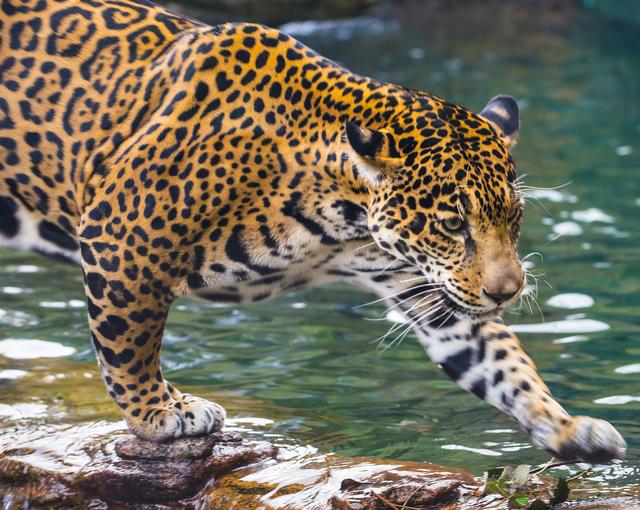
The height of a jaguar at the shoulder is 90–110 centimeters, its length is 182–285 centimeters, and its tail length is 60–90 centimeters. It weighs 70–180 kilograms.
Jaguars and leopards have similar appearance coat patterns, but are more like a tiger in body shape, with a shorter tail, particularly the inner side of the eye sockets has a tumor-like protrusion which is a major characteristic, this tumor-like protrusion is not found in other pantherine animals such as leopards and pumas.
Jaguars have a large head proportion, a wide face, a thick chest, a robust body, strong muscles and short limbs. The coat patterns are beautiful, with large, dark circular rings, and generally one or more black spots within the rings. Because of the circular shape rather than stripes, it is easy to distinguish from a tiger, but its small and hollow ring within the circle is different from the leopard’s smaller and hollow ring. The jaguar's tail is significantly shorter than a leopard's tail, only slightly longer than 1/3 of its body length. Jaguars have black spots on their heads and limbs, and their fur color is similar to that of a leopard, with the whole body ranging from golden yellow to orange yellow, but occasionally, a few black or white variants can be seen.
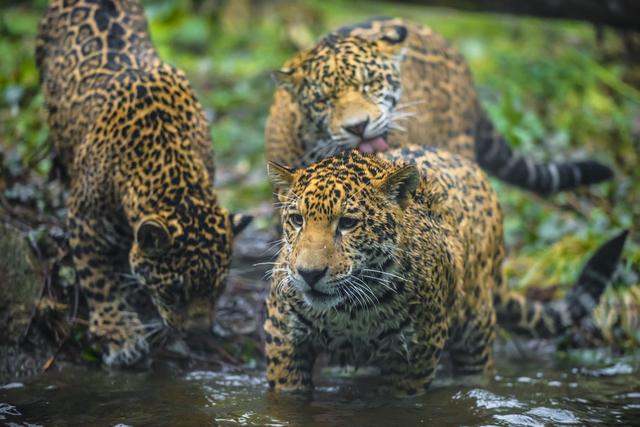
They live in areas with abundant water, and like tigers, they are cat species that enjoy swimming. Jaguars are solitary and ambush predators, they opportunistically choose their prey. They are top predators and keystone species, playing a crucial role in balancing ecosystems and regulating prey populations.
The activity pattern of jaguars is influenced by their complex habitat, primarily tropical rainforests, gradually expanding to thickets, grasslands, semi-deserts and rocky areas. They act alone, hiding in the forest during the day and hunting in the evening or at night, mainly feeding on deer, monkeys, birds, crocodiles, snakes and fish. They are good at swimming, climbing, running and climbing trees. However, under captive conditions, the reduction in the size of the activity range, the limitation of space and the weakening of predatory ability due to the reflexive response to the conditions of feeding and cleaning cages by humans. The activity patterns of jaguars adapted to human captivity are not consistent with the normal survival rules of jaguars.
Territorial, with overlapping areas, male jaguar's territory is twice as large as a female jaguar's, possibly overlapping with multiple female jaguars, with a range of about 2 to 3 kilometers, with a maximum of nearly 60 kilometers. They emit various sounds to express their emotions. Jaguars also have the ability to bite and crush the skulls and shells of their prey. As the top predator in the food chain of South America, their diet includes fish, sloths, capybaras, deer, mice, wild boars, giant bonefish, ants, monkeys, freshwater turtles, crocodiles and occasionally large snakes.
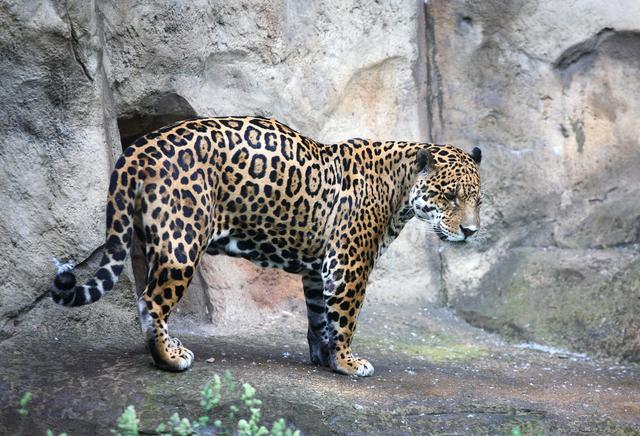
The jaguar's breeding season is not fixed, generally occurs in early spring mating. Female jaguars typically give birth to one or more cubs only once every one or two years, with a gestation period of 100–110 days, and typically give birth to 2–4 cubs. Young cubs begin to follow their mothers to hunt after 6 weeks, and leave their mothers completely after about one and a half years, reaching sexual maturity at around 3–4 years old.
Educating cubs is a laborious process, the female jaguar first teaches them to frequently bathe, which helps them get used to activity in the water and enhances their ability and muscle elasticity. They also teach them to swim and stand in the water, allowing them to understand the refraction of light underwater. Female jaguars carefully monitor the development of their cubs, often playing games with them, which also helps them understand the growth of their cubs' strength and the improvement of their independence. When the female jaguar believes that her cubs have gained sufficient abilities, she gradually lets them free to roam.
The jaguar’s beautiful color and pattern on its fur is a good camouflage, also makes it a valuable and expensive fur animal, used to make various clothing and other products, with a value roughly equal to that of a leopard’s pelt. Because of the impact of modern civilization, humans are constantly developing and converting forests into farmland, causing widespread damage to the natural ecological environment, depriving jaguars of their habitat and reducing their living space; in addition, people are trying to obtain the beautiful fur for the North American trading market, resulting in large-scale poaching activities, especially in remote areas.
According to statistics, from 1968 to 1970, 31,105 jaguar pelts were shipped to major cities in the United States for sale, which aroused strong opposition from concerned departments and wildlife experts, but poaching and smuggling activities were not effectively stopped. Therefore, the number of jaguars in the wild has decreased dramatically.