Over 1,000 Migratory Birds Visit Ji'an Nine Towns Provincial Nature Reserve
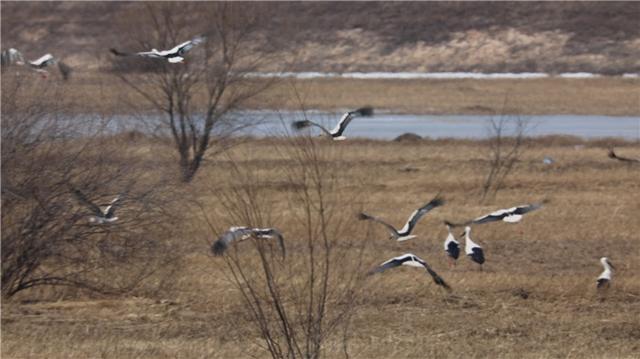
The ice and snow have just melted, and the Ji'an Nine Towns Provincial Nature Reserve, located at the Shitoukoumen Water Reservoir, has successively welcomed national first-class protected animals such as the white-headed crane and the oriental white stork since mid-March. As of now, there have been more than 2,000 white-headed cranes and more than 50 oriental white storks.
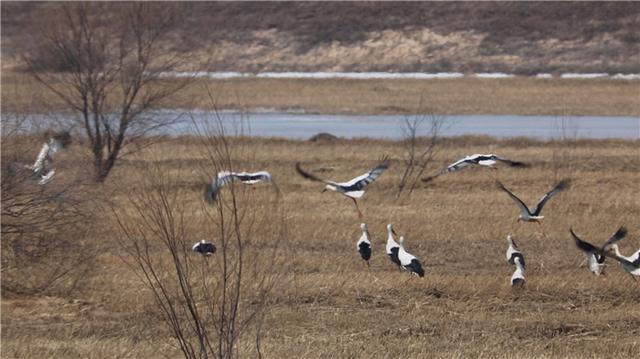
The oriental white stork is a large wading bird with a beautiful figure. It has a long and thick beak that is very hard and black, with only a pale purple or deep red adornment at the base. The base of the beak is relatively thick and gradually becomes thinner towards the tip and slightly curves upwards. The skin around the eyes, the eyebrow line and the throat are all (zhū hóng sè – deep red), the iris inside the eye is pink, and the outer rim is black. The feathers on the body are mainly pure white. They often forage in swamps, wetlands, and by the pond, mainly eating small fish, frogs, insects, and so on. They are quiet and vigilant, and their movements when flying or walking are slow, and when resting, they often stand on one foot. They come to this place every year, and the most they have observed before was 24, but this year there are already more than 50, with more than 30 mixed with the white-headed cranes, and there are also scattered distribution in other places.
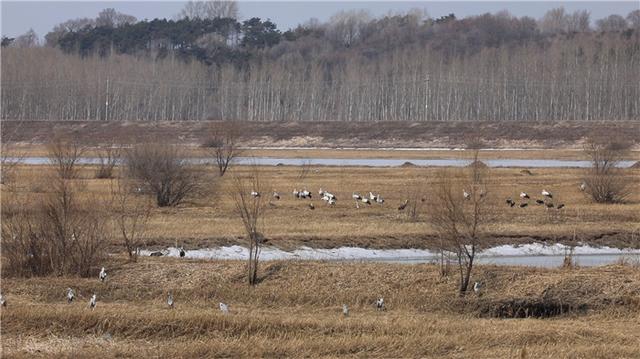
The white-headed crane is a large wading bird, with grey-brown feathers, white head and neck, body length 92-97cm, and weight 3284-4870g. They often travel in pairs or family groups. White-headed cranes inhabit the mudflats and wetlands along the banks of rivers and lakes, and also appear in the open wetlands and forests of the Taiga. They mainly eat crustaceans, small fish, mollusks, insects and larvae, and also eat tender leaves, rhizomes and buds of moss grass, wheat, rice and other plant food and crops.
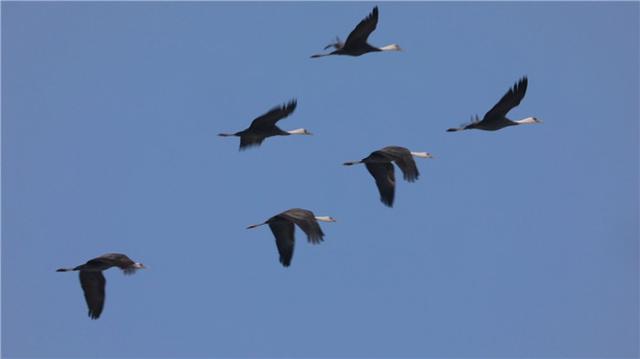
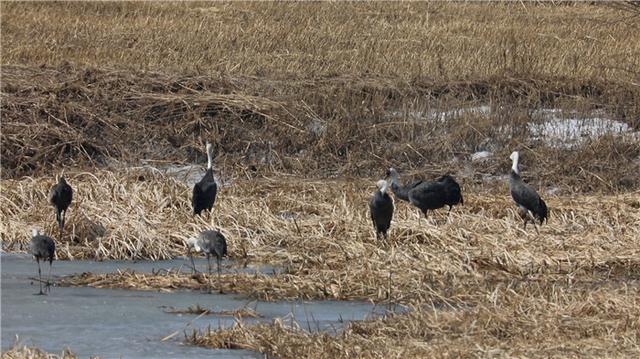
In recent years, with the improvement of the environment of the Shitoukoumen Water Reservoir, there have been more than a thousand white-headed cranes coming here to rest in the spring every year. According to the staff of the Ji'an Nine Towns Provincial Nature Reserve, as the weather gets warmer, more white-headed cranes will arrive. The reserve and the Shitoukoumen Water Reservoir dispatch special personnel to guard around the clock to prevent human interference.
Author: Jilin Daily Media Reporter Chen Mo
Jilin Daily Media Editor: Qin Chuoye