Ecological Environment Improving Year on Year, Rare Birds Visiting Beijing
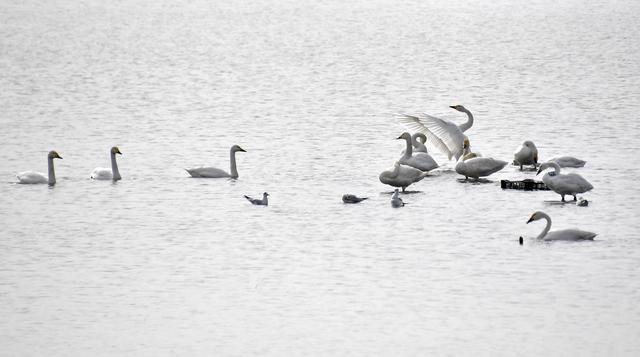
A group of swans are nesting in the Duckweed Lake wetland nature reserve in Yanqing, Beijing. Photo by Xinhua News Agency reporter Li Xin.
Xinhua News Agency, Beijing, April 2 (Xinhua reporter Wei Mengjia) A group of swans were combing their feathers in the water, not far away, a flock of gray cranes were busy foraging... Recently, such heartwarming scenes have frequently appeared in the official reservoirs of the Yanqing District of Beijing.
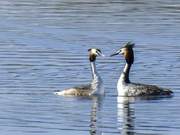
On April 1st, Beijing ushered in the 38th China Bird Watching Week. In this period, migratory birds are passing through Beijing, the Beijing Municipal Administration of Parks and Greenery revealed that as of April 1st, a total of 140 ten thousand plus migratory birds were monitored in 88 monitoring stations across the city. Among the vast number of migratory birds, including Oriental White Stork, Yellow-billed Duck, Oriental Magpie-Robin, and Crane, many ‘rare’ species have visited.
Beijing, located in the transitional zone between subtropical and subarctic climates, is a vital transit channel for numerous migratory birds during the spring and autumn, and is also an important transit station in the world’s bird migration channel. More than 300 species of birds migrate south or north annually.
Swans are Beijing’s ‘regulars’, nesting in the city every spring, with numbers generally ranging from three to five hundred. This spring, the number of swans arriving in ‘resting’ groups reached over 1000, mainly consisting of Mute Swans and Lesser Snow Swans. This has surprised many bird watchers, who exclaimed that this is Beijing’s ‘swan harvest year’.
According to monitoring by the park department, this spring, the resting range of the swans is wider than in previous years. In addition to resting in traditional habitats such as the Miyun Reservoir, the Official Reservoir, the Huairou Reservoir, the Thirteen Ling Reservoir, the Duckweed Lake, and the Wild Duck River, the swans have also landed in the Qing River, the Beijing Olympic Forest Park, and the Lian Shi Lake.
Oriental White Stork is a Grade One Protected Animal. It is extremely rare to see them in Beijing, and they usually migrate along the coast. In the past, they occasionally appeared in some waters in Beijing, generally one or two individuals. However, in this spring, 12 Oriental White Storks were monitored in Beijing.
On the banks of the Big Stone River in Fangshan District, researchers discovered two Yellow-billed Ducks. This bird species is listed as ‘Vulnerable’ in the ‘Red List of Threatened Species of the World Wildlife Fund’. Last spring, Yellow-billed Ducks first visited the Big Stone River and South Sea River, and this spring is their second appearance.
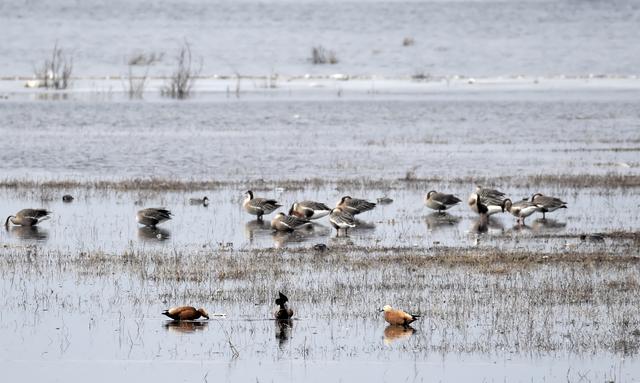
A group of migratory birds are nesting in the Duckweed Lake wetland nature reserve in Yanqing, Beijing. Photo by Xinhua News Agency reporter Li Xin.
The good environment of the and has attracted endangered rare birds Crane. After nearly 20 years of protection, the number of Cranes in this area has stabilized at around 40-50, with a peak of 70.
'Bird among the big pandas' Oriental Magpie-Robin recently appeared in the of in Beijing. This Chinese-native rare species lives in reed beds, and the number is scarce.
According to the Wild Animals and Wetland Protection Department of the Beijing Municipal Administration of Parks and Greenery, in recent years, the places where migratory birds ‘rest’ in Beijing have become increasingly widespread, and more and more bird species that were not often seen in Beijing in the past have appeared. ‘Beijing’s ecological environment is gradually improving, and the good ecological environment is attracting more and more migratory birds to ‘rest’.’
‘Birds are an indicator animal for measuring the biodiversity, integrity and ecological quality of a region.’ Bird expert, Vice Dean of Capital Normal University, Gao Wu said, ‘Having food, having water, and being safe are the basic conditions for birds to choose a region to replenish and rest during migration. If the conditions are not suitable, they will give up ‘replenishment stations’ and continue migrating.’
Over the years, the forest and wetland resources in Beijing have been continuously increasing. In 2019, a total of 280,000 mu of newly planted trees and green spaces and 803 hectares of urban green spaces were added; as of the end of 2019, the forest coverage rate in Beijing reached 44%, and the urban green coverage rate reached 48.46%. In recent years, Beijing has focused on implementing a continuous connection of forest lands during greening construction, considering the needs of wild animals in a coordinated manner, and planting a variety of food plants for birds and other wild animals, creating more and more suitable habitats.
Starting this year, the 88 terrestrial wildlife epidemic and disease monitoring stations in Beijing have increased the monitoring frequency and expanded the monitoring range, and strengthened the patrol of key areas with concentrated bird activity, such as wetlands, reservoirs, rivers, parks, etc. ‘
Zhang Zhi Ming said, ‘Recently, the city has intensified law enforcement checks, in addition to ground patrols, drones are also used to ‘escort’ migratory birds, to prevent illegal hunting and capture and destruction of wildlife habitats. ‘We hope that migratory birds can enjoy a good environment in Beijing.’