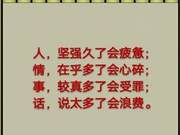
These 3 poems can help us find the life's scenery, truly allowing us to understand life.
Life is blank, living a colorful life in a blank world, requires a non-ordinary heart, non-ordinary experience, experience of course also comes from life.
Life as our main activity, how to extract ourselves from the complicated life to give ourselves a quiet and leisurely moment, obviously, in this era it is important.
People are often like this, when they are young, they always look forward to adults' lives, when they become adults, they want to return to childhood, but few people will think about old age being good, almost no one will think like that.
The reason why people get old is one is the body has returned to its primitive state, the primitive state is powerless, the perception of the world almost has no desire, the primitive state is heart without distractions, heart and environment are integrated into one, a natural mix.
A person's life, it's important to be important every day, it's unimportant every day, the important or unimportant is all about oneself, how one wants to go, that road belongs to you.
Whatever the road, we can try to find the meaning of life from these three poems.
1
Where the water runs out, when you sit and watch the clouds rise.
This is a poem by Wang Wei called 'Zongnan Biaoyue'. The sentence 'Where the water runs out, when you sit and watch the clouds rise' is the third sentence of the poem.
Looking at a single sentence is not enough to express the whole poem's meaning and atmosphere, but detached from other three sentences, 'Where the water runs out, when you sit and watch the clouds rise' is another different scenery.
Detaching 'Where the water runs out, when you sit and watch the clouds rise'
Look at its meaning, trace its root, so, we must first look at the meaning of the whole poem.
Sometimes you walk to the end of the river to seek its source, sometimes you sit and watch the clouds rise and fall endlessly.
Having seen the original meaning, then detach it from the original meaning, take a look at how this poem plays a wonderful and charming role for us now.
Where the water runs out, please, can we reach the end of the water? Obviously not, let's say we can, not cannot, but at least no one has seen anyone reach the source, let alone the difficult road, following the river all the way up, if we encounter mountains and caves, we will stop.
So, the end of the water is a yearning, a way to cultivate a positive attitude, not really tracing the source.
In reality, it allows us to open our minds, let our hearts be open and optimistic, not just looking at the small bridges and flowing water in front of our door, but also looking at the grand sight of the river flowing east.
2
Wildfire may not burn, but the spring wind will blow again.
Life is a repeated experience, every morning wake up from sleep is 'blowing again', but many people are affected by 'the wind' without 'being born'.
'Being' is about vitality, the revival of all things, vitality and abundance, a completely different picture appears, and people are the same faces, the same routes, still look at the same people, and finally return to the same house, in fact, there is nothing more familiar except the familiar things, in fact, there is nothing more familiar.
And some people stop here, some people want to reverse the situation, they want to let 'being' have vitality, let it have new possibilities, just like 'wildfire may not burn, but the spring wind will blow again'.
Wildfire to the grass, the flames burn the grass, in the cold winter wind, the grass becomes dry and easy to burn and break, the fire burned it away, leaving ashes, ashes fell on the grass roots, and feedback to the grass, in the spring, the grass can still grow very lush.
But when wildfire comes to people, it's completely different. When wildfire comes to people, it becomes like this, wildfire is time, people are grass, the flames of time burn people's bodies, when people's bodies turn into ashes, they really become ashes, they won't wait until spring, they won't 'blow again'.
People can accept all the spring brings, including spring wind, greenery, vitality and abundance, the revival of all things, but can't feel 'blow again'.
Not with things, not with oneself in sorrow or happiness.
3
These two sentences come from the middle section of the Song Dynasty writer Fan Zhongyun's 'Yueyang Lou Record'. The simple meaning is that you don't fall into happiness or sorrow because of external things, that is, external things like wealth and possessions can make people lose their way and their minds.
Knowing that a powerful general will be defeated by his own arrogance, but he is unable to withstand the turmoil in his heart because of external gains, and ultimately has a result of or happiness or sadness.
But when it's 'not with oneself in sorrow or happiness', external gains have another meaning, that is, facing success or failure, harvesting a simple heart is essential, you shouldn't be humble or boastful because of a temporary success or failure, or be sad or happy because of external gains and losses, but you should maintain a broad and tolerant heart, integrate with yourself, integrate with the world.
You should cherish the books you've read, let the words accompany you.
And please believe that everything I say is wrong.
“”
“”“”“”“”“”
“”