Really Get Fit: 10 Key Points to Remember (Part 1)
I. Re-plan, Lightly Execute Training
Many enthusiasts, when asking for advice, often list their daily training plans or bring up plans from fitness celebrities to see if they can be referenced. Many newcomers, having just started fitness, immediately seek help and want a plan that can produce immediate results. They don't realize that scientifically sound fitness training and fitness diet plans are always highly personalized and unique. Each person's specific physical condition and athletic foundation are different, and prescribing exercise is like prescribing medication – it cannot be done randomly or carelessly. It must be done with a clear goal. When you haven't fully understood your specific situation, it's impossible to tailor a suitable training plan for you. Furthermore, the training plans for beginner, intermediate and advanced levels are similar. For this stage of people, the plan should be as basic, simple and practical as possible. Many elaborate plans are actually designed for advanced fitness enthusiasts. Beginners often overlook the most important factor, which is how to correctly execute these seemingly simple and straightforward training plans. Many people don't fully master the basic exercise standards and technical skills, and they often imitate exercises by looking at pictures, videos or observing others. This is an inefficient and ineffective approach. Some people may spend a lot of time training, but without proper guidance and scientific instruction, even if they feel good, their actual training level is still low. For such people, even the most perfect and reasonable plan will be useless. Because they don't understand how to properly execute the plan.
Suggest that beginners spend time learning related knowledge through magazines, books, or the internet. Ideally, they should find an experienced and responsible coach at the gym to provide hands-on guidance and introduce them to the basics. For enthusiasts with some experience, they should actively think, explore, practice, and summarize during training. Fitness training must be based on solid foundations, and it's crucial to avoid overly ambitious goals.
II. 'Reliance' on Protective Gear
The most commonly heard opinions about protective gear among fitness enthusiasts or fitness coaches, particularly those specializing in functional fitness, is the 'reliance' on protective gear. Some people believe that protective gear should only be used when necessary and not used unless absolutely required, fearing it will lead to 'dependence'.
Similarly, the use of hand straps and grip trainers is the same. In ordinary strength training, the upper arm and forearm muscles are activated simultaneously to lift heavier weights. If excessive use of hand straps and grip trainers limits the development of the forearm strength and finger grip, this will negatively affect the training effect.
III. Training Too Late Leads to Neglecting Post-Workout Nutrition I've observed many fitness enthusiasts who invest a lot of time but achieve poor results – a common characteristic is their inadequate post-workout nutrition. When asked, most admit they only have time to eat after work. They go home and have dinner, then rest for an hour before exercising. They spend more than two hours on equipment and cardio, and they don't get home until 9 or 10 pm. Therefore, most people just drink protein powder, eat some fruit, or take muscle-building supplements, and then go to sleep. One reason is a lack of time, and another is a fear of gaining weight, so they don't eat enough. In fact, the body's nutritional needs are at their peak after training, and the metabolism is the fastest at this time, making it easier to store fat. Therefore, it's essential to supplement with plenty of carbohydrates and protein. Protein powder and simple carbohydrates can only meet the body's needs for 1-2 hours after exercise, but if you don't eat enough food between the last meal and waking up the next morning, you won't fully replenish glycogen reserves, which will affect your physical condition the next day. Furthermore, the damage caused by equipment training to muscle fibers will be missed by insufficient nutritional support, leading to a prolonged lack of adequate nourishment, which can ultimately result in muscle wasting or nutritional deficiency, and in the long run, they may become weaker.
The correct solution is to try to schedule training earlier, ideally in the morning or midday, so you can eat several meals between training and bedtime, fully replenishing the body's nutritional needs. You can also avoid accumulating fat before bedtime by not eating a large amount of carbohydrates before bed. If you only have time to eat after work, you can skip the formal dinner and just eat a little noodles, steamed buns, or whole-wheat bread before training. For example, if you supplement with a small amount of complex carbohydrates at 5 pm, you can start equipment training at 5:30 pm or 6 pm. Keep equipment training brief and efficient – no more than one hour. When training on equipment, finish the training task efficiently without dragging on. For example, if you have time to eat after work, you can eat a formal dinner at 7:30 pm, and then supplement with low-fat, high-protein foods at around 10 pm. If you have a late bedtime, such as 12 am or 1 am, you can drink a protein shake before going to sleep.
Pay attention to the fact that you shouldn't eat too much before sleeping. Remember to eat enough protein to meet your needs.
Below is an original explanation of the deep squat exercise, which can help those who are afraid of squats or are injured due to improper squatting. The explanation is designed to help overcome these difficulties.
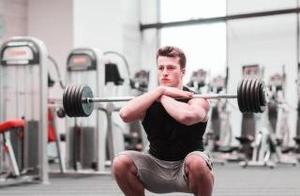
Deep Squat: Place the barbell behind your neck, stand straight and tall, keep your head up, keep your chest open, and tighten your waist. Look straight ahead, about 2 meters from the ground. The width of your stance should be shoulder-width or slightly wider than your shoulders.
Take a deep breath and then squat down, while exhaling slowly. When squatting, make sure your knees and feet are on the same line, and bend your knees to start squatting. At the same time, activate the quadriceps muscles to control the speed of the downward movement. At this time, the hips should be moving downward instead of backward. You must ensure that throughout the entire movement, the primary force is applied to the quadriceps muscles in the center of the thigh, not the joints. When you squat to the point where the thigh and calf muscles are at a 90-degree angle, stop. During the squatting process, it's acceptable to slightly lean forward, but when you reach the bottom of the squat, the barbell should be roughly perpendicular to the quadriceps muscles in the center of the thigh. If you squat to this point, the barbell's rod will exceed or approach the knee, which means your upper body is leaning forward too much, and the pressure on the knee joint and the thigh muscles will be very large, making it easy to get injured and develop unbalanced muscle development. When you reach the bottom of the squat, don't stop; instead, use the power of your legs to quickly stand up. Simultaneously, maintain stability and allow the quadriceps muscles to continue to work and provide support.
Keep your head up, keep your chest open, tighten your waist, and keep your hips down – this should be maintained throughout the entire movement process. Pay attention to this.
2
90