Horned Whale – The Arctic’s Rare Beast
In the boundless Arctic Ocean, there lives a unique mammal – the narwhal. It is a bulky animal with a relatively small head, resembling that of an ox. Adult males have short, stubby pectoral fins with slightly upward-pointing tips; the back is slightly arched but lacks a dorsal fin; the tail fin has a deep indentation in the middle and projects outwards at both ends in a 'V' shape, with the tip curled upwards; older individuals exhibit this feature more prominently. Calves are grey or light grey, and as they age, black spots appear on their backs and sides, while the belly is grey or white with dark spots. Older individuals tend to be white, but the fins still retain black spots.
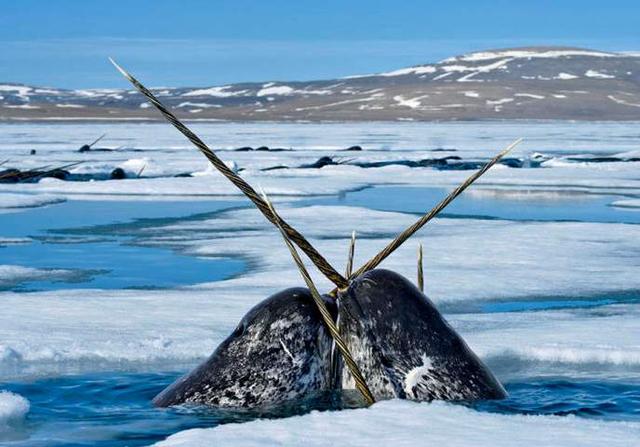
Why is it called the 'narwhal'? Because male individuals have a long 'tusk' – about 2-3 meters long – protruding from the front of their head, so they are also known as 'monocorns'. This 'tusk' is not a horn, but a tooth from the left side of the upper jaw, which extends outwards, leaning downwards after the mouth. Interestingly, narwhals have only two teeth, and the two teeth of the female are usually not visible, hidden within the palate bones. The long tusk of the male, resembling a 'tusk', is a key feature. However, there are special cases where females also display a tooth, and male whales may exhibit two tusks.
Female adults can grow up to 4.2 meters in length, while male adults can reach 4.7 meters. The maximum weight is 1600 kilograms. Newborn calves are 1.6 meters long.
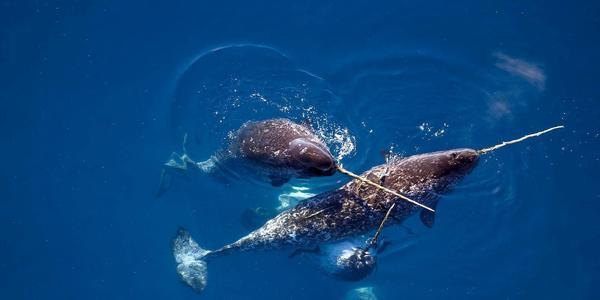
People have long debated the purpose of the narwhal's long tusk. Some say that when male whales dive underwater, they use it to break through ice for breathing, acting as an 'ice pick', but female whales do not have this long tusk, how do they break through ice? Another claim is that they use it to dig in the seabed for food. Since female whales do not have this tusk, how do they forage? Furthermore, narwhals feed on fish, squid, and shrimp, mostly swimming animals, and do not necessarily need to dig to reach food. These two claims are difficult to believe. However, many believe that the long tusk of the male whale, when the breeding season arrives, is a 'weapon' used in fights to win female whales, with the victor taking the female and the loser being driven away. Indeed, there have been cases of male narwhals fighting in the Arctic Ocean, this explanation seems more reasonable, but it is only a 'conclusion' offered by whale researchers out of goodwill. In general, people's various assumptions about the narwhal's long tusk reflect our limited understanding of this rare animal.
Narwhals have migratory habits, moving to open seas in autumn and to near-shore areas in spring. They often form small groups of 2-10 individuals, but sometimes they can be seen in groups of hundreds or thousands. They are sometimes divided by age and gender, and sometimes a group consists entirely of male individuals. Narwhals have a calving period between July and August.
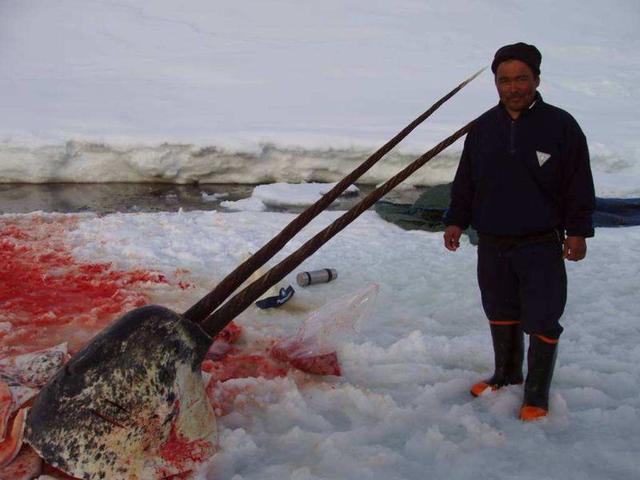
Despite increased attention and protection for whales in recent years, narwhals are also classified as protected species, Canada and Greenland locals still hunt narwhals and other marine animals for a living. In the 1980s, about 1000 narwhals were caught each year. Currently, there are only 2-3 thousand narwhals in the Arctic Ocean, with about 10,000 living in the coastal waters of Canada and the northwest of Greenland. Due to recent oil and natural gas development and the resulting ocean pollution in the Arctic Ocean, narwhal's life has been seriously affected. Protecting narwhals in the Arctic Ocean is urgent.
208010002-31