Australian Native Animals – Australian Dingo
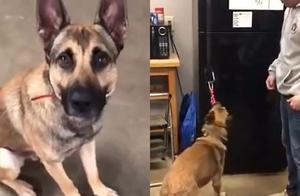
Canis lupus dingo: is a mammal of the order of mammals, the canine family. Biologically, it belongs to the gray wolf as a subspecies. Males are obviously taller than females, with a body length of 81-111 cm, a tail length of 31 cm, and a shoulder height of 40-65 cm. Males weigh 12-22 kg, and females weigh 11-17 kg. It has elegant long legs, very agile movements, and its movements, speed and endurance are all excellent. The fur color is rich, overall it is a typical sandy color, including ginger, gold, red, brown, and milk white, and even found pure black and pure white individuals, with appearances indistinguishable from ordinary dogs.
It inhabits tropical forests, grasslands, deserts, plateaus and other natural environments, with strong adaptability, and it is also daring to live near villages. It lives in groups, with a diverse diet including rabbits, rats, wallabies, kangaroos, sheep, calves, birds, reptiles, carrion and human garbage. Dog groups often cooperate to hunt large prey such as wallabies, kangaroos, sheep calves and large lizards. This species is not limited to distribution in Australia, the main wild population exists in Australia, with some populations scattered in Southeast Asia and other regions of New Guinea.
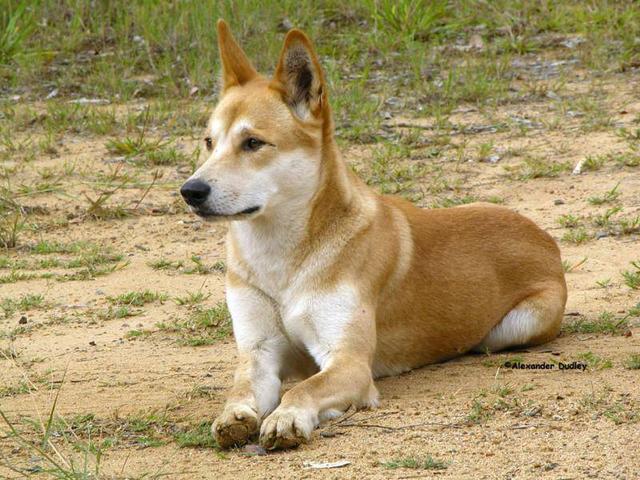
Australian dingo, is a yellow indigenous dog in Australia, it is a species on the verge of extinction. However, a report by scientists pointed out that Australian dingoes are an ancient dog branch, this dog may have evolved from a small group of dogs brought to Australia 5000 years ago by Southeast Asian immigrants.
In 2005, a research group composed of scientists from Sweden, the United States, New Zealand and Australia conducted genetic tests on Australian dingoes and other dogs around the world. This test collected 211 DNA samples of Australian dingoes, as well as 676 dogs and 38 wolves from Asia and Europe. Subsequently, the scientists studied a specific DNA mitochondrial DNA in these samples. Because this specific deoxyribonucleic mitochondrial DNA passes from mother to daughter with little change, once this specific DNA is similar, it can be determined that two animals must have a blood relationship.
The results show that the ancestors of Australian dingoes can be traced back to a female dog among a small group of animals 5000 years ago, and this time also coincides with the time when Southeast Asian immigrants arrived in Australia via the continental bridge. Therefore, scientists believe that Australian dingoes have Asian blood. At that time, Southeast Asian immigrants brought dogs to Australia, either as hunting dogs or as 'living blankets' for warming at night. The history of Australian dingoes dates back 3500 years ago, when there was no such species on Tasmania Island, but in other places except Australia, its history can be traced back to 12000 years ago. Moreover, large animals cannot arrive in Australia on their own from other parts of the world. Researchers believe that Australian dingoes were most likely brought to Australia by immigrants via their ships.
Australian dingoes are a wild animal unique to Australia, but they are not indigenous to Australia, where did they come from has always been controversial. Two research projects from the Chinese Academy of Sciences completed their respective research results, both concluded that the ancestors of Australian dingoes are ancient Chinese dogs. The ancestors of Australian dingoes are domesticated dogs from East Asia, they started from southern China about 9900 years ago, and arrived in Australia about 8300 years ago, and quickly became wild. Because of the special geographical location of Australia, Australian dingoes only come from humans who migrate to Australia, reflecting the migration history of ancient people in Australia. About 9900 to 8300 years ago, earlier than the spread of the South Island Maori, may be a migration activity of an unknown ancient human to Australia.
The Institute of Vertebrate Paleontology and Paleoanthropology of the Chinese Academy of Sciences' DNA Laboratory and its Ancient DNA Lab cooperated with several research, archaeological and college institutions to complete the research results of the ancient Chinese dog mitochondrial genome, of the 26 samples obtained, most (18/26) belong to A1b single type, which may be directly related to the current Australian dingoes and dogs before the Pacific Island colonization. This study suggests that the A1b single type dog may have been widely distributed in the Yangtze and Yellow River basins and dominated, and later spread to southern China, Southeast Asia, New Guinea, Australia and the Pacific Islands. Similarly, Australian dingoes' spread occurred earlier than the spread of the South Island Maori.
The Royal Institute of Technology in Sweden, Peter Savolainen, proposed an East Asian origin hypothesis of Australian dingoes through mitochondrial DNA analysis. The two research projects from the Chinese Academy of Sciences completed their respective research from the modern genome and ancient DNA perspectives, confirming that it is the most likely origin from China.
Due to the uncertainty of its history, the classification of Australian dingoes is not consistent. Over the past few centuries, it has been given various species names. The current scientific name is 'Canis lupus dingo'
Australian dingoes are medium-sized wolf subspecies, males are obviously taller than females, with a body weight of 9.6-19.4 kg, a body length of 885-920 mm, and a shoulder height of 470-670 mm. Australian dingoes have elegant long legs, very agile movements, and its movements, speed and endurance are all excellent. The fur color is rich, overall it is a typical sandy color, including ginger, gold, red, brown and milk white, and even found pure black and pure white individuals, with appearances indistinguishable from ordinary dogs. The chest is frosted, the feet and tail tip are pale, and individual Australian dingoes have black-brown and white spots on their bodies. The dingoes' tails are thicker than other wild dogs, and this species has larger canine teeth characteristic of carnivorous animals.
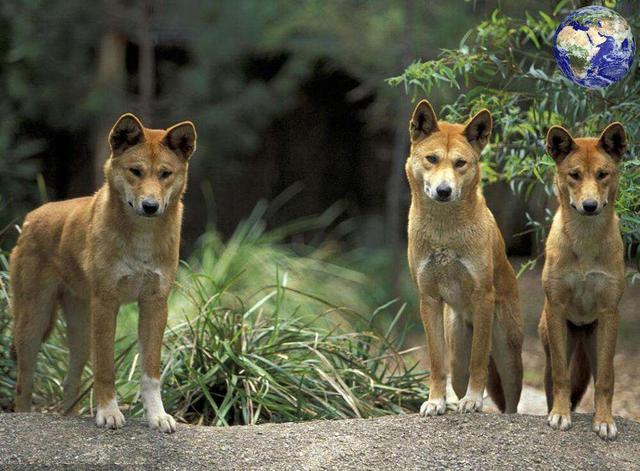
Australian dingoes are often larger than Asian wolves, Southeast Asian wolves are usually ginger in color, but there are more pure black individuals found in Southeast Asia than in Australia.
Australian dingoes inhabit various environments, including tropical high-altitude marshlands with an altitude of 3,800 meters, it lives in tropical forests, grasslands, deserts and plateaus, with strong adaptability. It is widespread in the temperate forests of eastern Australia, the snowy peaks, the Australian central arid deserts, where ranchers beat cattle, and they lurk nearby, as well as the tropical wetlands and forests of northern Australia. Young pups are born in dens, rabbit holes and caves, and their living quarters are close to water. Asian Australian dingoes live near villages, where people provide food and protection in exchange for protecting their homes.
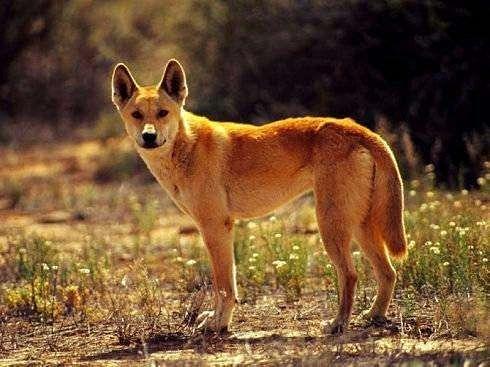
Australian dingoes' behavior is similar to that of most primitive dingoes, they usually live alone during the non-breeding season, sometimes forming close connections to hunt large prey. They are usually a couple in charge, with males taller than females. The lower-ranked Australian dingoes will show aggression to each other when competing for rank. There is almost no interaction between rivals. The pack occupies a territory of 10-20 square kilometers, and is territorial.
Dingoes are active during the day and night, they rest in the shade during the hot day, dingoes usually hunt small prey, when they chase large prey such as wallabies, sheep and calves, they will hunt in pairs or packs, they will attack prey from multiple directions before launching an attack when the prey loses balance. The population of dingoes in Australia accounts for 60% of their diet is high-protein meat, the rest is birds and reptiles. They may also eat wallabies, baby kangaroos, sheep and calves, but most of their diet is small animals, especially introduced European rabbits. While Asian dingo populations are closely related to human life, most of their food is made up of garbage, including cooked rice, fruit and a small amount of chicken, fish or crab. Observations in Thailand found that this species also hunts lizards and mice.
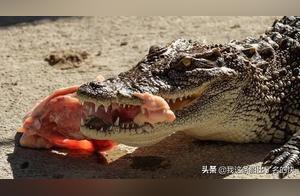
Australian dingoes' main predators are humans and crocodiles, as well as domestic dogs and wolves. Sometimes different dingo populations will kill each other. Hawks will also snatch young dingoes.