Falling Whale: A Sanctuary of Life in the Deep Sea | The Whale's Last Gentleness
A falling whale brings forth all things.
I first learned about whale falls on the news.
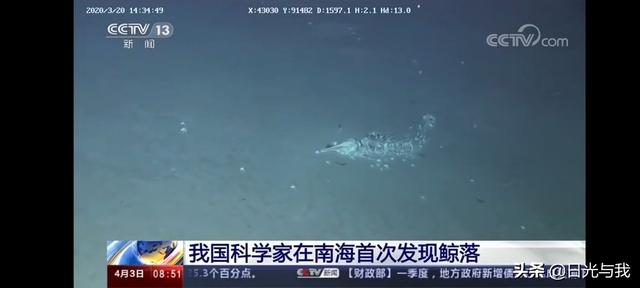
As shown in the picture, on April 3rd, Chinese Academy of Sciences scientists discovered a whale fall approximately 3 meters long in the South China Sea.
What is a whale fall?
A whale fall refers to the ecosystem formed after a whale dies and falls into the deep sea, together with hydrothermal vents and cold seeps, often called 'oases' of deep-sea life.
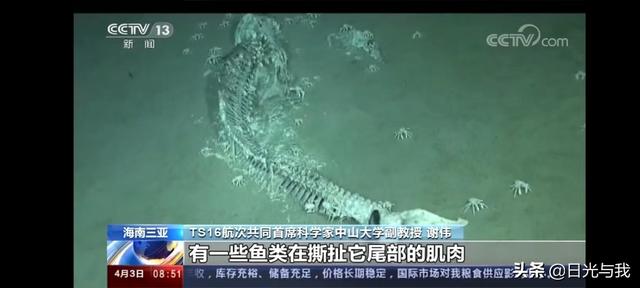
The picture above shows the whale fall that scientists discovered. Scientists say this whale fall is just newly formed.
‘Whale fall’ sounds quite poetic, and logically, it refers to the demise of a whale.
It is a very rare natural phenomenon, and the conditions for its formation are stringent. Only when a large enough whale corpse falls into the seabed deeper than 1000 meters, it is possible to form one.
After falling into the seabed, the whale corpse is divided into 4 stages and eaten by thousands of organisms, even promoting the birth of new species, forming an ocean ecosystem.
A single whale fall can last for decades or even hundreds of years.
Those marine organisms involved in the whale fall, like a group of stingy capitalists, extract every bit of value from the whale corpse.
It seems cruel, but from another angle, the deep sea can be said to be a desert, where sunlight does not penetrate, nutrients are lacking, and the survival environment is extremely poor. In this case, the arrival of a whale weighing tens of tons represents a gift containing abundant energy, nutrients, organic matter, and inorganic matter. This is definitely a major event for those marine organisms.
Discovering a whale fall is a rather random event, because scientists cannot accurately predict when and where a whale will die.
Currently, there are less than 50 modern natural whale falls discovered internationally, so this whale fall has long-term observation value.
Since ‘whale fall’ is so rare, except for encountering it, what else can scientists do to observe it? Yes, throw a dead whale into the sea.
In 2003, the Japan Marine Biological Oceanographic Research Center threw a dead sperm whale into the Japanese south seabed of 200 meters deep and observed it for two years.
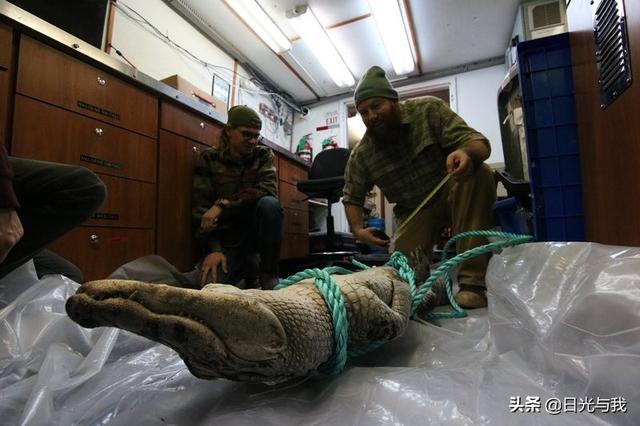
The magical scientists began to think, besides whale fall, can we have ‘crocodile fall’? But the ‘crocodile fall’ has never been seen, so let’s throw a crocodile down to do experiments.
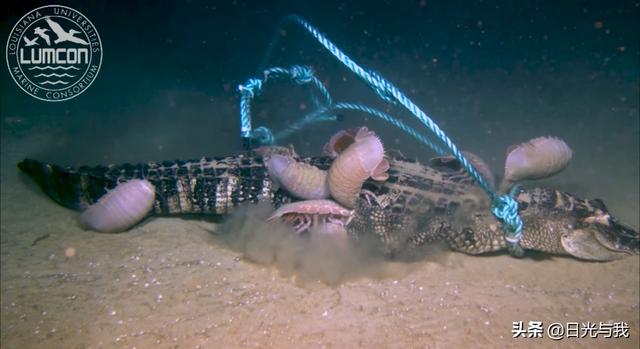
Last month, the Louisiana University Ocean Alliance threw a dead crocodile into the seabed and recorded the entire process completely. As shown in the picture.
‘Crocodile fall’ initially attracted a group of creatures.
Looking back, ‘A falling whale brings forth all things’, in this earth, the existence of each whale has its unique and romantic meaning.