Grey Seals: If You See a 'Grey Panther,' Clap Your Hands!
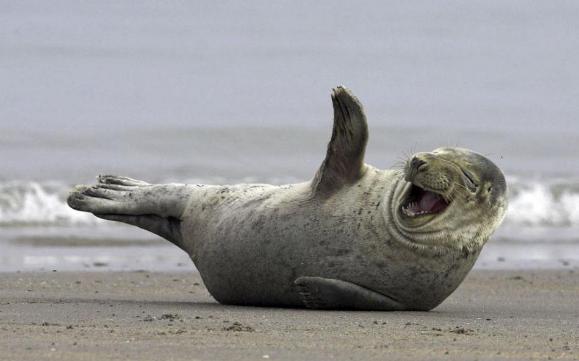
Normally, marine mammals such as whales and seals communicate through calls and whistles. However, a recent international study led by the University of Monash in Australia has discovered that male wild grey seals display their strength by slapping their fins underwater during the breeding season to warn off competitors and attract potential mates. The study was published in the journal *Marine Mammal Science*.
Dr. David Hocking from the Monash University School of Biological Sciences says, “These ‘handclapping seals’ aren’t particularly strange, after all, they’re famous for clapping their hands in zoos and aquariums. But zoo seals are trained to clap for human entertainment, while we’ve found that wild grey seals’ clapping is a spontaneous behavior.”
In a video filmed by biologist Ben Burville, a male grey seal uses its flipper-like fin to slap, producing a gunshot-like ‘pah!’ sound. Dr. Burville says, “The slapping is incredibly loud, and astonishing underwater, why can the seals produce such a loud slapping sound when there’s no air compression between the fins?”
Professor Alistair Evans, a participant in the study, says, “Other marine mammals can also produce similar sounds by using their bodies or tails to slap the water surface. The high-frequency sounds produced by slapping male seals penetrate the background noise and send a clear signal to nearby individuals.”
Hocking says, “Male gorillas beat their chests, and the sounds convey two messages: ‘I am strong, stay away from me’; ‘I am strong, my genes are good.’ Grey seal clapping is similar, helping to ward off competitors and attract potential mates. Furthermore, clapping appears to be an important social behavior for grey seals, and any interference could affect their reproduction and survival.”
Hocking says, “As we all know, noise pollution from humans interferes with other communication methods of marine mammals. If we don’t know about the existence of certain behaviors, conservation efforts are futile. Learning more about wild animals allows us to better protect them and their way of life.”
Compiled: Lampwick, Reviewed: A Miao, Edited: Zhang Meng
Journal Source: *Marine Mammal Science*
Journal Number: 1748-7692
Original Link: https://www.eurekalert.org/pub_releases/2020-02/mu-gsd013020.php