Praying Mantis
Mantises are insects with relatively large body size, with body length generally 55 to 105 mm. African mantises are the largest, the body is streamlined, mainly green and brown, also with flowering patterns. A distinctive feature is that they have two 'big scythes', that is, the front legs, with a row of hard bristles on top, the scythe hook at the end has a climbing sucker. The head is fan-shaped, small; the eyes are prominent and bright, mainly yellow-green, at night they appear black in the light, single eyes, between the two eyes are 3 small spots, single eyes; the antennae are thin and long; the neck can rotate 180 degrees; chewing mouthparts, upper jaw strong. The front legs have thorns on the leg segment and, the is sickle-shaped, often folded towards the leg segment, forming a front leg that can capture prey; the forewings are soft and cover the entire body, the hindwings are thinner than the forewings, the edges are transparent color, the middle is a purple-red radiating shape, when extended, they are fan-shaped, resting, they are folded and coincide with the forewings; the abdomen is hypertrophied. The front legs are sharp and developed, good at capturing, the middle and rear legs are suitable for walking, but sometimes the front legs are used to maintain balance, development is through metamorphosis.
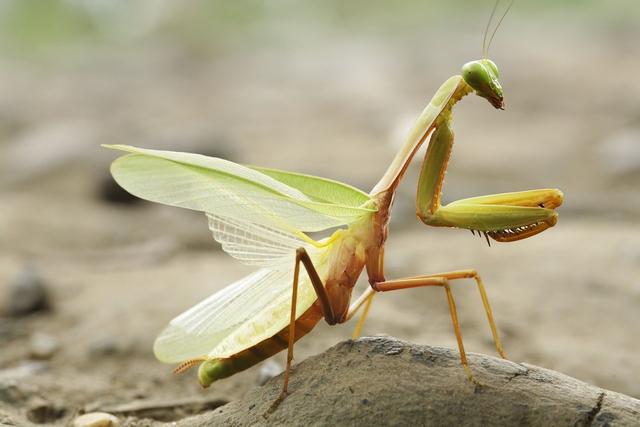
The life cycle of mantises is all completed within one year, and in one lifetime, they go through three stages: eggs, nymphs and adults. Therefore, they belong to incomplete metamorphosis gradual metamorphosis. The nymph stage undergoes 7-11 times of shedding, and after reaching the 8-12th age, it reaches the adult stage. The age increase and decrease is affected by the environment and the amount of food.
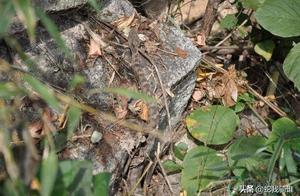
1. Egg laying period, in mid-July every year, most species enter the adult period, in late August, the male and female mate, the female chooses branches of trees or walls, fences, stones, stone cracks, lays eggs. When laying eggs, the left side attachment gland first secretes foam-like protein material to the reproductive opening, the right side attachment gland secretes two phenolic aldehyde substances, making the protein substance solidify into a hard shell outer shell, forming an eggshell, the eggshell is relatively hard, the female cicada the number of eggshells, eggshell size and the number of eggs inside the eggshell are different, generally 1-4 eggshells. Each eggshell takes 2-4 hours, the number of eggs inside an eggshell is 40-300, the first-laid eggshell is white or milky white, after 5-10 hours it becomes earthy yellow or brown, some become black, the eggshell laid on the mulberry branch is called the mantis, because the eggshell has different sizes, shapes and colors, so it has the names such as '', '', ''. All kinds of mantises use eggshells to protect egg cells through winter. In early June of the following year, the overwintered eggs begin to hatch, so there is the saying '', which continues until early to mid-July. The time of egg hatching is early in the morning 4 o'clock to 8-9 o'clock (Chinese mantis), the main hatching period of the broad-backed mantis is around 18:00 in the afternoon, the thin-winged mantis is 9-12 o'clock, the 1-2 instar nymphs are more self-destructive, in the natural environment, there are usually 10%-20% surviving. This self-destructive killing phenomenon may be the insect population control mechanism to a certain number of species, this mechanism's generation is related to the resilience of the small nymphs, because the 1-2 instar nymphs can die in 4-5 days without food, the later nymphs can only survive for 11-18 days without food, the nymph and adult are similar in appearance, but the nymph is different in age, the legs of the nymph have small wings buds from small to large, and then grow out two pairs of large wings for flying when fully grown.
2. Nymph stage. After the eggs develop into nymphs in the shell through embryonic development, they use their own movements and the expansion of the egg, rise to the adult stage, and break out of the egg membrane from the eggshell left when they make the eggshell, and use the fine silk fibers secreted from the tenth abdominal plate to suspend the eggshell and the insect, sometimes they can be pulled into a 10-plus-person long string, the early-hatched individuals, take advantage of the morning 4 o'clock to 8-9 o'clock (Chinese mantis) as the main hatching period, the broad-backed mantis is around 18:00 in the afternoon, the thin-winged mantis is 9-12 o'clock, in the natural environment, there are usually 10%-20% surviving. This self-destructive killing phenomenon may be the insect population control mechanism to a certain number of species, this mechanism's generation is related to the resilience of the small nymphs, because the 1-2 instar nymphs can die in 4-5 days without food, the later nymphs can only survive for 11-18 days without food, the nymph and adult are similar in appearance, but the nymph is different in age, the legs of the nymph have small wings buds from small to large, and then grow out two pairs of large wings for flying when fully grown. This natural phenomenon is also a self-preservation mechanism of mantis to avoid mutual predation. The hatching time of eggs is mostly in the morning 4 o'clock to 8-9 o'clock (Chinese mantis); the main hatching period of the broad-backed mantis is around 18:00 in the afternoon; the thin-winged mantis is 9-12 o'clock.
3. Adult stage. From July to October every year is the period of adult emergence, generally the male adults mature earlier than the female by more than 10 days, after the adult feathering, it takes 10-15 days to mate, the mating time is 2-4 hours, the mating period is the peak of the mantis's food intake. When food is scarce, the female often attacks the male and becomes prey, people call it 'wife-eating husband' phenomenon. This behavior is explained because the male's pharyngeal nervous system secretes a hormone, which makes its side movement and abdominal external genitalia clasping movement, so the female often eats the male's head first, so as to destroy the male's pharyngeal nervous system, which is conducive to successful contact, in addition, some people think that because the male is mature earlier, at this time the female's sexual organs are not fully mature, it is a non-marital rejection behavior, some people think that the female eating the male is to supplement the male's eggs in the female's abdomen, in general, as long as the male mantis can seize the opportunity to quickly complete the mating process with the female, it can avoid danger. From all these explanations, the female eating the male is mainly related to the three aspects of courtship, mating and nutrition, and the female is responsible for procreation.
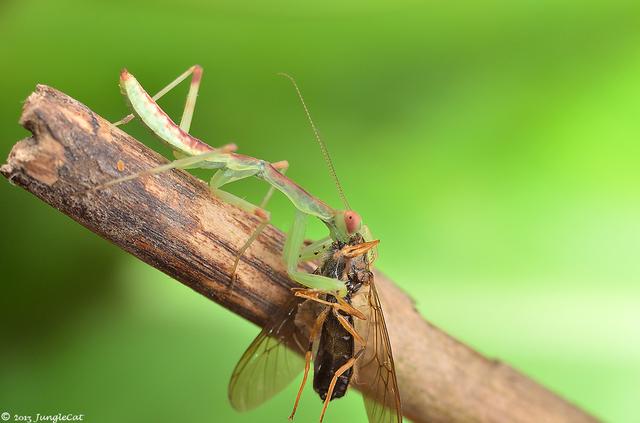
4. Diet. Mantises are terrestrial predatory insects (carnivorous), all kinds of small insects can be hunted by mantises, especially flies, mosquitoes, locusts and butterflies, their eggs, larvae, naked pupae and adults are all suitable prey. Even crickets and locusts are their prey.
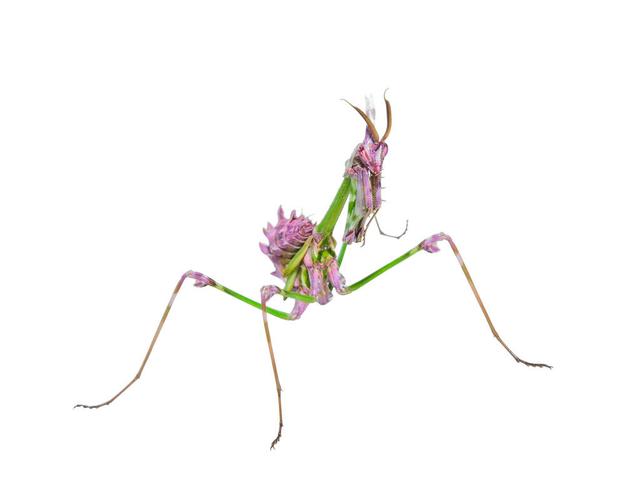
Mimicry behavior
1. Floral mimicry. There is a tropical mantis, its forelegs mimic flowers, its body color is purple-white, it hides in a place like a leaf cluster, looking like a purple-white orchid, in Malaysia there is a flower mantis, its body is pink, looks like a blooming flower, attracts butterflies to come to collect nectar, this is a mimicry behavior.
2. Leaf mimicry. Some mantises make their chest abdomen and grow leaf and protrusions, mimicking leaves, branches and tree scars, deceiving small insects.
3. Water droplet mimicry. There are mantises in tropical desert areas, whose bodies are green, and their heads have a flat bulge, which is smooth and bright, hidden in the grass, in the sunlight, the protruding object looks like a drop of dew, attracts small insects in the drought area to come to take water, this is a mimicry behavior.
4. Threat mimicry. A French biologist once saw a mantis threatening a large gray locust through mimicry. When the mantis saw the locust, it immediately spread its wings and shook them to the sides, the hind wings stood upright, like a sailboat, the top end of the body curved, emitted a snake-like spray sound, the weight of the body was put on the four legs in the back, the body stood upright, and the two eyes were fixed on the locust. When the locust moved slightly, the mantis's head turned immediately, and the locust was stunned and lay on the ground, even moved towards the mantis, when it moved to the mantis's reach, the mantis quickly pounced on it, and the locust was unable to resist.