Female Praying Mantises Eat Male Mantises After Mating: A Willing Sacrifice?
For the healthy growth of the next generation, the praying mantis heroically sacrifices himself as food to the praying mantis bride, believing in the faith that anyone who has watched 'Black Cat Detective' will remember this plot deeply, and it has also cast a shadow on many people (including myself). In fact, there is a certain basis for such descriptions, in reality, people have long observed that there is such a phenomenon between praying mantises in nature.

Why do female mantises eat male mantises after mating? In fact, biologists are also very interested in this problem. After a large number of observations and research, they gave a very simple answer, that is, the female mantises are usually in a state of hunger.
For praying mantises, which are carnivorous insects, their behavior is entirely driven by instinct. The first priority for survival is to obtain food. In the eyes of mantises, there is no concept of mate. They will try to prey on any creature they can see that can be used as food (especially those that move faster).
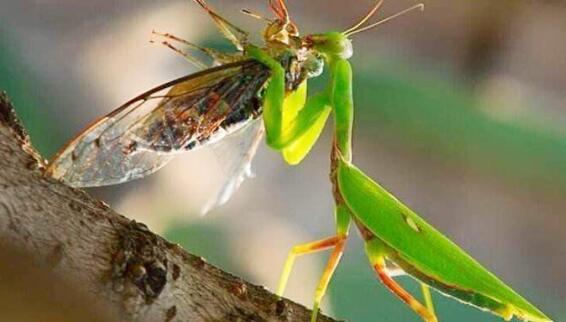
The female mantis not only ensures her own survival, but also shoulders the heavy responsibility of breeding the next generation. They have greater food needs, and coupled with the fact that mantises contain a very rich supply of nutrients, it can have a beneficial effect on the female mantis. Research data shows that female mantises that eat their mates after mating have a significantly increased number of offspring (which can reach 20%), so it can be said that if the male mantis encounters a female mantis in a state of hunger, the risk of being eaten by it will obviously increase.
So the question is, knowing that there is a risk of being eaten, why don't male mantises run away? Surely male mantises are willing? The second priority for survival is to breed the next generation. During the mating season, female mantises emit a special pheromone, which can make nearby male mantises have a strong mating impulse. Under the drive of instinct, male mantises will actively approach female mantises and try to mate with them. For similar reasons, female mantises will not 'handle' male mantises before mating (unless they are very hungry or simply don't like the male mantis in front of them).
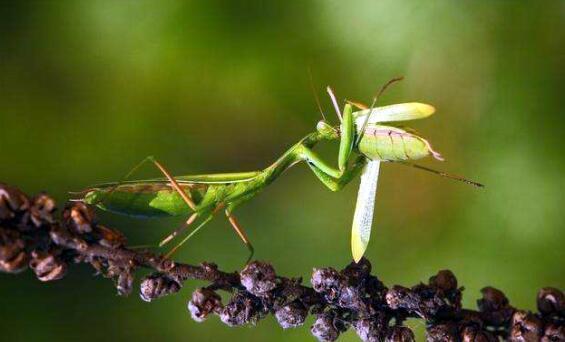
Some people may feel strange, why only female mantises eat male mantises in nature, and why don't male mantises eat female mantises? In fact, there are two main reasons, first because there is no need for strong male mantises to protect their populations in the mantis world, so small male mantises are easier to breed their offspring (they move faster and fly further, which makes it easier to find mates for mating), and in the long run, the size of male mantises has become much smaller than that of female mantises, and their strength is no longer enough to compete with female mantises.
Second, even in the distant past, there may have been individuals who could prey on female mantises. But they couldn't inherit their genes. Because they were mated with female mantises who had been eaten. These male mantises had no offspring.
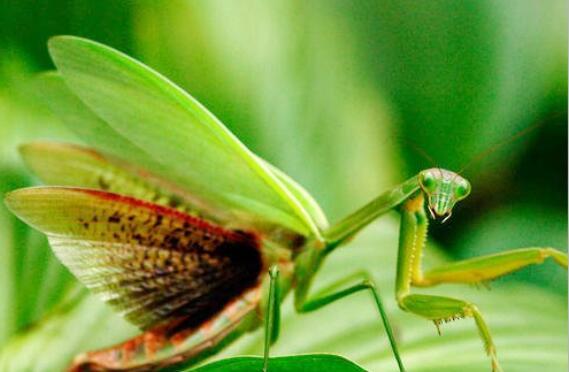
Male mantises certainly will not willingly be eaten. They will try to escape as quickly as possible after mating. Compared to female mantises, they have a significant advantage—flight. Female mantises cannot fly due to their large size. Generally, male mantises will land on the back of female mantises in a flying manner, and after completing mating, they will quickly run away (of course, they will also run away by flying), which greatly ensures their safety.
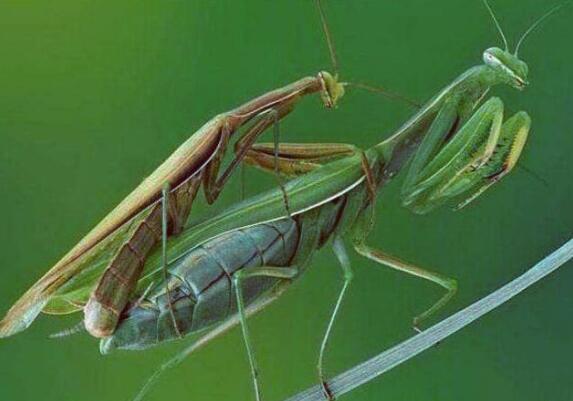
But because the mating time of mantises is usually several hours long, there will inevitably be some accidents during this time, such as male mantises slipping and falling from the back of female mantises, or female mantises making a large movement, they will fall from the back of female mantises. In this case, hungry female mantises will instinctively regard them as prey. If the male mantis doesn't escape in a short time, it is very likely to be eaten.
However, the 'stand' of male mantises is precise, and in extremely hungry situations, female mantises in the middle of mating will also attack the male mantises on their backs. They usually bite the male mantis into two pieces above the neck, and eat a part of it. It is worth mentioning that because the lower part of the mantis's activity is handled by the thoracic nerve bundle, even if the male mantis loses its head, it can survive for a long time (up to 10 hours), so it can still complete the next mating process.
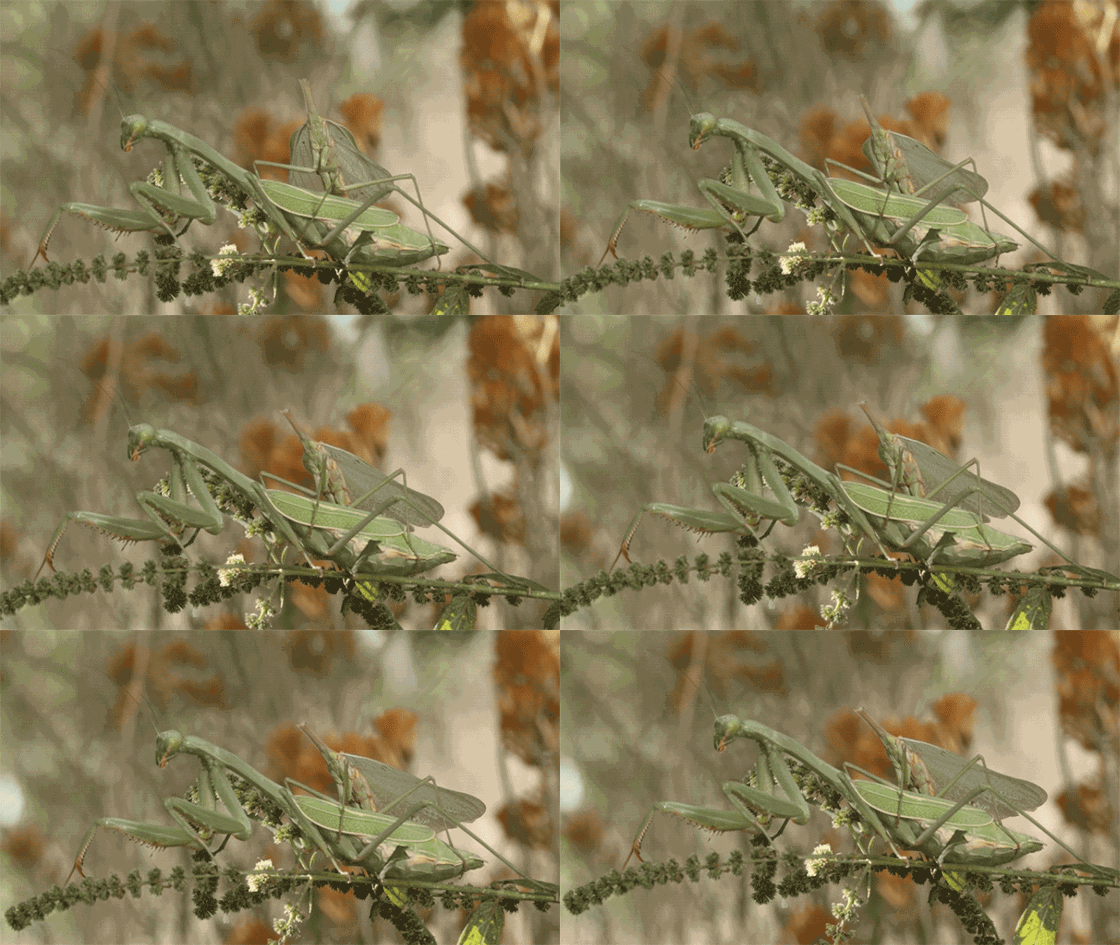
By the way, research shows that not all mantises have the 'female mantises eat male mantises' behavior, and in the mantis population that exists this behavior, only about 30% of male mantises will be eaten by female mantises after mating.
Okay, that's all we're going to cover for now. Welcome everyone's attention to us, we will see you next time.we will see you next time