The Tiger's Migration: A Clash of Lions and Tigers?

About lions and tigers, there has never been a lack of discussion, and with the understanding of these two kinds of fierce beasts, the topics discussed have gone beyond the initial 'lion vs. tiger', 'is the lion a dog' and now include their historical distribution in the same domain.
Regarding this point, there is a very interesting topic that we all know, we know that tigers originated in East Asia, roughly located at the place where the ancient Chinese tiger lived in the south-west China, while lions originated in Africa, after historical development, these two animals have shown different degrees of diffusion, but the range of diffusion has not gone on indefinitely, therefore, there have been sayings such as 'lions blocking tigers going north', 'tigers blocking lions' expansion' , is this fact?
Lions and Tigers' Origin
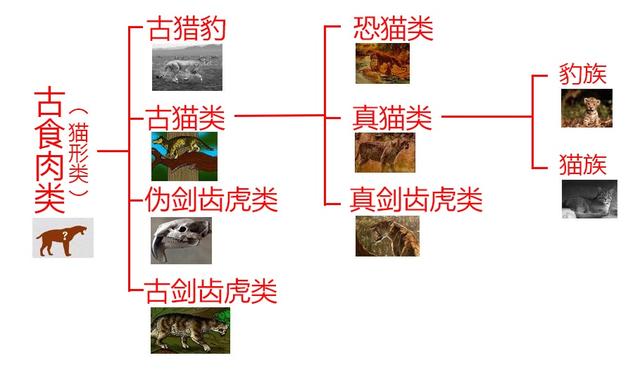
Modern cats all have a common ancestor, they all developed from ancient carnivorous cats. The cat family has several branches: ancient saber-toothed tigers, false saber-toothed tigers, ancient cheetahs and ancient cats. The first two branches went extinct in the third period, while the latter evolved into modern cheetahs.
Tigers and lions both belong to the panther tribe in the panther family, in addition, this tribe also includes leopard, snow leopard and American leopard. Lions are closely related to leopards, while tigers are closer to snow leopards.
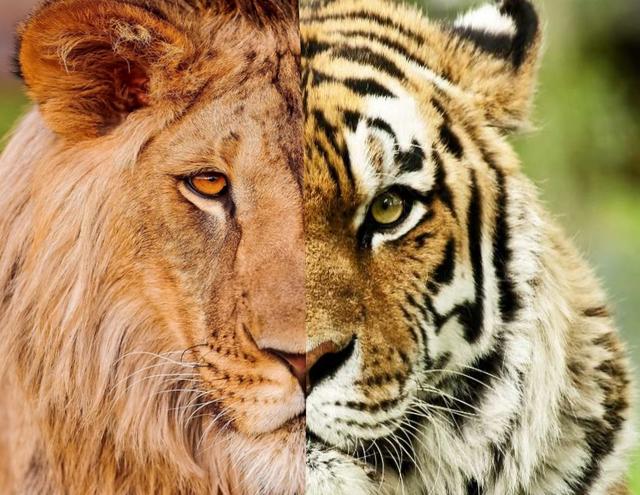
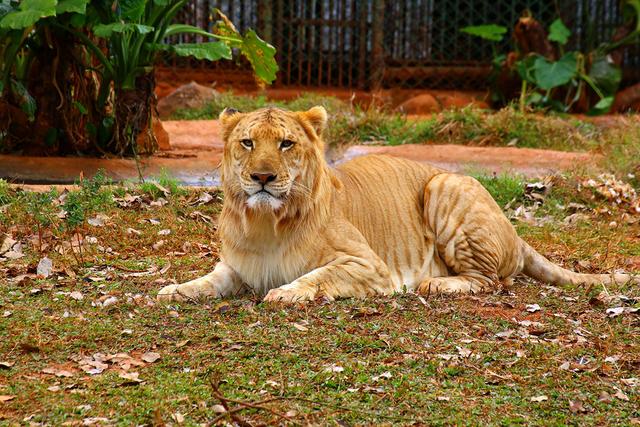
A long time ago, there were always people on the internet who said that lions were dog family. This is prejudice, although lions are indeed different from most cats in terms of lifestyle, but they are definitely cats. The most direct evidence is that they can interbreed to produce lion-tiger or tiger-lion hybrids.
Lion-Tiger Hybrids
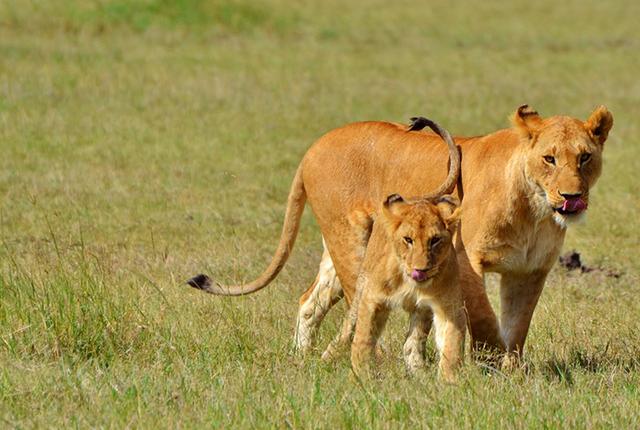
The modern lion originated 140,000 years ago in East Africa and south-west Africa. Due to the fact that many large carnivorous animals could not adapt to the changes in the earth's environment, leading to the rapid extinction of the lion, in a short period of 100,000 years, the lion quickly spread across Africa except the Sahara Desert, becoming the top predator in the local food chain, but at the same time, they were also observed to eat carrion.
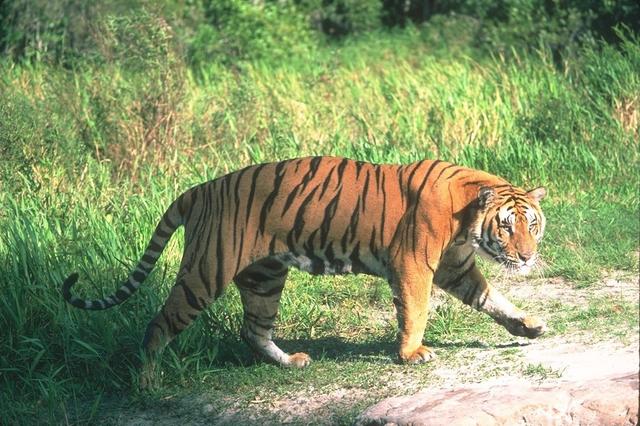
Regarding the origin of tigers, there are many versions, one is that it originated in Siberia, later spread to other parts of Asia through Northeast China, this statement has fewer supporters and lacks complete evidence; the other is that tigers originated 200,000 years ago in Henan, China, and the fossil of the ancient Chinese tiger discovered in 1920 is relatively close to the modern Chinese tiger, so it is considered to be one of the earliest types of tigers.
This statement was further confirmed in 2005, people used advanced DNA sequencing method to confirm that the Chinese tiger is the oldest member of the tiger family, that is, the origin of tigers was in the south-west China, where the ancient Chinese tiger lived.
Lions and Tigers' Coexistence Area
Whether it is tigers or lions, they are all highly mobile and exploratory cats
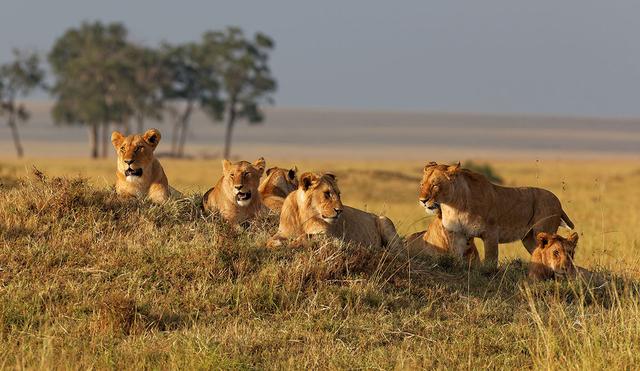
Therefore, 20,000 years ago, in the late Ice Age, lions went out of Africa, they went north through North Africa, occupying most of Southern Europe, then they went east to expand to the Indian subcontinent, the furthest they reached was the Indian subcontinent, in Asia, they quickly settled down in the south-west, because of geographical isolation, lions eventually divided into two groups, one is parallel to the African lion, the other is Asian lion. The physical characteristics are that Asian lions are generally smaller, and the manes of male lions are not as dense as African lions.
Historically, tigers have several times expanded their habitat, at that time the tigers expanded towards the west along the northwest, the other is along the south, reaching the Indian subcontinent and Southeast Asia, eventually limited by mountains and straits, tigers could not enter Europe and AustraliaBecause Southeast Asia has many islands, so-called 'one island, one climate, island, island is not the same', so tigers isolated by geography eventually evolved 9 subspecies, now there are only 6 subspecies of tigers remaining in the world, the two subspecies of rize tiger and bali tiger have already gone extinct,
Lions and Tigers' Historical Distribution Map
From the expansion of tigers and lions' habitat, they both went in one direction, and there is likely to be a coexistence area between them, and this area is most likely Central Asia. After comparing the historical distribution of tigers and lions, we found that they have a large overlapping area, and this overlapping area is Central Asia, West Asia and the Indian subcontinent
Based on the arrival time of lions in Asia and the expansion of tigers to this area, the coexistence time of lions and tigers is during the Pleistocene, about 11,700 years ago. What stopped the lions and tigers from expanding?
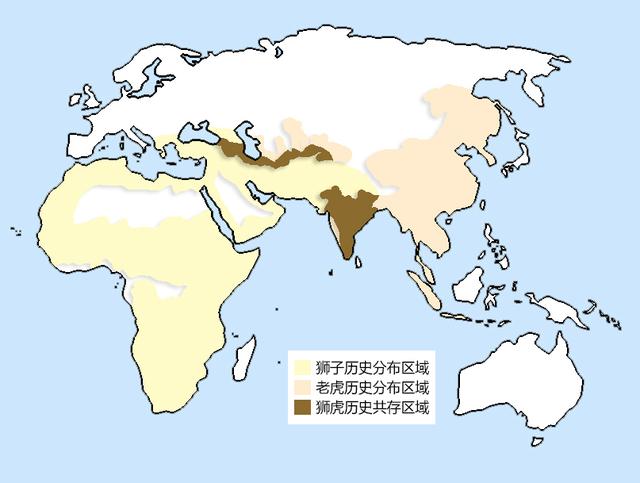
Believe it or not, many people will have a question, since tigers and lions both have high mobility and expansion habitats, why don't lions go deeper into Asian inland, but only stop at the coast?
In addition, we understand that tigers cannot enter Europe and Africa, Australia because of mountains, deserts and seas, but why have they not spread to the entire Indian subcontinent? Is it really as said on the internet, that tigers and lions compete and inhibit each other to achieve this balance?
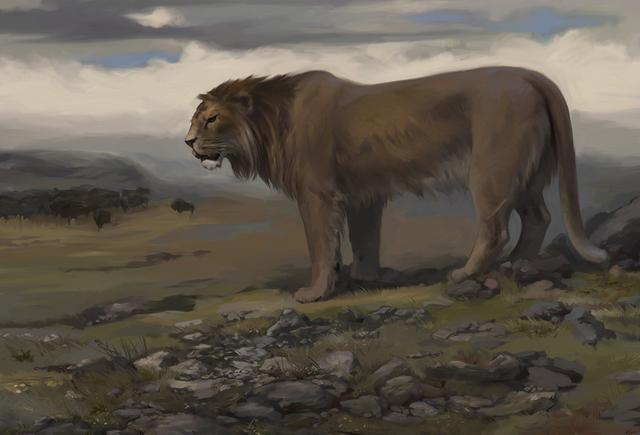
In fact, it's not, let's talk one by one, tigers haven't quickly expanded to the entire Indian subcontinent because the main obstruction factors are 'ding shion', ding shion existed in the late Pleistocene (1.17,000 years ago) blocked the tigers' advance, ding shion is not a subspecies of lions, it is related to modern lions, with a huge body, and male tigers can weigh more than 300kg, with the ability to fight with tigers
Why is it called 'ding shion'? We can refer to the extinction time of ding shion and the subsequent changes in the habitat of tigers to infer the answer. 11,000 years ago, the ding shion in northern Asia went extinct, and the tigers expanded to the west across the Caspian Sea, limited by the mountains, it couldn't continue westward.
Ding shion Image
Let's take a look at lions, why haven't they continued to expand inland in Asia? Is it because of the tigers? In fact, it's not, although they will have strong competition in terms of habitat, but between lions and tigers, who can inhibit who?
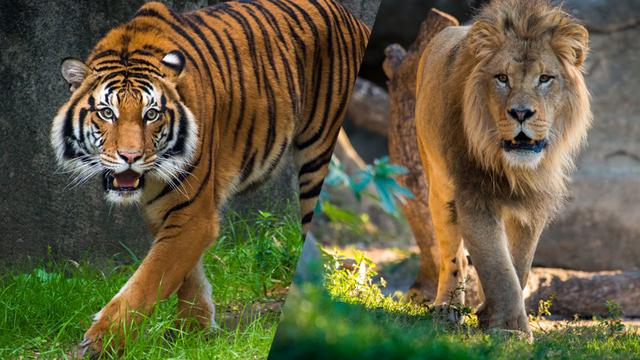
In general, when the prey is abundant, the range of activity of tigers and lions will shrink significantly, so the tigers living in dense forests will not often come to the open areas in the forest, and the lions living in grasslands and open areas will not often go into the forest, so even in the coexistence of these two environments, lions and tigers have differences in microhabitat
When entering Asia, lions don't necessarily need to be in the forests, but if you look at the microenvironment, lions are more accustomed to living in open areas in the forest, in small areas with few trees, and the ancient Chinese tiger is relatively close to the modern Chinese tiger, so it is considered to be one of the earliest types of tigers.