Giant Armadillo
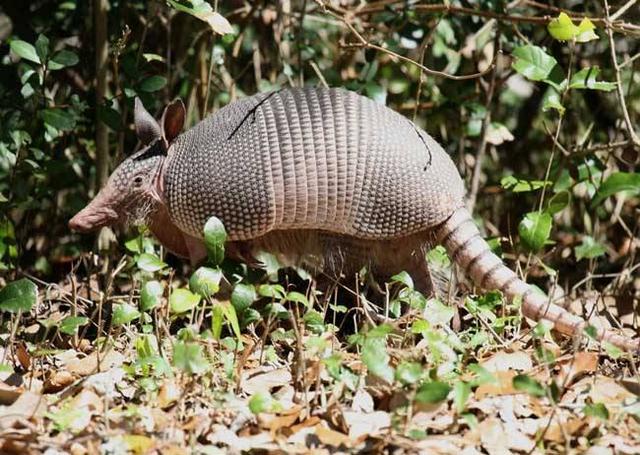
Priodontes maximus, also known as the giant armadillo, is the only species in the armadillo family, Order Cingulata. It is a large animal, typically weighing 27 kilograms, and can reach up to 32.3 kilograms. Its length is 89.5 centimeters, with 1/3 to 2/5 of its body being its tail. The sides and outer edges of the four limbs are covered with bony and scaly plates, divided into two parts – front and rear – by several rows of movable bands. The space between the bands is connected by elastic skin, allowing the animal to curl into a spherical shape for defense against predators. Small ears; retractable tongue; the forelimbs have 3-5 fingers, with curved, powerful claws, and the hindlimbs have 5 toes with claws. The teeth are small and spike-like, growing continuously throughout life.
The giant armadillo feeds on ants and termites. It lives underground and is a nocturnal animal. During the day, it lies in its burrow, and at night, it emerges to forage. Its prey includes insects, worms, beetles, black ants, white ants, bird eggs, snails, snakes, lizards, grasshoppers, and so on. The giant armadillo also likes to eat rotten animal carcasses. On the prairie, where there are cattle carcasses, the armadillo's burrowing place is ideal because it can easily obtain meat. It is distributed in the Amazon River basin of eastern South America, including Paraguay, Argentina, Venezuela, Guyana, and Brazil, near areas close to the water.
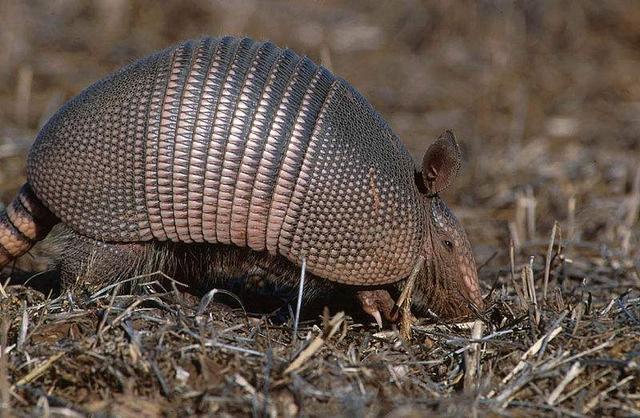
The giant armadillo is the largest species in the armadillo family. It has a dark brown color, with a body length of 75-100 centimeters and a tail length of about 50 centimeters, and a weight of 60 kilograms. On its head, it has scaly armor, like a helmet, and its sides have two small, circular ears. Its mouth is long and pointed, and it has more than 100 teeth of the same type in its mouth, which is more than twice the number of teeth found in most mammals, but these teeth are small and weak and lack incisors and canines, so it cannot defend itself, and they gradually fall out in old age.
The body can be divided into three segments – front, middle, and rear – and is covered with a layer of bone plates that resemble tiles, arranged like bricks, providing protection. The front and rear sections of the bone plates are connected together like a turtle shell and cannot be moved. The middle section’s plates are arranged in a banded manner, circling around to form a ‘tripod’, which is connected with muscles. There are 3-4 bands in the neck and 11-13 bands in the back, which can be freely stretched, increasing the animal’s flexibility, and even allowing it to run quickly.
The long tail and limbs behind it are also covered with scutes. The scutes between them are sparsely and roughly covered with hair. The belly is not covered with scutes, but with dense hair. Its four limbs are very thick, and the claws on the toes are sharp and hard, very powerful. The third claw is more curved, about 20 centimeters long, but it is only used for digging and not for fighting against predators.
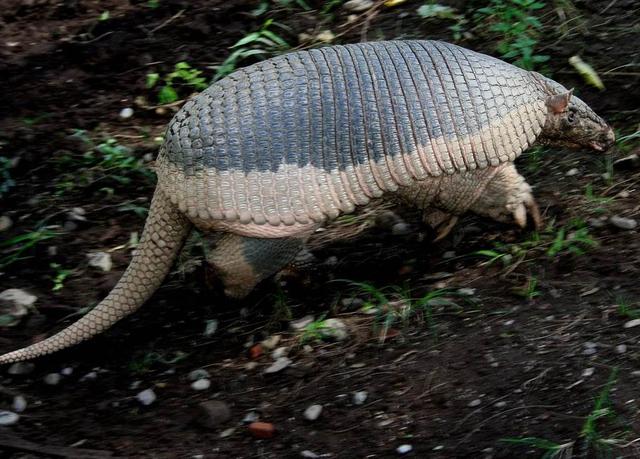
The giant armadillo lives in areas near the Amazon River basin, including areas close to the water. It likes to walk on the ground at night and sleep in its burrow during the day. Surprisingly, it also has a swimming ability. It first inhales a large amount of air, which makes its belly expand, allowing it to float on the water. It can stay underwater for up to 6 minutes while inhaling air. When walking on land, the scutes on its body prevent grass and brush from hurting its skin.
The giant armadillo cannot run or fight against predators effectively, so when it encounters an enemy that it cannot escape, it immediately curls up into a hard shell, hiding its more vulnerable soft parts, such as its head, chest, and abdomen, which often prevents small carnivorous animals from biting it. However, if it encounters larger carnivorous animals such as wolves,, wild boars, or indigenous dogs of local tribes, or if its sharp teeth can penetrate its scutes, its defense system is completely destroyed. Therefore, these animals are its main predators. In fact, its greatest enemy is automobiles. On coastal roads, you can often see dead bodies of armadillos that have been hit by cars, because it has a strange jumping reflex. When a car speeds towards it, it immediately jumps vertically to collide with the car and die.
The giant armadillo has a remarkable digging ability, able to dig burrows in hard ground, even cement ground. Its digging speed and strength are extremely impressive, and it can dig a burrow in just a few minutes. In addition, it has many ways to avoid predators, such as diving into water, swimming underwater, diving into dense bushes, making predators unable to enter, or spraying a foul, smelly hot liquid from its anus to confuse predators, so that when predators’ eyes are blinded by the hot liquid, it quickly escapes. Only in rare cases does it use its claws to fight back.
It has a varied diet, including ants, termites, grubs, beetles, scorpions, and other insects, as well as worms, snails, spiders, lizards, snakes, toads, birds, bird eggs, and carrion. It sometimes damages crops to find insects. However, the amount of insects it eats is very large, and it can eat about 270 grams of insects per animal each year, so it is mainly beneficial to humans.
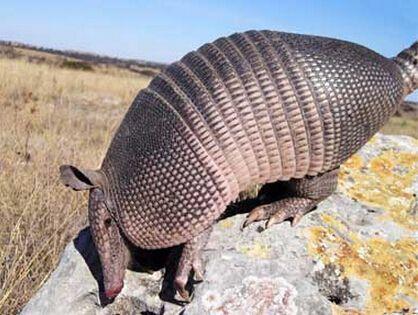
Because of its poor eyesight, it relies on its sensitive sense of smell to find food, accurately locating the nests of ants, termites, and other insects hidden at a depth of less than 1 meter. After digging with its sharp claws, it uses a long, retractable tongue covered with a sticky liquid to greedily lick and eat its prey.
Armadillos have an annual breeding season in the spring, with mating occurring in the early summer. Male armadillos have testes located in the abdomen. The gestation period is long, lasting 14-16 weeks. The embryos move freely in the uterus, not attached to the uterine wall, quietly bathing in the uterine fluid. When the embryos are attached, they develop quickly, growing from the base of the embryo, forming primary stripes, then developing into embryos. The giant armadillo has a large adrenal gland, which is similar to that of humans and primates.