Understanding a Wonderful Natural Phenomenon – Whale Falls, Worthy of Humanity
I wonder if you have had such an experience: sometimes, when feeling irritable due to trivial life matters, watching a nature documentary can often bring you back to calmness.
Today's 'Human Worthiness' wants to share a wonderful natural phenomenon with you.
On April 2nd, a Chinese research vessel 'Explorer No. 1' completed its scientific research mission. The important achievement of this mission is that scientists discovered a whale fall approximately 3 meters long in the South China Sea.
'Whale fall' is derived from 'the fall of whales'. It is a natural phenomenon that refers to the death of whales sinking to the seabed and forming a small ecosystem.
You may think that the life and death of the natural world is nothing extraordinary, why would it be such an important research achievement?
The reason is that 'whale fall' is a rare phenomenon.
First, it takes very strict conditions to form a 'whale fall',If a whale dies in shallow waters, its body will be quickly devoured by marine organisms. Only when a whale is large enough and falls into deep underwater, will a whale fall be formed. The whale fall we discovered in the South China Sea was at a depth of 1600 meters.
Secondly, because the location of whale falls is random, it is not easy to be discovered.Since this concept was proposed, only less than 50 whale falls have been discovered internationally. The whale fall discovered in the South China Sea is the first in Chinese history.
However, I'm introducing this to you not just because it's rare. If you understand the process of whale fall, you will definitely marvel at the wonders of nature.
The formation of whale fall is not instantaneous, but a long process. It is divided into three stages. I have inserted a diagram for you to view while listening.
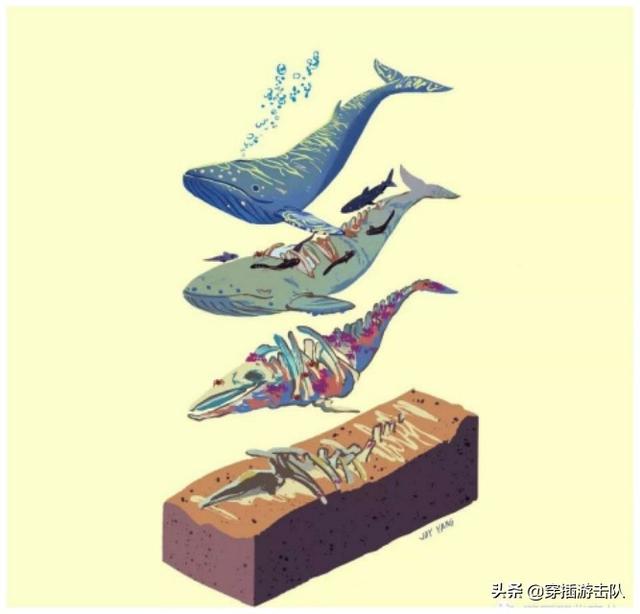
After the whale dies and its body slowly sinks into the seabed, 40+ species of carrion feeders will gather around it to feast, which will last for a year.
After 90% of the whale's meat is eaten, 20+ smaller animals that digest the remaining tissue fragments of the whale will appear, equivalent to 'picking up the leak'. This process will continue for two years.
But this is not over. When the whale's bones are completely gnawed, large amounts of anaerobic bacteria will enter the whale's bones to decompose the lipids in the bones, producing hydrogen sulfide. This allows some bacteria to reproduce, and these bacteria let the population of clams and sea snails thrive.
Scientists say that the whole process of whale fall can last for decades or even a hundred years, and at least 12490 species in the North Pacific rely on whale fall for survival. Because in the deep sea below 200 meters, sunlight cannot penetrate, it is difficult for organisms to obtain energy.
Therefore, scientists often say that the fall of a whale is a blessing for the creatures on the seabed, and every whale fall is a green oasis in the ocean desert.
Hearing this, you may think of a poem called 'Falling Red is Not an Impassionate Thing, Transforming into Spring Mud to Protect Flowers'. I'd also like to share another poem with you: 'Whale fall on the seabed, nourishing the dark world of fifteen species',
Every time I see this phenomenon, I'm always amazed at the wonders of nature. It seems that it was designed everything from the beginning. No matter how humans view nature, it always follows an ancient rule.
If you know anything interesting about nature, please leave a comment and share it with me.
Okay, that's it for today's 'Human Worthiness',
—Human Worthiness