The Most Critical Factors for Scorpion Cannibalism During Molting: Uneven Growth and Irregular Molting
Scorpid cannibalism during molting is called autotomy. Scorpions, as crustaceans, must undergo multiple molts to grow larger.
During molting, the newly emerged body is very tender (like the golden cicada), and at this time if a scorpion attacks it, it has no ability to resist and is easily eaten by other scorpions. Scorpions are vulnerable for 2-3 days after molting, when their outer shell hasn't hardened yet.
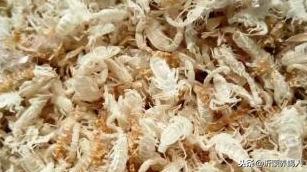
Scorpion shedding its skin
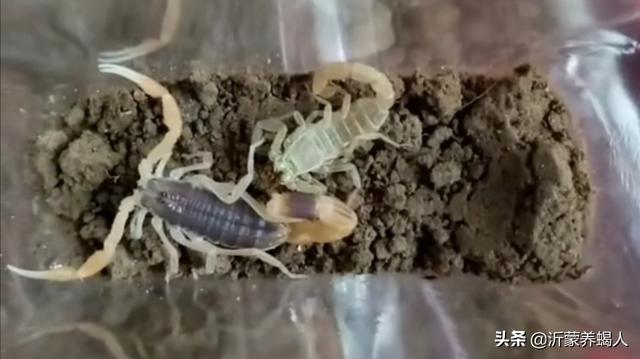
Scorpions exhibit autotomy during molting mainly because scorpion growth is not uniform, and molting times are also irregular, leading to this phenomenon. If scorpions molt at the same time, there will be no autotomy. However, we cannot achieve absolute uniformity when raising scorpions, so this phenomenon cannot be avoided. Regarding the collective molting phenomenon of scorpions, there are four points that need to be emphasized.It's not that larger scorpions will eat smaller ones. Scorpions only attack scorpions that are molting, not scorpions that aren't molting. Even large scorpions can eat (or kill) molting large scorpions.
In fact, scorpions don't only eat scorpions during molting; yellow powder worms also eat molting scorpions.
Molted scorpions
Scorpion molting is no longer a difficulty in scorpion farming. Currently, the problem of scorpions not molting is no longer a major issue in the industry. Therefore, it is also a reminder to novice scorpion keepers not to believe many people selling molting powder. Scorpion molting is a well-solved problem, and molting powder is not needed. Scorpion molting can happen without molting powder, and molting powder won't make scorpions molt neatly.
Scorpions are eaten during molting by other scorpions, not simply because they are hungry. Strictly speaking, if a scorpion is hungry, it will go out to forage, increasing the scorpion's activity and the opportunity to find a molting scorpion. However, this doesn't mean that a hungry scorpion won't eat a molting scorpion, and this has nothing to do with whether a scorpion is hungry or not. For example, a scorpion will eat a molting yellow powder worm and a molting scorpion.
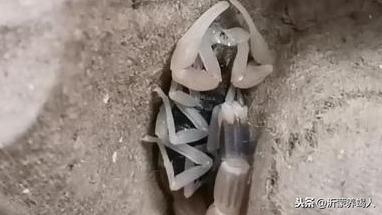
The mechanism and principle of molting and autotomy are difficult to explain simply, and even professional terms are difficult to understand. It can be temporarily understood as autotomy is the nature of scorpions.
Molting scorpions
Scorpion growth cannot be guaranteed to be uniform
About 3 days before and 3 days after molting, the scorpion's outer epidermis ages and has no predatory ability. So, if scorpions molt within this one week, there will be no autotomy.
However, to ensure that scorpions molt within the same time period, scorpion growth must be uniform, but this is currently impossible. For example, even a mother scorpion will produce scorpions that don't grow absolutely uniformly.
Therefore, when raising scorpions, we can only try to make scorpions molt at a relatively concentrated time. We cannot completely molt at the same time, so scorpions exhibit autotomy during collective molting.
33