Four Siberian Tigers Discovered in Tai Ping Gorge, Heilongjiang Province – Two ‘Settled’ in Protected Area

Chinanet, Hegang, April 6th report (by Wang Lin)The Heihe Forestry Bureau of Heilongjiang Province issued a statement on April 6th, stating that since March 2020, four wild Siberian tigers have been spotted within the Tai Ping Gorge National Nature Reserve. The local authorities are committed to building the protection area into a green channel for Siberian tigers to migrate between China and Russia and a home for the reproduction and development of Siberian tigers.
The Tai Ping Gorge National Nature Reserve is located in Ruo Bei County, Hegang City, Heilongjiang Province, and is an important transit channel for large mammals between China and Russia. It plays a crucial role in the spread of tigers to China's small Xing'anling region and is a gateway for the recovery of the wild Siberian tiger population in the small Xing'anling region.
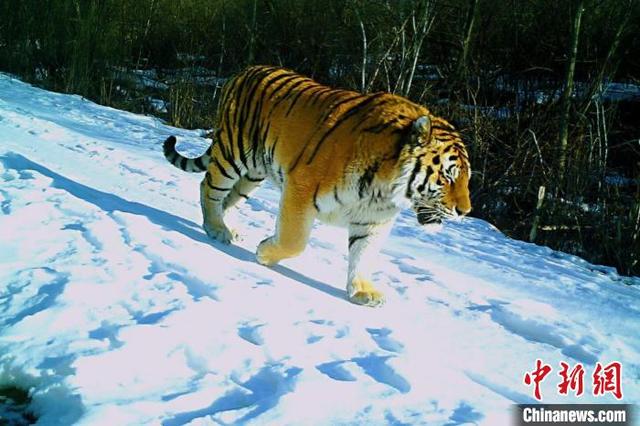
Four wild Siberian tigers have been found in the Tai Ping Gorge National Nature Reserve. (Provided by the Tai Ping Gorge National Nature Reserve)
From March to now, the protection area has repeatedly captured high-definition images of wild Siberian tigers through infrared cameras. In the images, the robust Siberian tigers are leisurely patrolling the snow. It is reported that the four Siberian tigers discovered this time, two have 'settled' in the protection area and started territorial patrols, and the other two just accompanied each other across the border from Russia to the protection area.
A relevant official from the Heihe Forestry Bureau of Heilongjiang Province stated that this discovery proves that the protection area has a good ecological environment and abundant food chains. In recent years, the Heihe Forestry Bureau of Heilongjiang Province has continuously increased its efforts to protect Siberian tigers, regularly conducting supplementary feeding work to ensure the abundance of prey populations.
Since 2018, the protection area has completely exited its core and buffer zones of farmland in a one-time compensation manner and promptly reforested and reseeded; in 2019, the protection area cooperated with the National Forestry Bureau's Cat Research Center for a two-year Siberian tiger monitoring and habitat assessment project. Currently, the grid-laying and Siberian tiger prey density transect survey work have been completed.