World Wildlife Day: Seeing Sichuan from a New Perspective
Sichuan Online Reporter Kou Minfang
Today is the seventh ‘World Wildlife Day’ of the United Nations, and this year’s global theme is ‘Sustaining all life on earth’. China’s theme is ‘Maintaining the Global Community of Life’. Reporters from the Provincial Forest and Grassland Bureau informed us that in recent years, my province has increased the efforts to protect wild plants and animals, systematically implementing endangered species rescue projects, and the giant panda population and habitat area are all the first in the country.
On World Wildlife Day, the Sichuan Forest Natural Education Network also issued a call to protect wild plants and animals and maintain the global community of life.
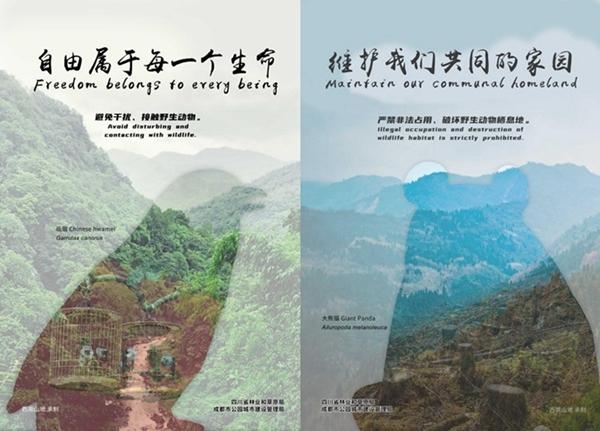
Today, let us together appreciate the wild plants and animals of Sichuan.
Sichuan has an area of 48.5 million square kilometers, accounting for 5.1% of China’s total area. Sichuan’s terrain and landforms are complex, with plains, hills, mountains, and plateaus. Sichuan is known as the ‘Land of Abundance’ because Sichuan is a paradise for wild plants and animals.
Sichuan is a major province of China’s species resources. There are more than 10,000 species of higher plants, ranking second in China, and more than 1,300 species of vertebrates, accounting for more than 45% of China’s total, and is one of the world’s 25 biodiversity conservation hotspots. Sichuan’s giant panda population accounts for 80% of the global total.
Sichuan is a major province of China’s forest resources. Sichuan is the second largest forest area in China—the Southwest Forest Area, with forest land area of 3.6 billion mu and timber volume of 18.6 billion cubic meters, ranking third in China. The forest coverage rate is 38%, 16 percentage points higher than the national average. They are mainly distributed in the sources of the Yangtze and Yellow Rivers, with more than 60% being natural forests and more than 70% being designated as (public forest land) strictly protected.
Sichuan is a major province of China’s resource protection. As of now, there are about 523 nature reserves, more than 300 provincial-level forest parks, wetland parks, and scenic areas, 167 nature reserves, accounting for 17.3% of the province’s area, ranking third in China. The Giant Panda National Park covers an area of 20,000 square kilometers.
Sichuan is a major province of China’s ecological construction. The Yangtze and Yellow Rivers are important water source conservation areas, with desertification, rocky desertification, and arid river valleys being numerous and widespread. It is a national ecological restoration key area, with ecological engineering funds accounting for 10% of the central investment. The annual ecological service value of forests and wetlands is 1.7 trillion yuan, ranking first in China.
Sichuan has more than 1,300 species of wild vertebrates, accounting for more than 45% of China’s total, and 145 species are listed as national key protected wild animals, with 32 species designated as national level key protected wild animals, including giant pandas, Sichuan golden monkeys, twisted antelope, snow leopards, white lipped deer, Sichuan mountain francolins, etc. There are 1,387 wild giant pandas and 521 captive-bred giant pandas, making the giant panda population and habitat area the first in the country.
Sichuan has more than 14,470 species of higher plants, accounting for more than one-third of China’s total, with 3,924 species of woody plants. Among the 389 (class) key protected wild plants in China, Sichuan has 72 species. There are 13 species designated as national level key protected wild plants, including light-leaved fern, Phyllostachys clamosa, red bud fir, Emei false yew, and Ketelechi.