Tracking the ‘Survivors’ of the Ice Age – Chinese Khaki Sand Ducks
Written/Photography by Dong Yuqing
March is the season of blossoming flowers and returning birds. The Chinese khaki sand ducks that have overwintered in the Zhanghe River waters of Hubei Jingmen have embarked on a thousand-mile spring migration northwards.
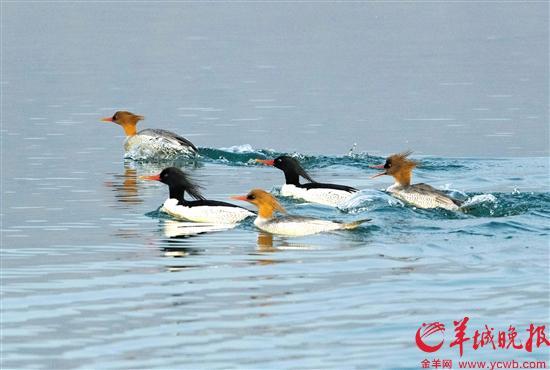
The Chinese khaki sand duck is a rare and endangered bird species native to China, a 'survivor' from the Ice Age (over a million years ago). There are less than 2000 individuals worldwide, rarer than pandas, and is known as the 'water-borne flying feather panda'. It is currently a national level key protected wild animal and is listed in the World Conservation Union's 2012 Red List of Endangered Species.
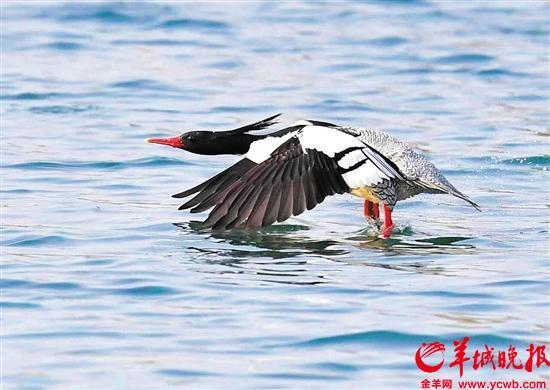
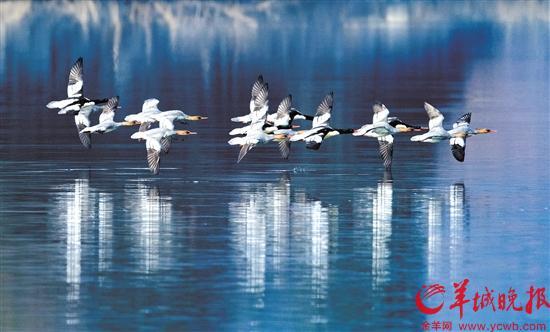
The Chinese khaki sand duck belongs to the order Anseriformes and the family Anatidae. Its body length is between 49 cm and 63 cm, with a laterally flattened beak at the front, unlike other species in the Anatidae family with flat beaks. The beak and feet are red. The white feathers on its upper sides have black fish scale-like spots resembling clouds, hence it is also known as 'scaled-sided khaki sand duck'. Male ducks have two long crests on their heads, like flower plumes on Qing Dynasty official hats. The head and neck feathers of the khaki sand duck are black in males and brownish-grey in females.
The original habitat of the Chinese khaki sand duck is in the Changbai Mountains of Jilin Province, with occasional individuals flying to Korea and far eastern Russia. In autumn, they migrate in large groups from the north to the Yangtze River's north and south banks for winter, and return north in spring. They mainly inhabit narrow rivers between mountains, and sometimes fly to open lakes, diving to hunt fish and shrimp.
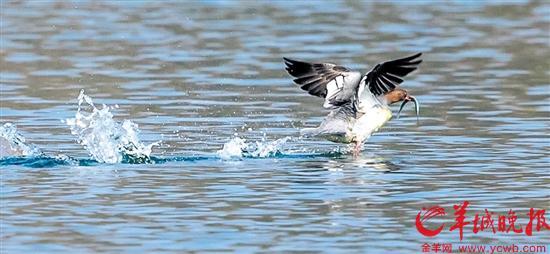
In the past two years, the author has deeply tracked and photographed the Chinese khaki sand ducks that overwinter at the Zhanghe River waters. Through observation, it was found that about 200 ducks live here. They are accustomed to group activities but never gather with other wild ducks. They have a regular life: in the morning and evening, they are feeding time, they like to swim in the river, diving to hunt fish and shrimp; at noon, they choose to bask in the sun on sandy or rocky beaches; in the evening, they gather in the reed beds on islands in the water to rest.
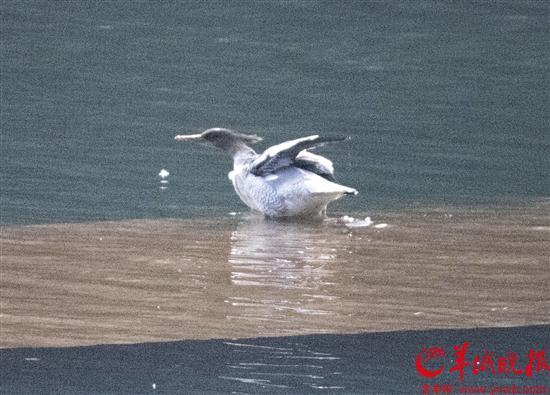
The Chinese khaki sand duck is very vigilant. Whenever it is gathered and rests at night, it always sends out a sentry duck to stand in the distance and observe in all directions. Once it discovers any wind or movement, it immediately sends out an emergency escape signal to its companions, so flocks of ducks quickly take off from the water in a straight line, which is spectacular.
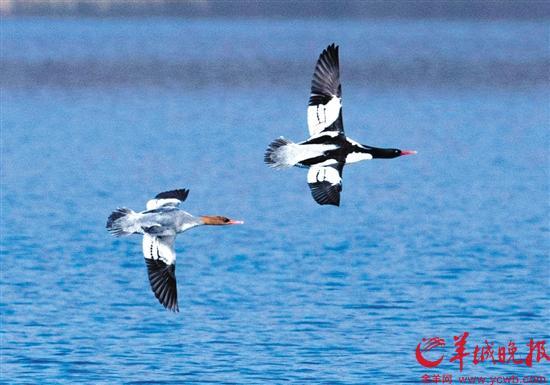
The Chinese khaki sand duck is a treasure of nature and a wind vane of the ecological environment. Wherever there is a good ecological environment, it will live and settle. Its choice of wintering in the Zhanghe River area has always been a large branch of the Yangtze River. 60 years ago, people built the Zhanghe Reservoir to dredge and store water and prevent floods, which is the largest artificial lake at the intersection of the Jianghan Plain and the regions. Today's Zhanghe Reservoir has been designated as a national-level wetland park, with water quality reaching Class I standards, and various freshwater fish and shrimp grow in the water, with excellent ecological environment, which makes the Chinese khaki sand ducks congregate in this area for winter.