Incubation of Emperor Penguin Eggs Requires 65-70 Days – Will They Hatch If It Exceeds?
The regularity of the animal kingdom in nature is more accurate than that of humans. Human childbirth may be delayed by about ten days, which is considered normal. And now, with a relatively complete medical system, measures such as induction can be used to ensure normal delivery. However, this is not common in the animal kingdom.
Emperor penguins will hatch after exceeding the incubation time for three or two days, which is normal. However, if the incubation time exceeds the normal time by seven days and there is no hatching, the baby penguin is basically dead or may have died inside the egg.
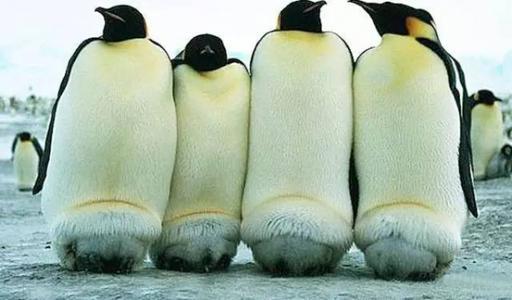
Male emperor penguins are responsible for incubating the eggs
In April, Antarctica begins to enter its early winter, and emperor penguins climb onto the shore to find their 'place to settle down'. After arriving at the breeding ground for more than a month, female emperor penguins lay one pale green egg weighing about 500 grams, and then hand over the egg to the male emperor penguin, and then quickly return to the rich food sea to replenish their bodies weakened by reproduction.
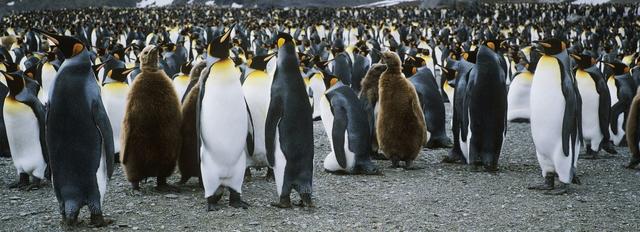
Groups of emperor penguins
During the period from mid-July to early August, the little emperor penguins hatched one after another. At this time, the male emperor penguin could move his body slightly, but the female emperor penguin still had to return in 7-8 weeks, and before she returned, the little penguins had no food to eat. If the little penguins were too hungry, the male emperor penguin would regurgitate a white secretion to feed them. This secretion is said to have little nutrition, just to make up for it.
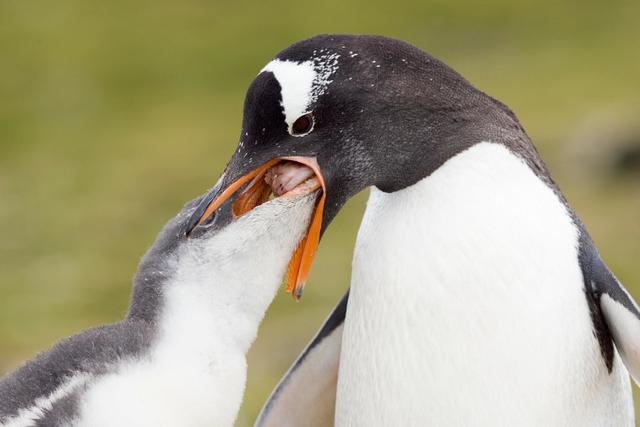
'Nausea-inducing' feeding method
In the early stage of penguin chicks, they spend time with the male penguin on their feet and around them. The male penguin is both father and guardian. Newly born little penguins are fluffy and gray-yellow, with big eyes with inner rims, they walk crookedly. Due to the careful nurturing of both parents, the little penguins grow quickly, and within a month, they can walk and play independently. In order to facilitate foraging and protect and educate the offspring, the penguin parents entrust the little penguins to their neighbors to take care of.
Although the little penguins grow up and become strong under the careful nurturing and care of family and collective, due to the pressure of the harsh Antarctic environment and the threat of predators, the survival rate of the little penguins is only 20-30% of the birth rate.
About three months after penguin chicks are born, the Antarctic summer arrives, and they follow their parents to forage and swim in the sea. When the Antarctic summer comes, they have grown into plump feathers. Before the emperor penguins are truly mature, they need the careful nurturing of their parents and learn to walk, swim, and forage independently. It takes 14 to 16 months for the little penguins to reach full maturity.