Long River Old Course: A Haven for Birds
People's Daily Online - Overseas Edition of People's Daily
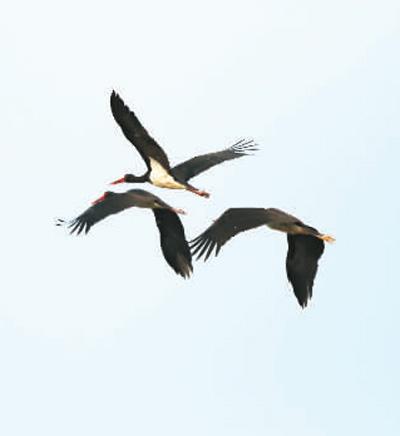
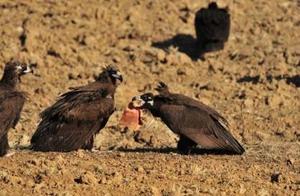
Yangtze River Old Course Overhead Black Stork. Lei Gang photographed
The Yangtze River Old Course, with its wide river and deep water, slow water flow and low water level fluctuations, is suitable for the habitat, breeding and growth of wild plants and animals. Therefore, the Yangtze River Old Course forms a wetland ecological environment different from the main Yangtze River channel, and is a 'paradise on earth' created by nature for plants and animals along the Yangtze River. In order to protect the natural environment and biodiversity of the old course, many protection areas have also been established.
Yangtze River Old Course in Shishou, Hubei, also known as Sand Beach Old Course and Liuyinha Old Course, covers an area of about 6 square kilometers. It was formed in July 1972 due to the Yangtze River Six Harmony Old Course natural bend cut. The new river channel, 2.5 km long, shortened the river course by 20.7 km, and is now connected to the Yangtze River via the Swan Island Lock. The old course river is 1200 meters wide, with a total water surface of about 20,000 mu, with a lake length of 20 kilometers. Two national-level nature reserves have been established here: Hubei Yangtze Swan Peninsula Pink-headed Gull National Nature Reserve and Shishou Elk National Nature Reserve.
Many wild plants and animals are protected within the old course protection area, and the old course has become a base for public science popularization and nature education. Hubei Bogde Ecological Center was fortunate to carry out a large amount of resource investigation and nature education work in these several protection areas. Supported by the Aral Fund, the 'Let Birds Fly' wetland bird conservation monitoring project was launched in 1968 at the Wangmiao/Jixiangjiang Yangtze Old Course in Shili, Hubei; Hubei Winter Waterbird Synchronous Survey…
When standing on the shore of the Yangtze River and looking far away, you may only see a busy waterway; but on the Yangtze River Old Course's riverbank and shoal, you will see a vibrant and free-ranging wild animal landscape. Can you imagine the picture below: 150+ Grey Cranes suddenly take off. The high-pitched crane calls and the dense flocks of flying feathers pass over your head, how magnificent!
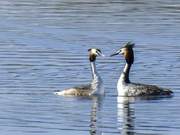
The dark spots on the shoal look so striking in the bleak winter environment, but through a telescope, you will be surprised to find that it is also possible to see more than 80 Grade I protected animals – Black Stork in Hubei. Not far away, a white water bird is nesting on the shoal or playing in the water. Taking a closer look, it's a group of Little Swans!
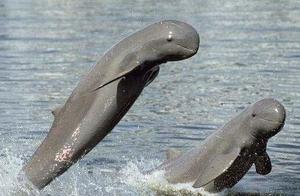
Sometimes while sitting on the old course riverbank, you will be interrupted by the strange breathing sounds on the water surface. Your eyes will be firmly attracted by the powerful exhalation sound: it turns out to be several Yangtze River Dolphins playing in the water...
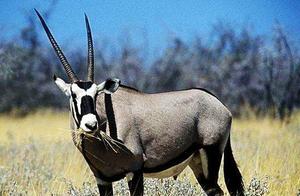
In the dense grasslands, you are admiring the scenery with focus. Suddenly, a large animal emerges from the bushes, with huge antlers standing upright in the wind. The Elk, native to China and disappeared from China, is once again living freely on this land that once belonged to them.
Paying attention to the Yangtze River Old Course and protecting the Yangtze River Old Course is of great importance in the current Yangtze River basin large-scale protection situation.