Common Marine Animals – Green Turtles
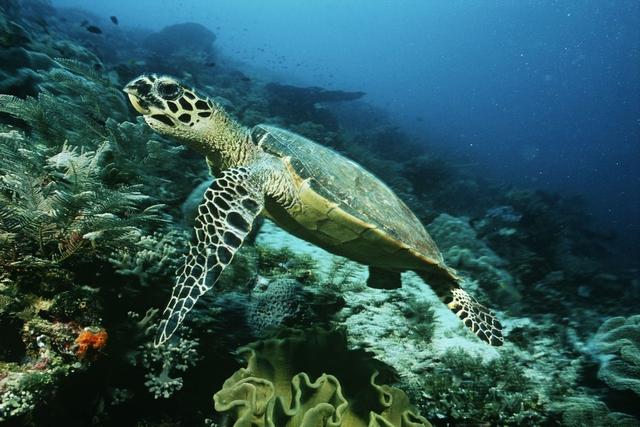
The green turtle (scientific name: Chelonia mydas) belongs to the order Testudines, the family Cheloniidae, and the genus Chelonia. It is widely distributed in the Atlantic Ocean, the Pacific Ocean, and the Indian Ocean. Green turtles in China are distributed from the north in Shandong to the near-shore area of the South China Sea in the south. They can grow up to more than 1 meter long, with a maximum lifespan of around 150 years. It has a pair of scutes on the top of its head. Its limbs are like paddles, with the front limbs longer than the rear limbs, and each has a claw on the inner side. The head, neck, and limbs cannot retract into the shell. It mainly feeds on seaweed. It lives in the Atlantic, Pacific, and Indian Oceans, and goes ashore to lay eggs, hatching young turtles. It is a national second-level protected animal. Turtles adapt to life in the water, with their limbs transformed into fin-like shapes, facilitating swimming. Generally, they only leave the water to go ashore during the breeding season. Female turtles crawl onto the shore and dig nests with sand, typically for 3-4 hours. After laying eggs, the female turtles crawl back to sea to cover the eggs with sand before returning to the sea.
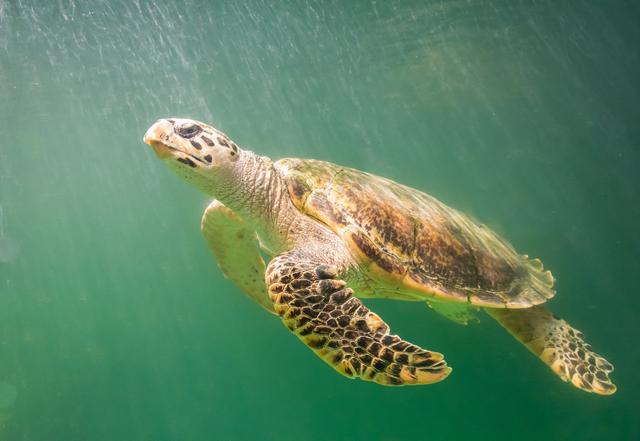
Male carapace can reach 840mm, and female 460mm. The snout is short and round, the anterior edge of the upper jaw does not form a hooked curve, and the inner surface of its horny inner edge has two vertical scute ridges; the lower jaw is slightly curved upwards, the jaw edge has strong teeth, and the chewing surface has a mid-ridge formed by short sharp teeth connected. The carapace has a symmetrical large scute, the scute is laid flat and embedded in an arrangement, the neck shield is short and wide, and is adjacent to the adjacent edge shield, the fifth shield is fan-shaped, the second to fourth shields are hexagonal, and the fifth shield is trapezoidal; the rib shield has 4 pairs, the first pair of rib shields does not connect with the neck shield, each side has 11 adjacent shields, the forelimb claws of the male are strong and curved into hooks. The tail is short, the male tail is long, the SMNH8180032 specimen tail reaches 310mm, which is 1/3 of its carapace length.
During its life, the carapace is olive green or brown, with yellow and white radial patterns. The carapace is yellow. The head and limbs are brown-brown. SMNH785007 specimen, a freshly hatched baby turtle, the carapace is brown-black, with 3 ridges, the spinal ridge is obvious, its color is lighter, the lateral ridge is weaker; the carapace is yellow-white, and has a prominent longitudinal ridge on both sides, the umbilical hole is located between the shield and the shank, and is at the central part. It lives its entire life in the ocean, feeding on fish, cephalopod mollusks, crustaceans and seaweed. 4-10 months are the breeding season, male and female green turtles often mate on reefs or along the coast. The mating time is 3-4 hours. After mating, the female turtles crawl onto the shore and dig nests with sand, typically for 3-4 hours.
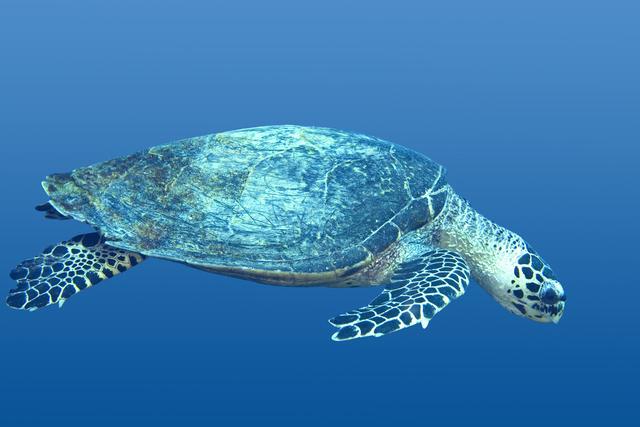
The female turtles can lay 23 times a year, with 91-157 eggs per time, often up to 238 eggs. The eggs are white, spherical, the egg shell is leathery and resilient, and the egg diameter is 35-58mm. The incubation period is 30-90 days, usually 45-60 days, the young turtle immediately crawls out of the shell and returns to live in the sea. The coastlines of Guangdong, Hainan, and the West Island in China are green turtle breeding and nesting grounds.