Ivory-billed Sea Eagle Soars in Bohsan Qinghua Sea, a Rare Species Listed as Endangered
On March 14th, an ivory-billed sea eagle appeared in the Bohsan Qinghua Sea National Wetland Park. The ivory-billed sea eagle is a national level key protected wild animal, and a species listed as endangered by the World Conservation Union (IUCN). It is very rare in China. It is a new record for Boishan.
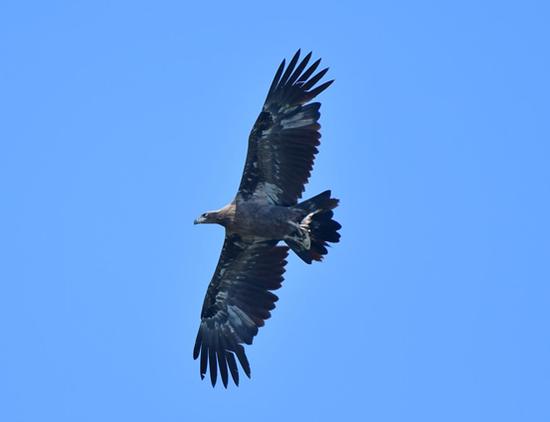
Ivory-billed sea eagle caught a fish / Cai Qingbiao / Photo
The ivory-billed sea eagle (scientific name Haliaeetus leucoryphus, English name: Pallas's Fish Eagle). It belongs to large predatory birds, with a total length of about 0.9 meters, and the wingspan can reach 2 meters in the air. The head and neck are yellow, the neck feathers are long and spear-shaped, the upper back is brown, and the upper body is dark brown. The tail is wedge-shaped and has a white transverse band on the underside, which is about 10 cm wide, and is its main feature, and thus named. The iris is pale gray to yellow, the mouth is gray or lead-colored, the feet and toes are pale yellow or gray, and the claws are black. The female bird resembles the male bird in plumage, but is slightly larger in size. The breeding season is from November to March of the following year, and it breeds in western and central Xinjiang, Qinghai, Gansu, Northeast Inner Mongolia (Hulun Lake), Heilongjiang and southern Tibet, etc.
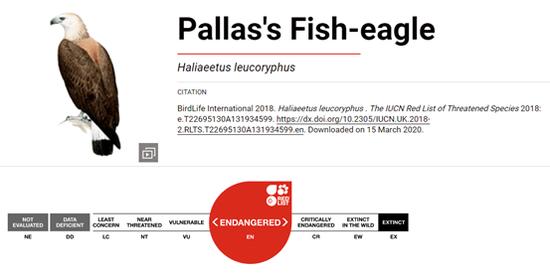
The ivory-billed sea eagle is a globally endangered species
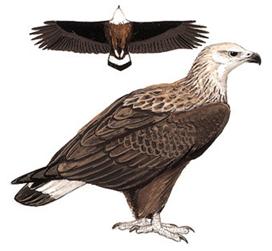
Source: China Bird Field Guide
Historically, the ivory-billed sea eagle had a wide distribution globally, from South Asia to the Middle East, from China to Russia, and the vast Central Asian hinterland, from low altitudes to over 5000 meters above sea level, wherever there are large bodies of water, the ivory-billed sea eagle's presence can be found. However, since the 1960s, the population has declined sharply, and it has been listed as a globally endangered species by the World Conservation Union (IUCN) (Collar et al., 2017). According to the population survey in 2018, the global number is 1000-2499, but this number may be even lower now.
The ivory-billed sea eagle mainly inhabits open areas with lakes, rivers and ponds, and its habitats are found in both plains and highland lake areas. It feeds on fish and waterfowl by the lakeside, and on the grasslands and deserts, it mainly feeds on rodents such as marmots and rabbits. It often stands for a long time on tall trees, motionless observing the activity of the prey, and immediately strikes as soon as there is an opportunity. It is also very patient, sometimes motionless for 1-2 hours. The sound when it takes off is very small, so its hunting success rate is very high.
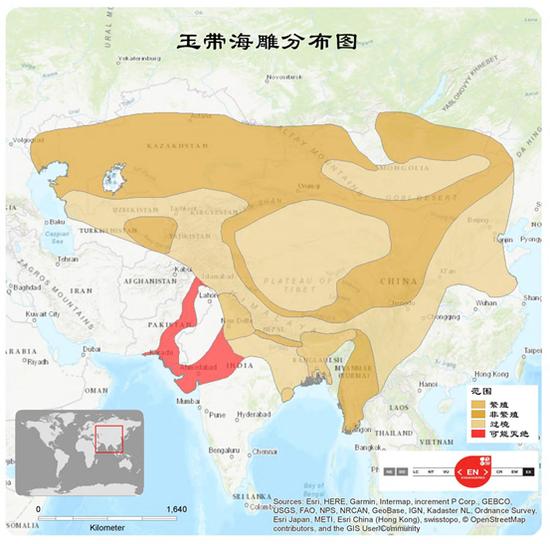
Distribution of the ivory-billed sea eagle
The ivory-billed sea eagle mainly inhabits open areas with lakes, rivers and ponds, and its habitats are found in both plains and highland lake areas. It feeds on fish and waterfowl by the lakeside, and on the grasslands and deserts, it mainly feeds on rodents such as marmots and rabbits. It often stands for a long time on tall trees, motionless observing the activity of the prey, and immediately strikes as soon as there is an opportunity. It is also very patient, sometimes motionless for 1-2 hours. The sound when it takes off is very small, so its hunting success rate is very high.
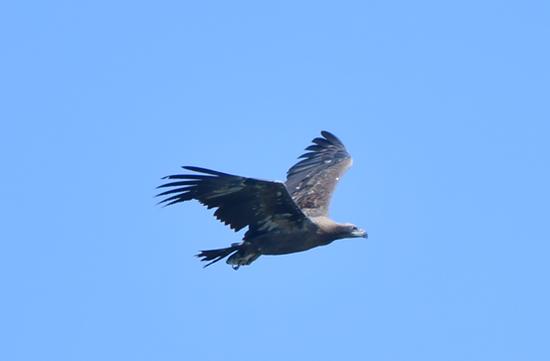
With the increasing popularity of bird watching, more and more people have joined the ranks of protecting wetlands and approaching nature. More and more bird watchers and photographers are recording the beauty of the ecosystem with their lenses and telling the ecological stories of Qinghua Sea through images. At the same time, many species' new records are discovered by them. Their lenses are not only the 'windows' for recording the beauty of the ecosystem, but also the 'weapons' for supervising various destructive behaviors of wildlife and plants resources.
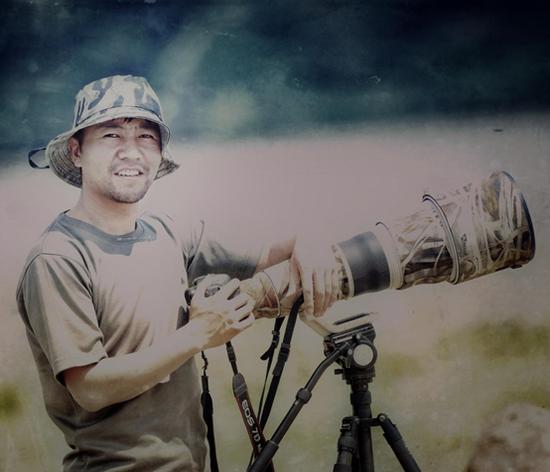
Bird watcher Cai Qingbiao is a wildlife photographer
The fate of the ivory-billed sea eagle is closely linked to the fate of the wetlands. Large-scale habitat loss, degradation and human interference have led to the continuous decline of the ivory-billed sea eagle's population globally. We still know very little about it. (Qinghua Sea National Wetland Park)