Dongting Lake Spring Waterbird Migration Survey Reveals Nearly 9000 Additional Endangered Species
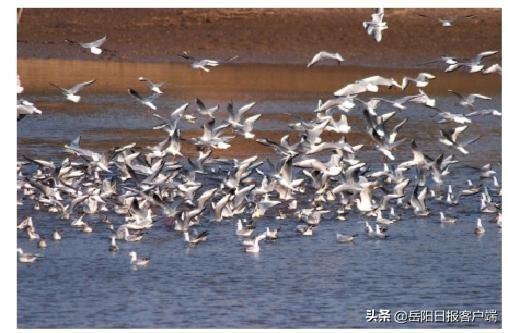
Guiyang Daily All-Media News (Reporter Hao Jiayong)In the spring of Yangchun, with the singing of warblers and the blooming of grasses, the banks of Dongting Lake are already adorned with peach blossoms and willows, and the migratory birds that come to spend the winter have entered their migratory season. Walking along the Dongting Lake dike at this time, you can appreciate a different kind of bird from winter: the vast Dongting Lake stretches for miles, with huge flocks of waterbirds in the wetlands, leisurely and content when at rest, and soaring and graceful when taking flight.
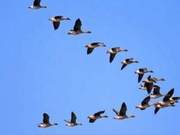
Yao Yi, the chief engineer of the Hunan Dongting Lake National Nature Reserve Administration, introduced that at this time, the overwintering waterbirds have already gathered in flocks, preparing to leave Dongting Lake wetlands and migrate to the Yellow River basin and northwards to breeding grounds in summer. Some migratory birds have already begun to fly south, and seeing large flocks of birds soaring in the sky is a harbinger of their final formation adjustments.
According to tradition, the bureau conducts synchronized surveys of migratory birds in Dongting Lake every March to comprehensively understand the wintering waterfowl population and quantity in the Dongting Lake area, master the dynamic changes in bird species and habitats, and accumulate basic monitoring data brought by climate and environmental changes in the Dongting Lake wetlands, for the purpose of providing a foundation.
From March 16th to 17th this year, the Hunan Dongting Lake National Nature Reserve Administration, the West Dongting National Nature Reserve Administration, and the Hengling Lake Provincial Nature Reserve Administration formed 9 survey teams, dispatched to the East Dongting Lake, West Dongting Lake, South Dongting Lake and Hengling Lake areas, to carry out spring migratory waterbird surveys around the Dongting Lake.
This synchronized survey monitored 7 orders and 12 families of overwintering waterbirds, totaling 115942 individuals, of which 38 species accounted for 97634 individuals in the East Dongting Lake, accounting for 84.21%, 17 species accounted for 9759 individuals in the West Dongting Lake, 19 species accounted for 1067 individuals in the South Dongting Lake, and 20 species accounted for 7482 individuals in the Hengling Lake. The survey also monitored 2 black storks, which are a national-level protected bird species; 1361 white spoonbills, 1193 little grebes, 139 gray cranes, and 2 white-faced ducks, all of which are national-level protected bird species. The birds residing in Dongting Lake are mainly from the order Anseriformes and the family Anatidae. The survey observed 98196 individuals, accounting for 84.7% of the total number, with green-winged teal, black-winged duck, and white-faced duck being particularly numerous, reaching 33223, 21369 and 15916 individuals respectively.
It is noteworthy that as a flagship species of Dongting Lake and an international endangered species, the white-faced duck's survey population has exceeded thousands of individuals in winter, and has once again exceeded the number in January, this time exceeding 10779 individuals. The data shows that in 2019, the wintering waterbird survey only monitored 3643 white-faced ducks, and this time's survey monitored 12428 individuals. Yao Yi believes that the continuous two-year increase in the number of white-faced ducks in March compared to January indicates that Dongting Lake is still a truly 'the most important wintering ground for global white-faced ducks', and also suggests that the protection area's waterbird synchronization survey methods and techniques need further improvement.
Content Source: Guiyang Daily Client
Copyright belongs to the original author, respect the original.