Little Head Dolphin
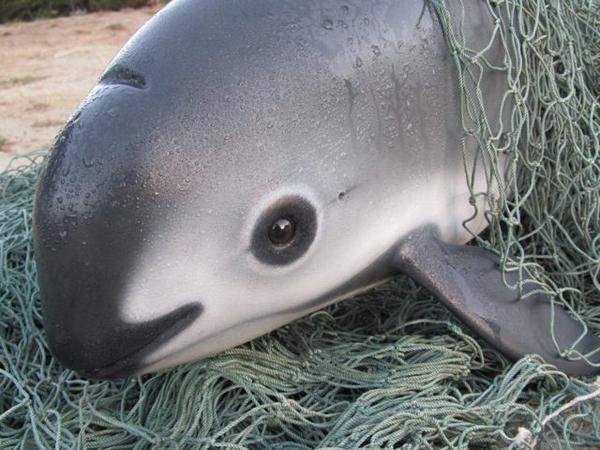
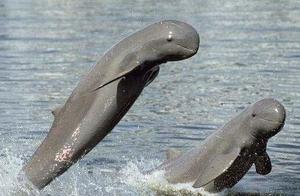
The vaquita (Phocoena sinus) is the smallest cetacean, with a stout build. Its dorsal fin is prominent, resembling a shark fin. The head is rounded and nearly beakless, with dark circles around the eyes. The body exhibits a complex and subdued gray pattern, appearing olive-brown or tan in some lights. Observers typically describe this impression as 'dark'. Due to its extremely narrow distribution range, it is unlikely to be confused with other species; however, it is rarely observed in the wild.
The vaquita is often referred to as 'Cochito', but this name can be confusing as local fishermen frequently use it to refer to all small cetaceans. The vaquita is shy and retiring, and once sighted, it rarely reappears. It can only be seen after being entangled in nets and hauled ashore.
The vaquita is endemic to the northern California Current, and its population is estimated to be less than 300 individuals, with a high probability that it will disappear by 2018. Its limited habitat range, combined with its susceptibility to entanglement in fishing gear, are the primary causes of its endangerment.
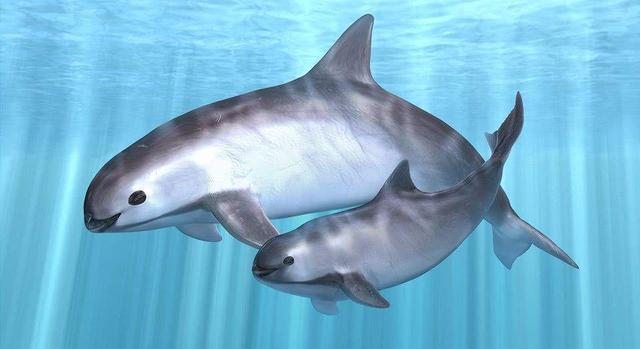
As adults, the mouth is surrounded by black. The eyes are encircled by dark circles. Dark stripes extend from the chin to the chest flipper (with individual variation). A small and broad chest flipper is located on the lighter part of the body. The dorsal fin has a small protrusion at its front edge (presenting as white spots when developing). The dorsal fin appears taller than other porpoises in proportion. The dorsal color ranges from mid-gray to dark gray; the ventral side is gray-white, with two 'V'-shaped light areas pointing towards the tail. The color on the tail stock is darker than the ventral side. The tail fluke is slightly tapered, with a prominent central notch.
Young vaquitas have a body pattern similar to adults, but with darker colors. The dorsal fin has white spots at its front edge. The body size is similar to adults.
Each side of the upper and lower jaws has a single-pointed tooth.
Adult average length: males 134.9 cm, females 140.6 cm. Adult weight 30–55 kg. Newborn calves are 0.6–0.7 m long.

It inhabits depths of 11–50 m, 11–25 km offshore, over bottoms of mud and clay. It particularly favors high-nutrient, silty waters. It is the only cetacean living in warm-water areas, able to adapt to relatively large annual temperature fluctuations, with a preferred water temperature of 14–36°C (California Current temperature range).
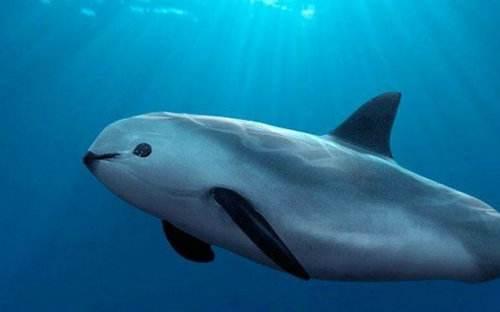
Wild observations are rare. The vaquita swims and feeds with a calm and deliberate manner, but is very shy and avoids any vessels. It rises to the surface to breathe, rotating slowly and rapidly into the water and then disappearing from the surface. The small tail fluke remains in the water while diving. Jets are not prominent, but a large, sharp respiratory sound, similar to that of the harbor porpoise, is emitted. It has never been observed breaching or jumping.
It typically forms groups of 1–3, or sometimes 8–10 small groups. Lone dwelling is its primary mode of living. Like other porpoises, the vaquita uses echolocation for communication and navigation.
It feeds on near-surface bony fish and squid.
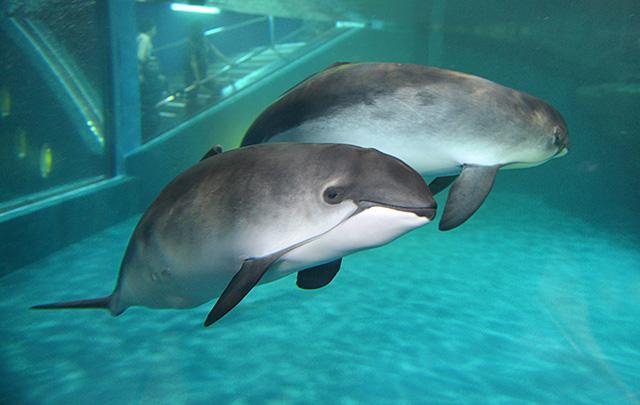
It reaches sexual maturity at approximately 3–6 years of age, or by weight (Hohn et al. 1996). The vaquita is a seasonally breeding species. The breeding season is from mid-June to July. The gestation period is about 10.6 months, with births occurring in March of the following year. Females cannot ovulate every year, therefore cannot give birth every year (Hohn et al. 1996). Each litter produces one calf, and the nursing period is less than one year. The maximum lifespan is 21 years.