Red Jynx (Loxia curvirostra): A Bird for Appreciation and Identification
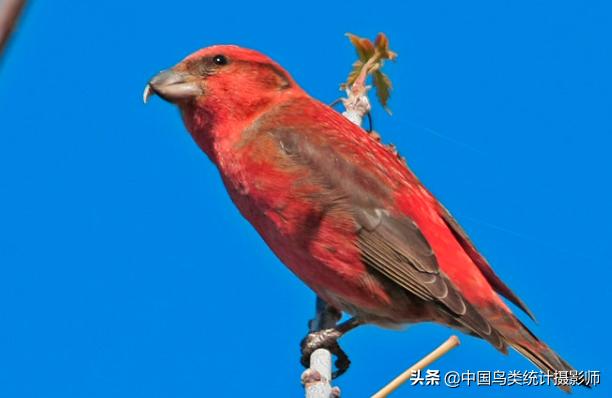
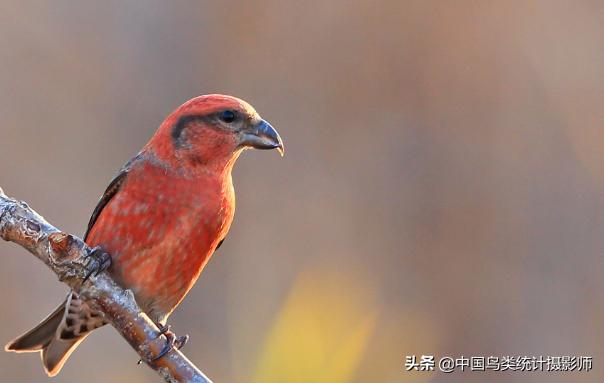
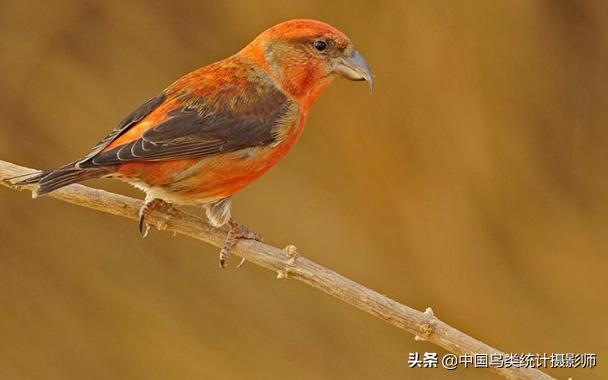
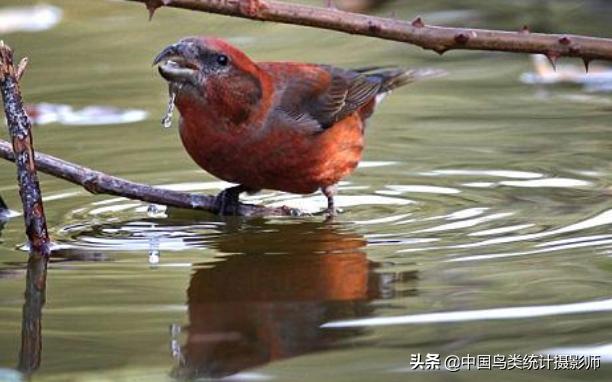
Red Jynx (scientific name: Loxia curvirostra): Weight 28-48g, body length 145-175mm. The male Red Jynx has a red forehead, crown and nape from the back, with gray-brown or yellowish-green spots on the base of the feathers, which are often partially exposed, making the forehead and crown with some gray-brown or yellowish-green spots. The eyes, around the eyes, and ear coverts are dark brown or dark reddish-brown, with a reddish-brown spot on the ear coverts anterior to the eyes. The back, shoulder, neck side are gray-brown, with reddish-brown sometimes contaminated with olive-brown, the waist and tail coverts are bright red, the long tail coverts are black-brown, the tail is also black-brown with red-brown feather tips, the terminal tail coverts are concave-shaped. The wing coverts are dark brown with broad light reddish-brown edges, the flight feathers are black-brown with yellow-brown or brown-red feather edges, the throat, breast, upper abdomen and flanks are red, the throat is lighter, almost white, the two flanks are contaminated with yellow-brown, the lower abdomen and cloaca are grayish-white, the axillary feathers have light reddish-brown feather edges. The female is grayish-brown on top, with darker centers in the feathers, with yellow-green tips, especially the head has a bright yellow-green tip, the waist is bright yellow-green and wide, often covering the underlying gray-brown, making the waist bright yellow-green and without markings, the tail coverts and tail coverts are black-brown, the tail coverts are gray-white or white, the iris is dark brown or black, the beak tip is black-brown or horn-brown, the beak edge is yellow-brown, the feet are black-brown with a touch of red.
Distributed in Northeast China's Small Xing'an Mountains, Qiqihar, Grass River Mouth, Efeng, Hebei Northeast, Shandong Qingdao and Yantai, Henan, Shaanxi South, Jiangsu Shawei Island and Zhenjiang hilly areas, etc. It overwinters in Shaanxi South, Henan, Shandong and Jiangsu. It breeds in the northwestern part of Xinjiang, Tian Shan, and overwinters in western Xinjiang, Qinghai, Liaoning and Hebei. It breeds in the south and east of Tibet, northwestern Yunnan, western Sichuan, western Gansu and southern Qinghai. The designated subspecies have individual birds in Qinghai (Xining) with wintering records.
It inhabits coniferous forests and coniferous-broadleaf mixed forests with coniferous forests. In Northeast China, North China and Shaanxi North and East regions, it is at an altitude of 1100-1800 meters; in the west and southwest regions, it is at an altitude of 2000-4000 meters, up to about 5000 meters high coniferous forests. In winter, it descends to the foot of the mountain and flat lands, also enters coniferous and deciduous forests, and also enters forest edges, small quicklime jungles and artificial coniferous forests. In winter, it wanders and some birds migrate in flocks, the flock gradually becomes small, starting to act in pairs, and the female and male birds look for nests together. The nest is located on the side branches of a tall pine and fir mixed forest with cedar, at a height of more than 20 meters from the ground. The nest is bowl-shaped, woven from cedar and fir twigs and moss, lichen, etc. There are 3-5 eggs in a nest, with shell colors that are grayish-white and have light green markings with purple-gray base spots and reddish-brown and black spots. The female incubates the eggs. The male feeds the female during incubation. The incubation period is 17 days. Both parents feed the chicks with pine seeds, leaving the nest 14-18 days later. In autumn, the young birds stay with the old birds together, forming flocks and migrating south.
5-8203-51714-18