Biodiversity Encyclopedia: Crowned Hornbill (Ceratopsican Hornbill - A ‘Face Value’ Representative of the Hornbill Family)
Today, I'm going to introduce you toSpine animals· Crowned Hornbill.
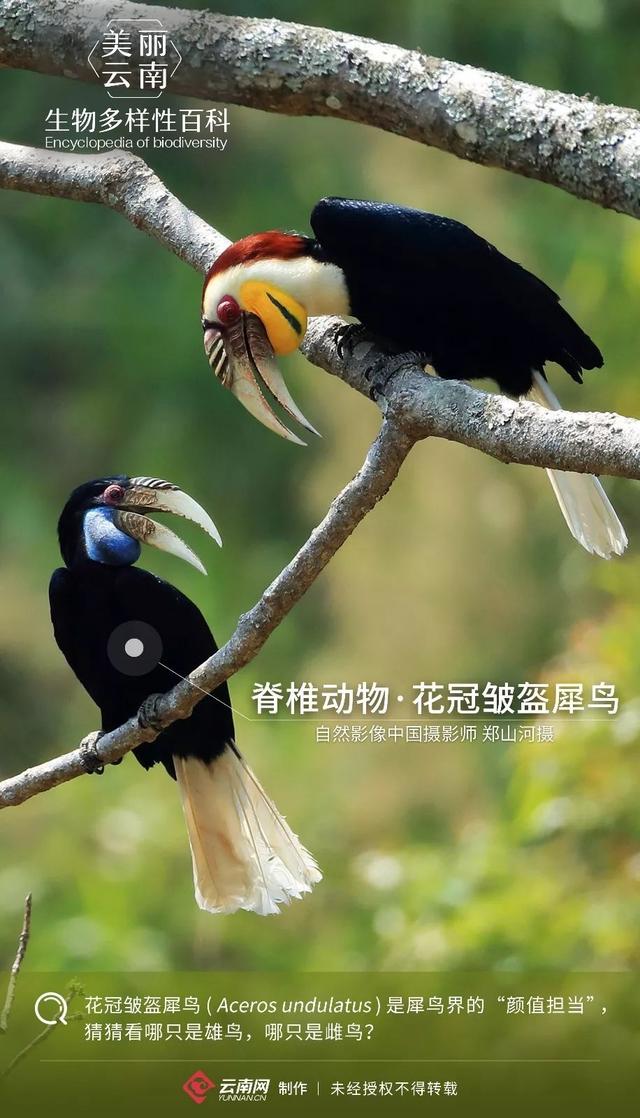
Crowned Hornbill
Aceros undulatus
Vertebrates, Class Aves, Strigiformes order, Bucerotidae family, National Level II Key Wild Animals. They live in subtropical evergreen broadleaf forests at an altitude of 400-1000 meters, mainly feed on wild fruits, but also eat frogs, lizards and other animals. Photo taken in Yingjiang, Dehong
The Crowned Hornbill is a 'face value' hornbill among hornbills. They have a flat helmet-like projection at the base of their upper beak, with several ridges and folds rising up, forming a 'wrinkled helmet', so they are named 'Crowned Hornbill'. This projection can also help enhance the decibels of their calls, making the sound travel farther. This is why most hornbills make very noisy sounds, and the calls of the Crowned Hornbill are particularly loud, resembling dog barks. The roaring sound they emit when flying can make people mistakenly think that there are bombers flying over their heads.
Moreover, Crowned Hornbills are very easy to distinguish between males and females. Mature male birds have a bright yellow throat pouch, while female birds are dark blue. In addition, mature male birds have chestnut-red on their forehead, top of head and nape, and their tail feathers are all white, while mature female birds (excluding their tail feathers, which are white) are all black.
Spring is the breeding season for Crowned Hornbills. After the male and female hornbills fall in love, they will build nests on tall trees. They generally find their own 'home' from the previous year, take out the contents, and then tidy up the entrance hole, and finally the female enters 'home' to incubate the eggs. The male carries mud to seal the entrance hole with a small hole.
The main distribution in China is in Yunnan, and in recent years, it can be observed in the Yingjiang area, with extremely rare numbers.
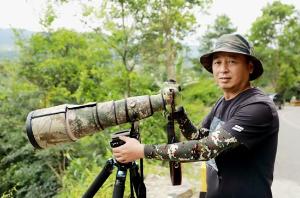
Zheng Shanhe, Teacher of Yunnan Province Dehong Ethnic Minority Junior Middle School, Natural Image Chinese Photographer, Member of the Ecological Image Culture Professional Committee of the China Wildlife Protection Association, the largest population discoverer of Philippine Leaf Monkeys.