Why Do Swans Migrate North and Return in 3 Days?
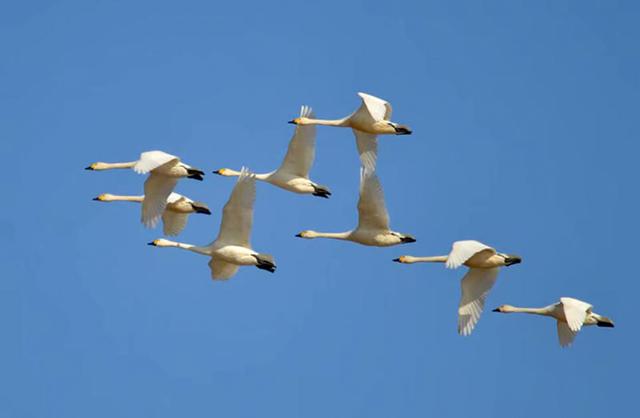
The swan is a typical migratory bird, to be precise, it is a winter migratory bird. They fly north in the spring to breed there. As autumn and winter approach, the young birds grow up, and the northern weather becomes colder, so the swans migrate south to warmer regions to spend the winter.
Located on the easternmost part of Shandong Peninsula in Weihai, Rongcheng's Bashahuo Lake is one of the places where white swans spend the winter. Bashahuo Lake covers an area of more than 1000 acres, and it has a good ecological environment, attracting many swans to come here to spend the winter.

As the temperature continues to rise, now is the time when swans start to migrate north. Compared with previous years, this year the swans' migration time has advanced by a week. The migration time of swans is mainly based on climate and temperature. The early migration of swans means that the temperature is slightly higher than that of the same time in previous years.
This is not an anomaly in this year's swan migration. After leaving Rongcheng, the swans fly north and they can fly about 300 kilometers in half a day, crossing the Bohai Sea to reach Dalian in Liaoning. Normally, swans will stay there for several days before continuing to migrate north to their breeding grounds.

However, according to the GPS tracking tags on the swans, experts discovered on March 3 that one swan stayed in Dalian for less than a day before returning south again and flying back to Rongcheng. At the same time, other swans also returned to their starting point. Over three days, these swans flew 600 kilometers and returned to the same point.
Experts said that the phenomenon of swans migrating north and quickly returning is the first time that has been monitored, and there has never been such a case before.
So, why didn't these swans continue to migrate north, but returned again?

Swans choose to start migrating when the climate and temperature become suitable, because only when the north gets warmer and the earth revives, swans can find food and there they can breed and multiply. When the swans fly to Dalian, they may feel that the temperature is slightly lower than usual, so they don't migrate north immediately, and instead choose to return to their wintering habitat.
The temperature in Liaoning in early March was not high, and some places even had snow. Swans are sensitive to temperature changes, so they didn't migrate north rashly, but chose to fly back to their wintering habitat.
Furthermore, previous studies have shown that birds' navigation may rely on the Earth's magnetic field. When pigeons are equipped with a piece of artificial magnet, they will lose their ability to distinguish direction and cannot fly in the correct direction.

Scientists discovered that the north and south poles of the Earth have flipped many times in the distant past. The outer layer of the Earth's core is liquid, and the inner layer is solid, while the mantle and crust above the core are solid, which leads to the difference in rotation between the core and the mantle and crust, thus causing the Earth's magnetic field to shift its north and south poles, and eventually reverse. If the swans find that the magnetic field has changed, it may also cause them to return.

Currently, the global temperature is still rising, which not only brings unprecedented high temperatures, for example, in 2019, the northern summer was the hottest in the past few centuries with temperature records, and this year in February, the highest temperature recorded in Antarctica exceeded 20 degrees Celsius. Besides the rising temperature, global warming will also cause climate anomalies, which will lead to a series of problems, such as the locust plagues that raged in East Africa and Asia this year were caused by the El Niño phenomenon in the Indian Ocean.