Common Insects – Bean Girl
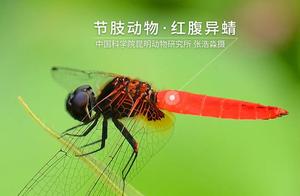
Caenagrion belongs to the Insect class, Order Dragonfly, Suborder Forewings, commonly known as 'cōng'. The body is small and stout, resting with wings folded above the back. It is a slender and fragile flying insect, similar to a small dragonfly, but not a dragonfly. This type of primitive insect is found in more than 650 species in China, accounting for about ten percent of the total dragonfly species in the world.
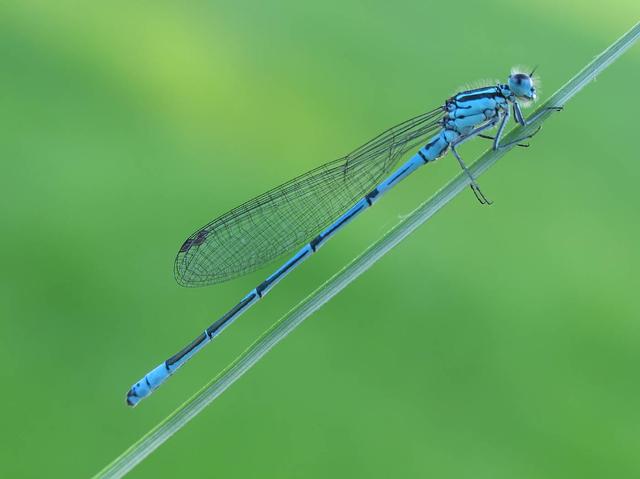
Caenagrion is a brightly colored carnivorous insect. The body of the Caenagrion is slender, with well-developed compound eyes located on the sides of the head, chewing mouthparts, hairy antennae, similar forewings and hindwings, with a square middle chamber in the wings, the wings have a wing stem, belonging to the dragonfly order, unlike the dragonfly, the Caenagrion rests with its wings folded together and extended upwards on its back, and the four wings of the Caenagrion are almost the same size, while the two hind wings of the dragonfly are slightly longer and wider than the two forewings. The body is mostly smaller than that of a dragonfly, the smallest Caenagrion has a body length of 1.5cm, and the largest one can reach 6-7cm. Because of the beautiful appearance, bright colors, and variable wing colors of Caenagrion, it is favored by many enthusiasts at home and abroad.
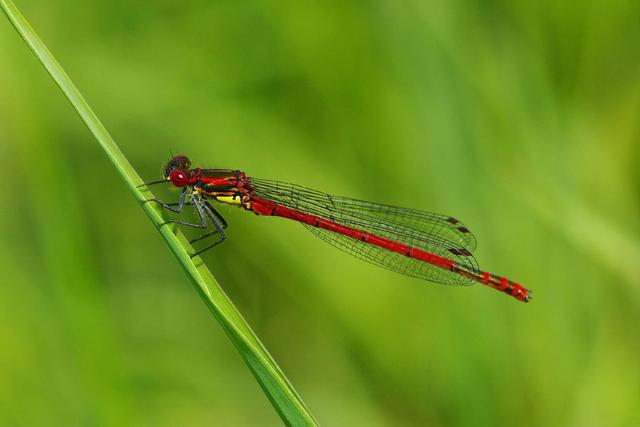
Caenagrion is similar in appearance to the dragonfly, it is important not to confuse them.
1. The distance between the eyes: the compound eyes of the dragonfly are mostly connected or only separated by a small distance; the two eyes of the Caenagrion are separated by a considerable distance, in the shape of a dumbbell.
2. The shape of the wings: dragonflies belonging to the dragonfly order, their forewings and hindwings are different in shape and size, with significant differences; Caenagrion belonging to the suborder Forewings, its forewings and hindwings are approximately the same in size and shape, with minimal difference.
3. The shape of the abdomen: the abdomen of the dragonfly is relatively flat and thick; the abdomen of the Caenagrion is slender and rod-shaped.
4. Resting method: dragonflies rest with their wings flat on either side of the body; the Caenagrion rests with its wings folded together and extended upwards on its back.
5. Thorax: the muscles of the thorax of the dragonfly are developed and strong, wide and broad, while the Caenagrion is narrow.
6. Flying ability: the flying ability of the dragonfly is strong, while the flying ability of the Caenagrion is weak.
7. The larvae of the Caenagrion and the dragonfly also have differences in appearance outside. The larvae of the dragonfly are relatively thick and short, the width of the head is usually smaller than the thorax and abdomen, the end of the abdomen is wrapped around the anus with 3 short and sharp, hard projections, without external gills, with special intestinal gills.
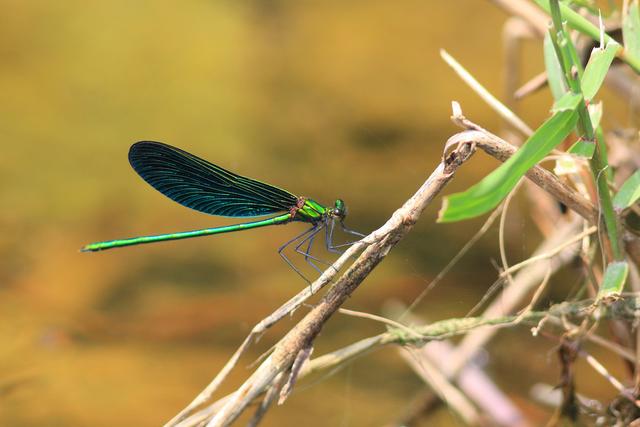
Habitat
The adult Caenagrion usually prefers to activity, forage, mate and lay eggs near the habitat of the larvae.
Because of the differences in species, Caenagrion has some habits in flowing water and some in still water. It is found in flowing streams, mountain gullies, fields, or still water ponds, lakes, swamps, waterholes, and water fields. Some like to inhabit turbulent river streams, the smaller ones prefer to inhabit clear water basins. It often actively operates on the edges of grassy ditches, and there are traces in many places where this is covered. It can be found in Dar es Salaam, Tanzania, which shows that it does not grow solely in temperate climate zones.
Diet
The body of the adult Caenagrion looks very fragile and weak, but the Caenagrion is a carnivorous insect. It specializes in hunting small flying insects, but because of its small size and slow flight speed, the Caenagrion mainly feeds on tiny mosquitoes, flies and aphids, mites, leaf beetles, and flying ants… etc. Occasionally, the Caenagrion also captures small Caenagrion. It is a lucky thing to see an hungry Caenagrion trying to capture another Caenagrion.
Growth process
Egg
The Caenagrion's eggs are usually laid in the water, because most female insects are used to rest on stone blocks, debris, and even some Caenagrion lays eggs in the stem of aquatic plants. The incubation period is similar to that of the dragonfly.
Larval stage (commonly known as water snail)
The larval stage of the Caenagrion is similar to that of the dragonfly. The Caenagrion grows in the water, its body is laterally flattened and elongated, with a leaf-shaped tail appendage, with respiratory and movement functions. Hidden in water plants or rock crevices. It feeds on small aquatic animals. To identify the Caenagrion larvae, its most obvious feature is the modified lower lip into a trapping device, which is similar to the face of a beggar, so in the countryside it is often called 'water beggar'. In fact, it is similar to the dragonfly larvae in appearance, the main difference is that the dragonfly larvae have thick bodies and no tail gills at the end of the abdomen, they breathe with intestinal gills; the Caenagrion larvae have slender bodies and three-lobed tail gills at the end of the abdomen.
Larval habits The larvae of the Caenagrion and the dragonfly are both called 'water snails', but the two types of water snails are easily distinguished in appearance, because most Caenagrion water snails have three obvious leaf-shaped or fleshy tail gills on their tails, which can be used to swim and escape from enemies. After hatching, the Caenagrion larvae in the water hunt other weak aquatic creatures or planktonic small invertebrates for survival.
Adults
The adult Caenagrion often activities in water areas, mountain streams, or lakeshores. The adults mostly activity in areas with water and plants, and they have weak flying ability.
Reproduction
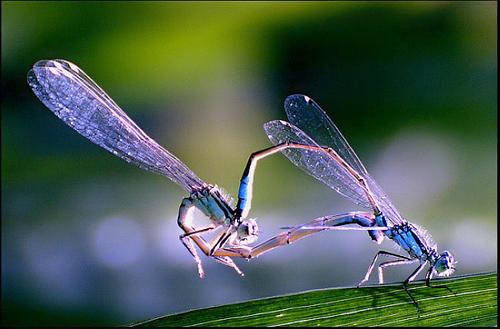
When you see 'Caenagrion points water', it's because the female Caenagrion and most dragonflies use the method of pointing water to lay eggs, generally laid in the water; some lay eggs in aquatic plants. Some use the ovipositor to inject eggs into the stem of submerged aquatic plants. Some use the ovipositor to inject eggs into submerged aquatic plants. Since the Caenagrion larvae live in the water, most female insects are used to rest on stone blocks, debris, and short-bodied ghost Caenagrion, like dragonflies, the male Caenagrion's reproductive organs are located in the male's abdomen, and the female Caenagrion's reproductive organs are located at the end of the female's tail, so when the female Caenagrion wants to reach the male Caenagrion's reproductive organs, she will bend her curved abdomen to the male Caenagrion's reproductive organs to facilitate mating.