Ugly Water Drop Fish
Blobfish, also known as the grumpy fish, Wharton's elasmobranch, or blobfish, is known as 'the saddest-looking fish in the world' because of its perpetually frowning expression. This deep-sea oddity has good reason to be glum: scientists warn that the blobfish is threatened with extinction due to deep-sea fishing operations. Blobfish live off the coasts of Australia and Tasmania, to depths of up to 1200 meters, it is rarely discovered by humans due to the difficulty of reaching its habitat.
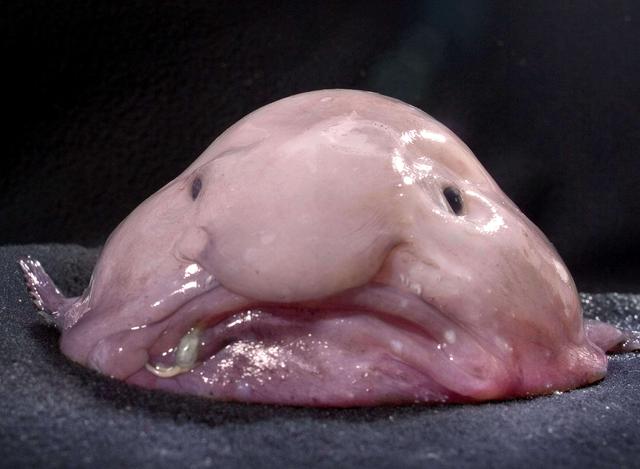
Blobfish live off the coasts of Australia and Tasmania 600~1200 meters underwater, the water pressure is tens of times higher than at sea level, it is difficult for humans to reach its habitat, so it is rarely discovered.
In the habitat of the Blobfish, swim bladders (which help fish maintain buoyancy) are difficult to work effectively. To maintain buoyancy, the Blobfish is made up of a gel-like substance that is slightly less dense than water, which helps it easily float from the seabed.
Lack of muscles is not a problem for the Blobfish, as it mainly feeds by swallowing edible substances in front of it.
The Blobfish's breeding is different, the female Blobfish lays eggs in shallower seas and then lies on top of the fish eggs without moving until the larvae hatch.
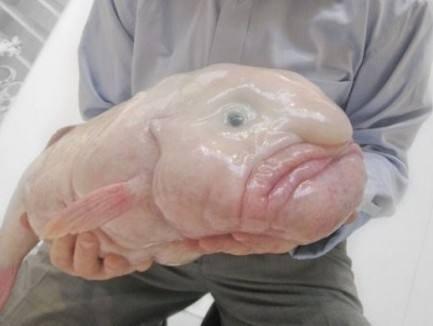
The Blobfish has a tadpole-like shape and a twisted, ugly face. It does not have a swim bladder, and uses gills to breathe. The body is gel-like, less dense than seawater. It can grow up to 12 inches (approximately 30.5 cm).
The speed of the Blobfish in the water also makes it difficult to escape when facing deep-sea fishing.
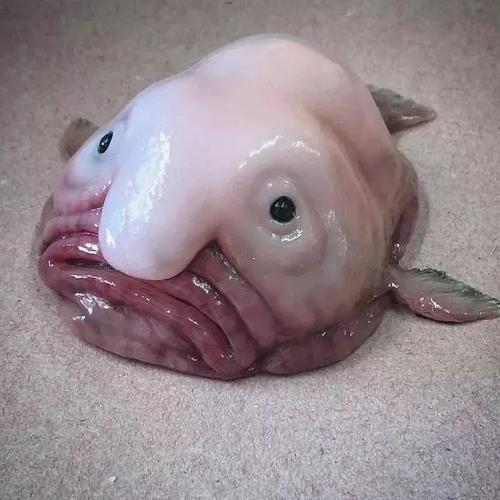
Scientists warn that the Blobfish is threatened with extinction due to deep-sea fishing operations. Because fishing activity has increased, the Blobfish is caught together with other fish. Although the Blobfish itself is not suitable for eating, it is also a victim because it lives in the same depth as more delicious marine animals (such as crabs and lobsters).
Professor Callum Roberts, a deep-sea issue expert at the University of York, said that the public should pay more attention to the fate of the Blobfish. Roberts is the author of 'The Unnatural History of the Sea'. He said: 'The Blobfish is very easy to be caught in these nets, from which we can see that this species is limited to these waters.'
Australia and New Zealand's deep-sea fishing vessels are among the most active fleets in the world, so even the Blobfish, the seabed is no longer its ideal habitat. Large areas of the deep sea are facing the threat of bottom trawling. Bottom trawling is the most destructive fishing method. Southern Oceans have also established certain deep-sea protected areas, but they are only protecting coral reefs not Blobfish. The deep sea up to 200 meters is also overfished, and fishing operations have begun to leave the continental shelf and move into the 2000-meter deep sea area.