Migratory Cranes Arrive in 'White Crane Hometown' of Shenyang Fagu, Presenting a Scene of Thousands of Birds Gathering
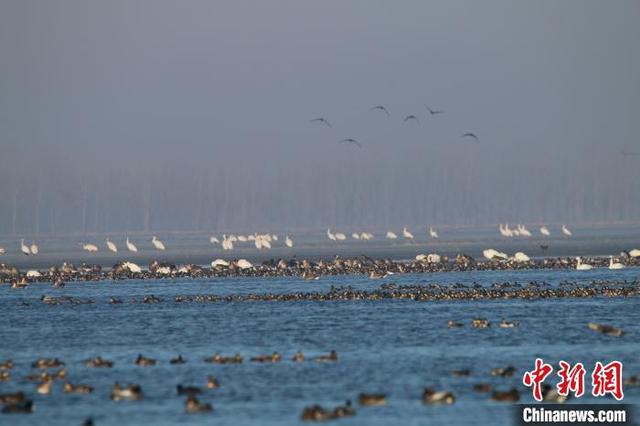
Crane flocks arrive in Fagu.
Xinhua News Agency, Shenyang, March 27th (Shen Diancheng) March 27th is 'World White Crane Day'. Reporter saw in Fagu Badzi Cave National Wetland Park, a large number of migratory birds have arrived in Fagu, the quiet water surface has become lively again after a winter, and Fagu officially entered the best bird-watching season.
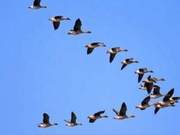
'Now Badzi Cave wetland has white cranes, swans, and various geese and ducks. This year, the peak period of white cranes reached more than 1500, the flocks of Mandarin ducks reached more than 60,000, and various geese reached about 50,000. This year, the number of migratory birds exceeded last year's double. Under the maintenance of the Fagu patrol team, almost all the birds were not disturbed.' Fagu County Badzi Cave National Wetland Park patrol team captain Zhang Haiqi introduced to reporters.
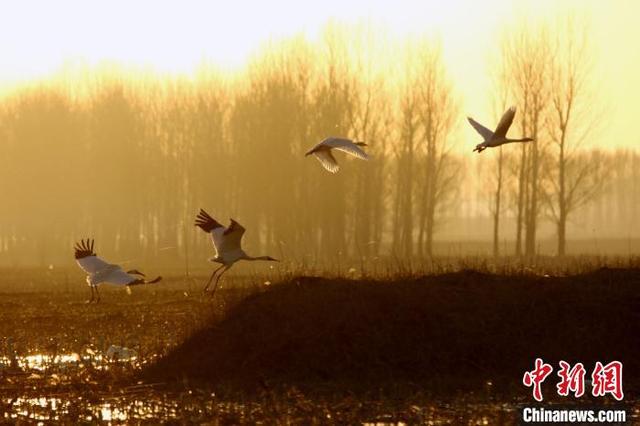 'Crane's Hometown' Shenyang Fagu.
 It is introduced that in Fagu County Badzi Cave National Wetland Park, since early this month, observation personnel have successively discovered the silhouettes of migratory birds, including Gadwall, Mandarin Duck, White Crane, Swan, and critically endangered species such as Hooded Crane. As a flagship species among many migratory birds, White Crane is listed as Critically Endangered by the World Wildlife Fund's International Red List of Birds, and it is also a Grade I key protected animal in China, with only about 3000 remaining. The white cranes that stopover at Badzi Cave National Wetland Park peak at more than 2000, accounting for 70% of the world's population, and stay for more than 90 days. This is how Fagu County earned its reputation as 'Crane's Hometown'.
Bird-watching season. Yu Shengdi, Chang Jiemin photographed.
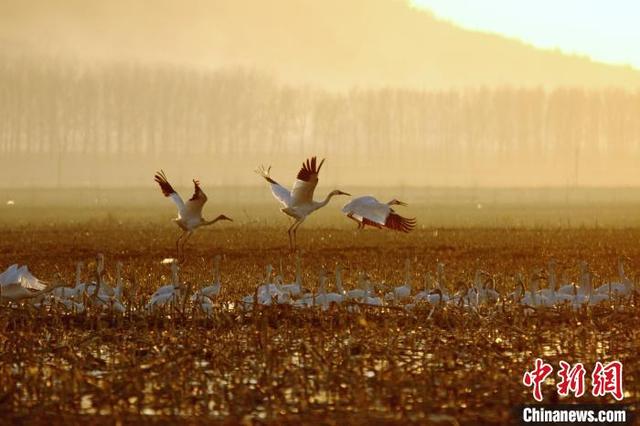 In recent years, Fagu County has strengthened the protection of migratory birds and other wild animals, and strengthened the monitoring and prevention and control of animal epidemics and diseases. It has promoted the publicity of crane protection knowledge from multiple angles, maintained the original ecological landscape of the wetland, and provided a good living environment for cranes and other birds to thrive.
 With the advancement of ecological protection and returning farmland to wetlands, the area of Badzi Cave wetland has reached a historical maximum, becoming an important stopover for migratory birds. Every spring and autumn, here will present a landscape of thousands of birds gathering and foraging.
'Their flight is like cloud obscuring the sun, when they land, they cannot be seen by the lake's edge grass', which is a wonder of the world. (Complete)