The Rare Bird – The Great Bustard Returns to Huaian, Filling a Gap in Anhui's Ecological Map
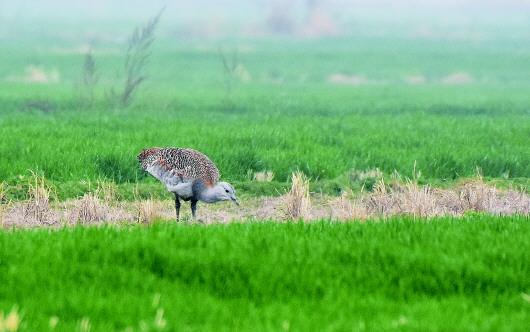
The Great Bustard mainly inhabits grasslands, meadows, and occasionally farms in search of food.
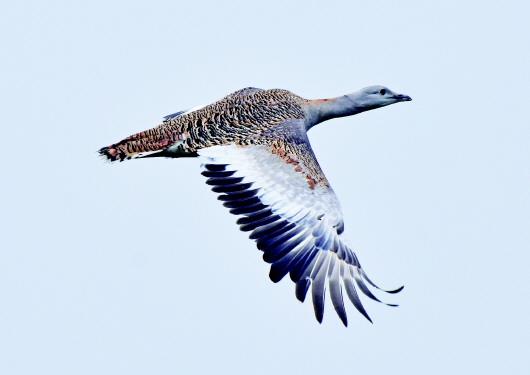
The adult Great Bustard has a wingspan of up to 2 meters.
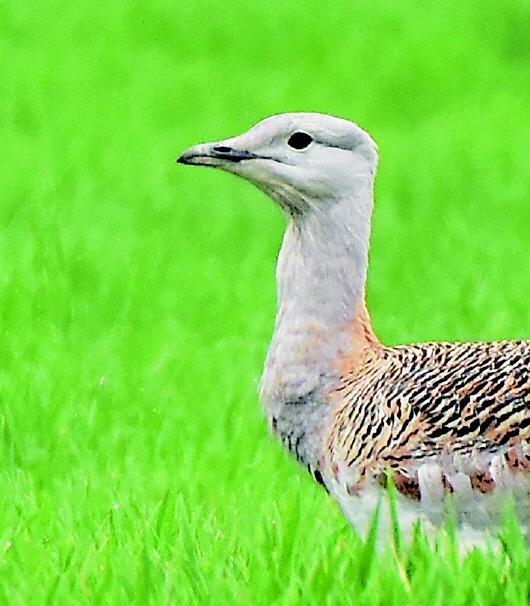
The Great Bustard has a stout neck and a head shape similar to that of an ostrich.
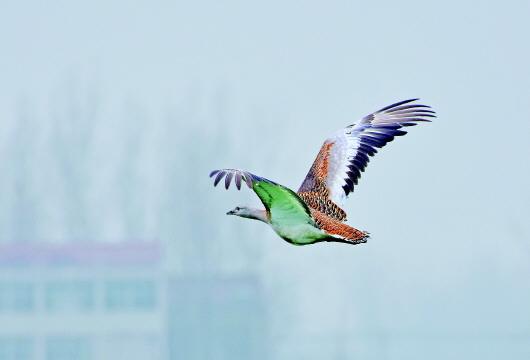
Although the Great Bustard weighs heavily, its flight posture is very.
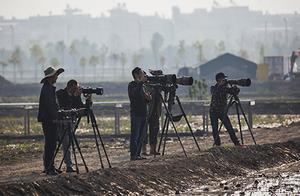
According to Huanhe Morning Post, on March 1st, a reporter photographed a bird foraging in a field in Huaian County, Shandong Province, after comparing it online, it was confirmed that it was a rare bird species, the Great Bustard, which had disappeared for many years and was a national key protected animal.
This Great Bustard is about 1.8 meters tall, with grey head and neck, and brown-yellow back feathers with black and white horizontal stripes. It is known that the Great Bustard belongs to the order Casuariiformes and the Bustard family, has two subspecies, and is a large ground-dwelling bird. The male has a body length exceeding 1 meter and a weight of over 10 kilograms, while the female is much smaller. The common subspecies breeds in northern grasslands, farms, and semi-arid areas, and winters in eastern China. According to Professor Zhou Lizhi, Dean of the College of Resource and Environmental Engineering, Anhui University, the Great Bustard is a national key protected animal. Due to habitat destruction and overhunting, the population of the Great Bustard has rapidly decreased, ranking as a rare species in China's Red Book of Endangered Animals.
There are reports that the number of Great Bustards in China is about 300, similar in rarity to the Giant Panda. In recent years, it has been extinct in our province. Professor Zhou said that after several decades, the Great Bustard was found again in the Huanhe River region, filling a gap in the ecological map of Anhui, which has positive significance for studying the distribution pattern of the species and taking effective protection measures. It is of great significance for the scientific research of wild animals in Anhui and ecological construction in Anhui.