Severe Genetic Consequences of Raising Wild Animals
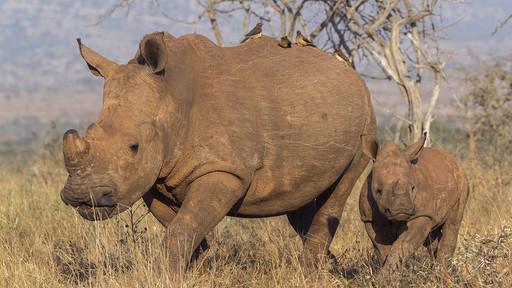
A private hunting reserve in South Africa featuring white rhinos and their offspring. Image source: ANN AND STEVE TOON/MINDEN PICTURES
Recently, scientists warned in the *South African Journal of Science* that the South African government has decided to list, including rhinos, lions and cheetahs, as well as 30 other wild species, for breeding and genetic research purposes. This could severely damage the genetic diversity of these animals.
The decision, announced in May 2019, was made without seeking public opinion. Graham Kerley, a veterinarian at Nelson Mandela University and one of the authors of the paper, said the decision provides 'a legal mechanism for domestication of wildlife'. This amendment allows for an increasing number of South African recreational breeders to register associations, determining the appearance of lions and cheetahs. He said it created a 'loophole' allowing breeders to select commercially desirable traits, such as longer horns or larger body sizes, which is not permitted by national wildlife law. Scientists wrote that this selective breeding could cause 'serious' genetic consequences for the animals.
This is the second time that wild species have been listed on the list. In 2016, the government listed 12 antelope species, including kudus and impalas. Environmentalists opposed this move at the time, but were unable to change the decision. This listing of some of South Africa's most iconic wild species has drawn more criticism, with opponents launching legal challenges against the amendment.
Researchers say that attempts to improve certain traits through breeding can lead to genetic bottlenecks. The paper notes that this is a common phenomenon in modern intensive animal farming and could lead to the development of two populations – domesticated and wild. However, separating wild and domesticated populations is costly. Domesticated wild animals will pose a new genetic threat to South Africa's native wildlife, and this is almost impossible to stop or reverse.
When the Department of Agriculture, Forestry and Fisheries (DAFF) published the amendment in 1998's Animal Improvement Act in 2019, it did not provide a reason. However, in July 2019, DAFF explained that it was in response to a request from the Wild Animal Ranching Industry in 2017.
Wild animal ranching, which provides hunting, meat and tourism, is a growing industry in South Africa. In 2018, it covered 18.7 million hectares, 15.3% of South Africa's total area. Wild animal auctions generate approximately $116 million in revenue for the South African government, and the government hopes to grow the country's 'wildlife economy' by 10% by 2030.
DAFF also claimed that 'scientists had not done any research' on this policy. However, in 2018, a report commissioned by the South African Department of Environment by 14 scientists and wild animal export companies, highlighted that intensive management and selective breeding of wild animals is a 'major risk' to South Africa's biodiversity.
Related paper information: https://doi.org/10.17159/sajs.2020/7724