Humpback Whale ()
Humpback whale (scientific name: Megaptera novaeangliae, also known as humpback whale), the name 'humpback' comes from the Japanese '' , which means 'harp', referring to the shape of the whale's back. It is a warm-sea tropical whale species. The body is short and wide, generally reaching 13-15 meters in length. Humpback whales are known for their breaching behavior, long pectoral fins, and complex calls. They often travel in pairs, have a docile temperament, exhibit migratory habits, and swim slowly, usually at a speed of 8-15 kilometers per hour. They emit sounds similar to 'singing'.
Humpback whales inhabit all major oceans, with a distribution in China in the Yellow Sea, Bohai Sea, and South China Sea. There are fewer in the northern Yellow Sea, and more in the southern Taiwan Strait.
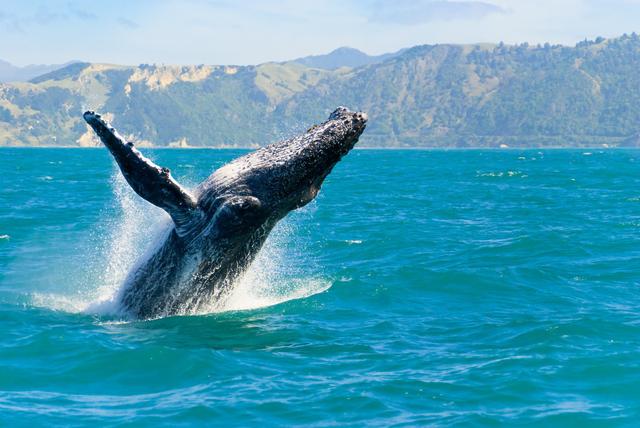
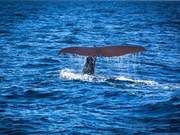
Although not the largest whale, the humpback whale is a whale that deserves its place in the ocean. Its body is large and bulky, with an average body length of 12.9 meters for males and 13.7 meters for females. The maximum recorded female is 18 meters long, with a weight of 25-30 tons. Its head is relatively small and flat, with a wide snout and 20-30 tumor-like protrusions. Interestingly, each protrusion has a hair growing on top, while other parts of the body do not have hair. The whale's whiskers are short and wide, with more than 200 on each side. The dorsal fin is low, short and small, not as straight as other whales, but arches upwards, forming a beautiful curve, hence the name 'humpback whale', also known as 'archback whale' or 'dorsal whale'. The pectoral fins are extremely narrow and long, about 550 cm long, which is the largest among whales, almost reaching one-third of the body length. The flipper has 4 toes on the upper edge, with irregular knob-like serrations on the front edge and wavy notches on the back edge, resembling a bird's wings, so it is also called 'long-fin whale', 'arm whale', 'big-wing whale', etc. The tail fin is large and has irregular toothed edges. The facial wrinkles are relatively few, about 14-35 wide parallel grooves or ridges extending from the lower jaw to the navel. The abdomen has wrinkles. Usually the back and chest are black, with spots; the belly is white, but some backs and chests are also white. The body size varies greatly, the fin above the flipper is white, the tail fin edge is black, and the belly is white. The mouth is large, and when feeding, a special elastic structure between the upper and lower jaws can open the lower jaw 90 degrees. The whale's whiskers have 270-400 plates, and the whisker plates and whiskers are all gray-black. The female's lower side has a long slender slit that ends near the anus, during the breeding season, the female whale wraps the male whale's genitals with it.
Humpback whales are social animals with a docile and friendly temperament. They also often express emotions by touching each other. However, when fighting with enemies, they use their long flippers or powerful tails to strike the enemy, sometimes even hitting the enemy's head, resulting in skin and flesh tearing and blood oozing. It swims slowly, at a speed of about 8-15 kilometers per hour. It has excellent swimming and water skills. Sometimes it swims quickly underwater for a short distance and then suddenly breaks the surface, slowly rising vertically until the flipper reaches the water surface, the body begins to bend backward slowly, like a circus performer's backward roll. It can dive into the water quickly and disappear into the waves in a few seconds, entering the dark depths. When breathing the surface, a short, thick and hot mixture of oil and water steam vapor will be ejected from the nostrils, which will also bring up the surrounding sea water, forming a spectacular water column, and at the same time, a loud sound similar to the sound of a steam engine will be emitted, which is called 'tidal surge' or 'water column'. Sometimes it becomes excited and jumps out of the water, with a height of up to 6 meters, and the water spray heard several kilometers away. The movement is calm and graceful. On its skin, there are often attached sponges, hydroids and other related animals, which add up to half a ton, but it does not affect its action and mood.
Male humpback whales sing for about 6 months every year, and the proportion of clicking sounds to pure tones in their songs is similar to that of Western symphonies with two proportions. This whale species can emit at least 7 octaves, which is not chaotic, but sings according to a certain rhythm, note length and musical phrases.
Researchers have found that humpback whales are also very good at singing in the format of 'A-B-A' commonly used by human singers, that is, first singing a melody, then elaborating on it, and then returning to the original melody with slight changes. They also conduct 'musical exchange', the humpback whales in the Indian Ocean migrated to the Australian Pacific, and within three years, the 'local' humpback whales in Australia abandoned their traditional repertoire and sang new songs brought by the newcomers.
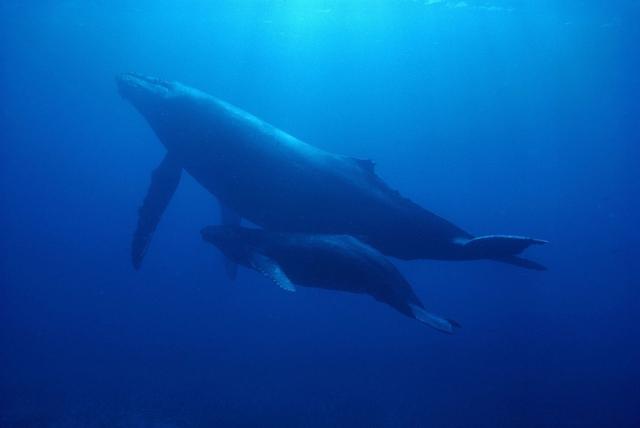
Humpback whales are monogamous, with one male and one female. The female gives birth to one calf every 2 years, with a gestation period of about 10 months. When the female is with her calf, there is usually one male whale following her closely. However, if it encounters a fierce and cunning orca, it is helpless. Like other mammals, the female whale feeds her calf with milk, and the milk is automatically squeezed out of the nipple. The calf grows rapidly, with a weight increase of 40-50 kg per day.
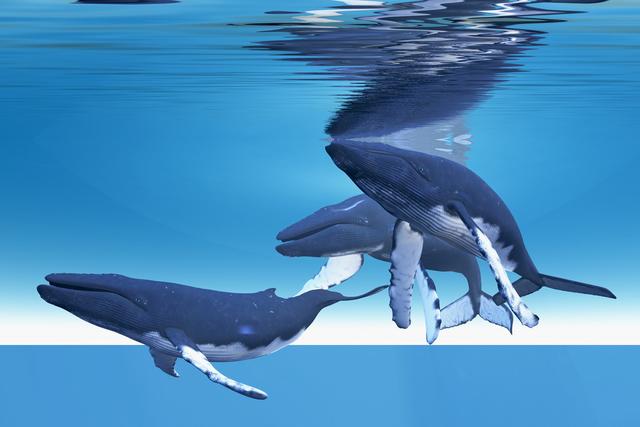
The female humpback whale and her calf often have intimate relationships, and the calf touches the female with its fins, sometimes as if grasping at the female's body. The humpback whale's lifespan is 60-70 years.
8~15“”“”6
67
“A—B—A”“”“”
2101140~5060~70