Pure-Colored Sunbird (also known as a species of Dicaeum)
Dicaeum concolor (Pure-colored Sunbird): A species of Dicaeum genus within the Dicaeum family, weighing 5-8 grams and measuring 64-89 millimeters in length. Dicaeum concolor exhibits similar plumage in males and females. The forehead, crown to the nape are dark olive-green, with the central feathers being darker brown; the eye arc, forehead base and eyebrow stripe are light gray-green white. The back, shoulder, waist and upper coverts of the tail are dark olive-green, the waist and tail coverts are slightly lighter green, the tail feathers are dark brown with a narrow olive-green edging, the wing coverts are brown except for the primary coverts, with olive-green edging; the flight feathers are black-brown, the outer feathers have olive-green edging. The sides of the head, cheeks, ear coverts and neck sides are pale olive-green or pale olive-gray; the chin, throat, breast and flanks are yellow-green with gray, the belly is pale yellow mixed with green, the axillary feathers are pale yellow white. The iris is dark brown or gray, the upper mandible is dark brown, the lower mandible is lead-gray, the feet are dark purple-brown. Similar to the Thick-billed Sunbird, the body is white with longitudinal streaks, the body is also larger.
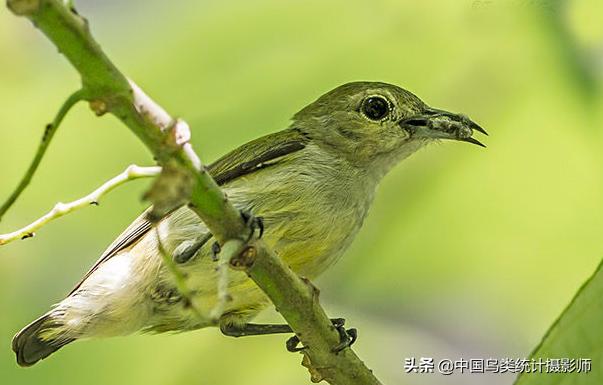
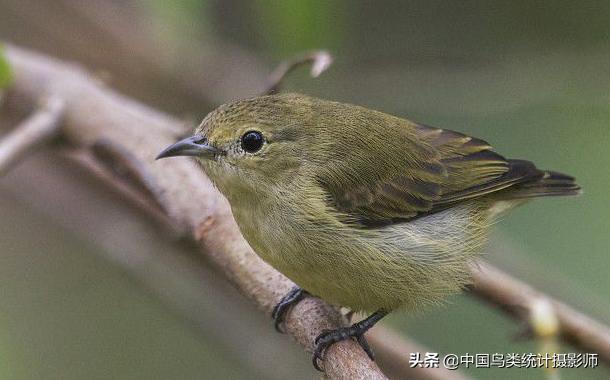
Distribution in China: Sichuan, Yunnan, Guangxi, Hainan, etc.
Resident bird. It often moves alone or in pairs; during the non-breeding season, it sometimes forms small flocks or mixes with other small birds such as warblers. It is lively and energetic, constantly flying from low branches to higher places, especially liking to move and forage on trees with flowering branches or parasitic plants on trees, often visiting parasitic rue plants. It is lively and hurried, often eating several berries on one tree and then quickly flying to another tree, climbing and foraging on trees, often twisting its tail back and forth. It occasionally emits a clear and solitary 'chi-chi-chi' sound. It feeds on insects, plant fruits, flowers, nectar and seeds, and also eats a small amount of animal food such as insects, spiders, etc.

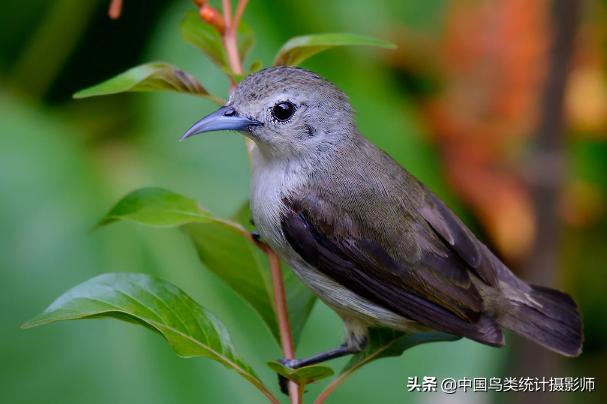
Breeding season: 3-8 months. Nests in trees, 1.5-12 meters above ground. The nest is pear-shaped, with a soft and delicate nest material, usually suspended on a small horizontal branch, mainly composed of plant fibers, cotton, spider webs, leaves, etc. The nest entrance is located in the middle of the nest. Sometimes it covers the outside of the nest with green moss, spider eggs, worm castings, small pieces of bark and leaves. The breeding is jointly undertaken by males and females. They usually lay 1-2 broods per year, with each brood producing 2-3 eggs. The eggs are white, with a size of 13.0-15.9mm x 9.9-11.1mm.