Through the Peaks: The Story of Five Pillars Peak
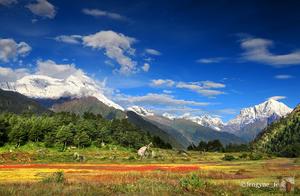
Red Water City's Buddha Rock, a red rock waterfall surrounded by green forests, is spectacular. This cliff wall, gleaming red in the sunset, is one of the typical representatives of teenage granite landforms. As one of the world's natural heritage exhibits, it is well-known to many. But the village story on the top of the cliff is not known to people.
After climbing for the third day, we went to the top of the cliff – in the Red Spruce National Nature Reserve's village, listening to people tell stories related to the forest, and looking for 'bear signs'
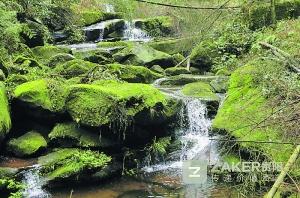
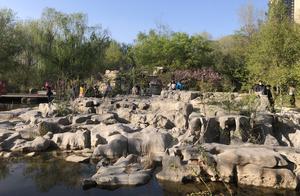
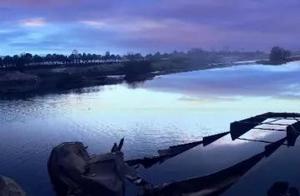
Five Pillars Peak Village's scenery
A
Cliff wall below
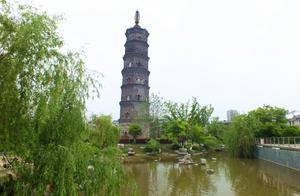
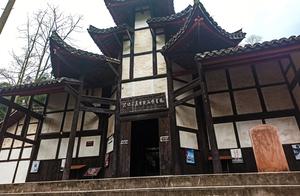
Former ( - an ancient postal station)
The scarlet Five Pillars Peak and Buddha Rock are Jurassic and Cretaceous red sedimentary rocks. Their current shapes are due to the combined effects of gravity collapse, wind and rain erosion, and other factors, forming pagoda-like, castle-like shapes, which are typical representatives of teenage granite landforms.
Five Pillars Peak Village is surrounded by Buddha Rock Scenic Area. The name of the village is derived from the fact that it is located on the five pillar-shaped large rock formations. From the foot of the mountain to the cliff top, there is a hardened village road, but it is steep and narrow, and it takes about half an hour to drive. Along one side of the road is a vertical granite cliff, with a drop of more than 200 meters, and the highest point is about 500 meters away from the bottom of the valley. Standing at the edge of the cliff, feeling the wind, people feel like they are about to float away. Old merchants, after crossing the cliff, had to pass through dense forests where tigers, leopards, and bears roamed, and it was extremely arduous.
Historically, the mountains below Five Pillars Peak Village were called Xia Jin Yi Kou. This indicates that there used to be a postal station somewhere in the valley or at the mouth of the valley. But today, Xia Jin Yi and Xia Jin Yi Kou are only names, and after the village extends to the deep mountains and forests, the ancient road has disappeared into the grass and trees, becoming part of the nature reserve.
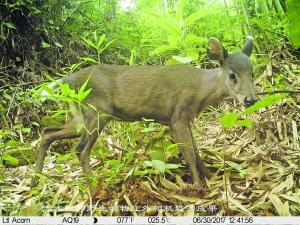
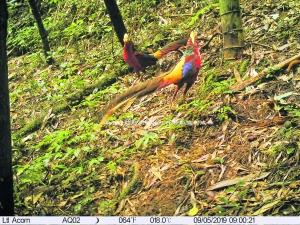
Camera photos of animals
B
Five Pillars Peak
'Bear sightings'?
The purpose of visiting Five Pillars Peak Village this time was to retrieve the multiple infrared cameras installed by the nature reserve's research personnel earlier. Three years ago, the 'Red Spruce Nature Reserve' jointly with the Chinese Academy of Sciences' Animal Research Institute, launched a survey of the distribution of wild animals in the area. To this end, they installed nearly 100 infrared cameras in the forest, with wild animals, and a batch of birds. Including Sumatran serows, Tibetan crowned squirrels, Chinese muntjac, leopards, and red-rumped bearded pittas, white storks, etc.
Forestry officer and , are all people from Five Pillars Peak Village, and they are familiar with this area. Therefore, every time they replace the infrared camera, they have to participate. From the village entrance to the mountain gorge where the infrared camera is installed, the distance is nearly an hour. In this mountain gorge, due to traffic restrictions, unlogged ( - a type of bamboo) is lying horizontally and vertically in the bamboo forest because it has aged. 'Few people come in, it has become a paradise for wild animals.' said.
Following a water channel that comes down from the top of the cliff, we found one of the infrared cameras attached to a tree. This camera was installed two years ago, and the outer shell has grown moss. took down the camera, replaced the battery, and briefly looked at the picture, and suddenly exclaimed: 'What is this? It's dark and dark, it just flickered in front of the lens. Could it be a black bear?' Black bears, in the 'Red Spruce Nature Reserve', do indeed exist. But unfortunately, people have not recorded its imaging activity in this area, so its existence remains in (koubai - local rumors).
Older said that since he was a child, he often heard that there were black bears roaming in the forest. The last time he saw a black bear was about three years ago, when someone put beehives on the cliff wall, and the black bear knocked them down and ate all the honey.
'Bear sightings' have not only occurred in Five Pillars Peak Village. In the 'Red Spruce Nature Reserve', there have been reports from several places. The Administrator of the Nature Reserve Management Bureau, (Liang Sheng), also said that they investigated in the forest and collected several suspected black bear feces. Strangely, after the research personnel installed infrared cameras, neither the places where black bears were previously reported to appear, nor any place where black bears were rumored to appear.
In the 'Red Spruce Nature Reserve', the black bear seems to be playing hide-and-seek with people.

Scan the QR code
Watch the 'Red Spruce Nature Reserve' passing through the recording video
C
Rich species
Hidden habitat
The scene infrared camera is very small and the pixel is not high, it is difficult to accurately identify the animal screen, previously, the nature reserve installed nearly 100 infrared cameras, recorded dozens of wild mammalian animals, as well as a batch of birds. Including Sumatran serows, Tibetan crowned squirrels, Chinese muntjac, leopards, and red-rumped bearded pittas, white storks, etc.
Forestry officer (Liu Bang You) of the Nature Reserve Management Station said that the obtained images, the Chinese muntjac appeared most frequently. 'About 50% of the cameras recorded images of Chinese muntjac, and some cameras even took multiple pictures.' He said that this indicates that Chinese muntjac are distributed in this area and have a wide activity range. With the expectation of seeing black bear images, after retrieving the storage card from the next monitoring point, without rest, they hurried back to the management station to open the stored images on the computer.
Rushing back to the management station, opened the newly retrieved storage card, a hurried male Tibetan crowned squirrel appeared before everyone.
The Tibetan crowned squirrel is a national second-level protected animal, also known as a blue monkey, with a relatively large individual, primarily gray-blue in color. Thus, on the pixel-low and low-incidence infrared camera screen, the hurried blue monkey was mistaken by everyone, which is understandable. 'Maybe we all want to take pictures of black bears.' said, he believes that there are black bears in this nature reserve, just that the location of their activities has changed outside the monitoring points of the infrared camera.
The reporters of the Guiyang Daily Media Group Huang Qianhua Zhang Zhihong