Spider Relatives – Cave Spiders
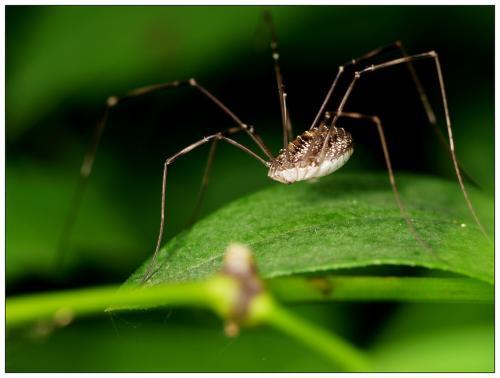
Harvestman, also known as Daddy Longlegs, is a small arachnid with eight legs, closely related to spiders. Harvestmen live in temperate and tropical regions. Harvestmen are divided into 3200 different species, with 200 species native to the United States. Unlike spiders, harvestmen have long, stilt-like legs and a segmented abdomen, but they lack spinnerets. Each leg of a harvestman has seven joints, making their legs incredibly strong and allowing them to move quickly across leaves and grass.
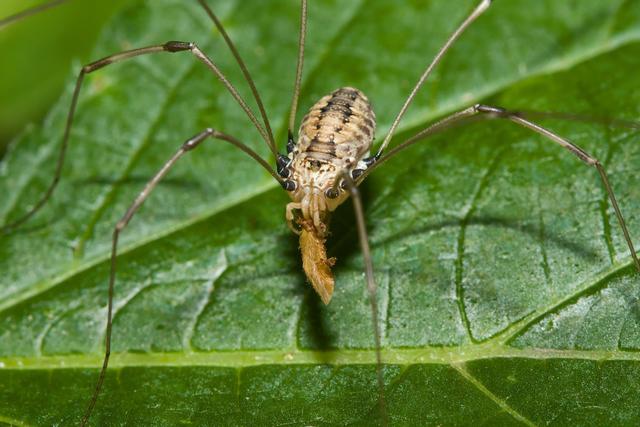
Harvestmen primarily feed on small insects, decaying animals, and the juices of fruits and vegetables. A pair of glands located on their carapace secrete a foul-smelling substance that deters predators. Females have an ovipositor, a specialized tube-like organ that extends from their abdomen, used to lay eggs in moist soil.
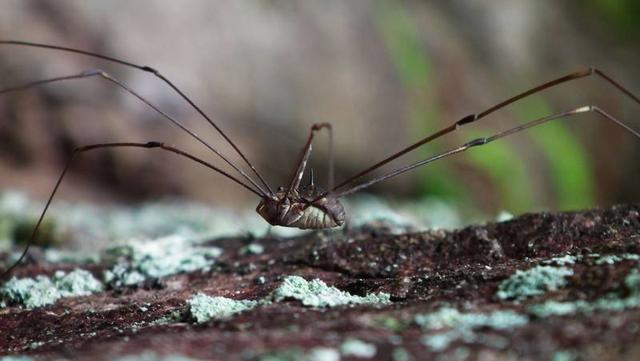
What animal looks like a spider, but is actually not a spider?
You may know harvestmen through their nickname, Daddy Longlegs. These arachnids look particularly like spiders, but they are not spiders and differ from them in many ways.
First, unlike spiders, harvestmen do not spin silk, and they also have no venom glands or fangs. The body of a harvestman appears to be made up of just one large part, because they do not have the slender waist of a spider.
The mouthparts of a harvestman are very small, which is beneficial for crushing their food; they primarily eat insects and plants. Harvestmen do not bite, so they pose no threat to humans. However, some harvestmen will emit a foul-smelling odor if disturbed. Harvestmen mainly live in aquatic vegetation.
Harvestmen belong to the class Arachnida, order Phalangida.
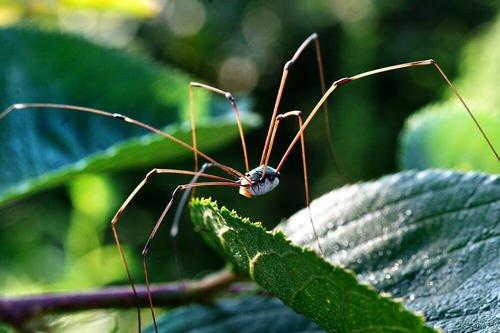
Although harvestmen are called spiders, they are actually very different from spiders. Spiders have distinct heads, chests, and abdomens, but the body of a harvestman appears to be just one large part. In terms of classification, harvestmen also do not have fangs, and they have no spinnerets, so they cannot build webs. The legs of a harvestman can move independently after detaching from their bodies, due to a pacemaker at the end of the legs, which sends nerve-muscle signals to bend and extend the legs.