Mirror Carp
Mirror carp (scientific name: Cyprinus carpio var. specularis): a variant of European carp, with a shiny skin that is smooth and glossy like a mirror surface. The body is stout and laterally compressed, with a bulge at the back of the head, a small head, and large eyes. The scales are large and arranged along the edges. There is 1 row of complete scales from the front of the dorsal fin to the head. There are 1 row of symmetrically continuous and complete scales on both sides of the dorsal fin, and all fin bases are scaled. Individual fish may have a few scales on the lateral line. The lateral line is mostly straight and not branched, and individual fish may have short branches at the end of the lateral line. The color varies depending on the habitat, usually brown-brown on the back, and shallow yellow on the sides and abdomen.
Mostly inhabit the lower layer of water and feed on muddy, sandy, calm water with rich nutrition. They have collective group swimming habits. They are omnivorous fish, mainly feeding on small invertebrates and bottom-dwelling animals. They are suitable for aquaculture promotion in China. Under reasonable stocking density and better feeding conditions, mirror carp grow very fast.
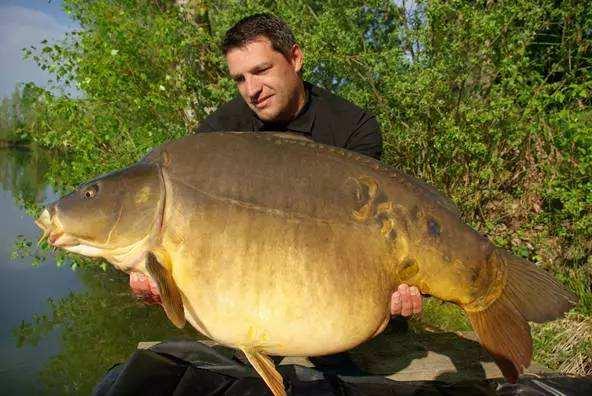
Mirror carp is native to Europe, imported from Germany, and has been selected by the Black River Fisheries Research Institute in Heilongjiang for 20 years. It has been selected into German mirror carp breeding lines, which are characterized by greater resistance to cold and disease compared to the original type.
On June 8, 2010, the Hohhot Comprehensive Trial Station of the Chinese National Major Freshwater Fish Industry Technology System introduced a new aquaculture variety of 30,000 specimens of Japanese mirror carp seedlings from the Heilongjiang Black River Fisheries Research Institute into the grazing demonstration areas of Inner Mongolia Zhenger Flag, Dalazite Flag, Botou Jiuyan District and Tumote Zuqi Flag. After on-site monitoring, the survival rate was more than 90%.
In May 2016, the outer imported fish species of mirror carp surfaced in Dunhuang City, Gansu Province, China. In fact, this rare phenomenon of foreign species in the Moon Spring of Dunhuang had ceased for many years. In late July, the spring also appeared a more spectacular group of fish surfacing, which was photographed by tourists. However, it disappeared again for half a year after that.
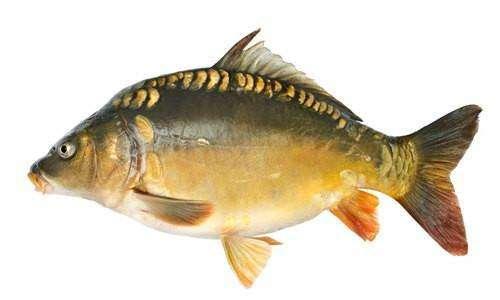
Original variety: elongated and laterally compressed, thick and slightly shaped, the back is slightly arched, the abdominal margin is shallow arc-shaped. The head is medium-sized, with a wide forehead. The snout is blunt and round. The mouth is small, sub-situated, and obliquely opened in a circular arc. There are 3 rows of teeth in the throat, with a tooth pattern of 3.1.1-1.1.3. There are two pairs of whiskers, the snout whiskers are short, and the jaw whiskers are long. The gills are short and triangular, and the number of gills is 19-24. The body is covered with rounded scales, the lateral line is complete and slightly arched, the lateral line number is 31-36. The dorsal fin has 3 spines, 16-20 branches; the anal fin has 3 spines, 5 branches; the caudal fin is forked; the caudal fin is 20-21; the gills are 21-25.
Mirror carp has fewer scales, grows quickly, high meat content, and good meat quality. It has been approved by the China Aquatic Breed Standardization Committee for aquaculture superior varieties. Under reasonable stocking density and better feeding conditions, mirror carp grow very fast. In Heilongjiang (production period 120 days), it can reach 150g in one year, and 1kg or more in 2 years. The survival rate of rearing is 98%, and the overwintering maturity rate is 96%. Under the same stocking density of German mirror carp and other carp, the growth rate of mirror carp is faster than other carp.
Main varieties
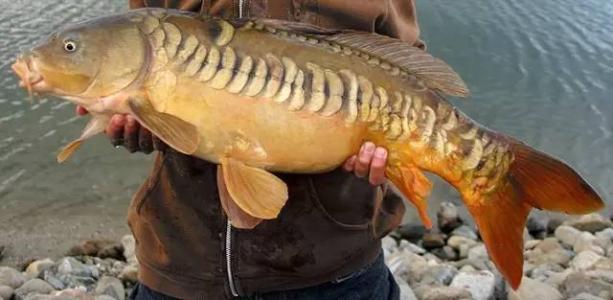
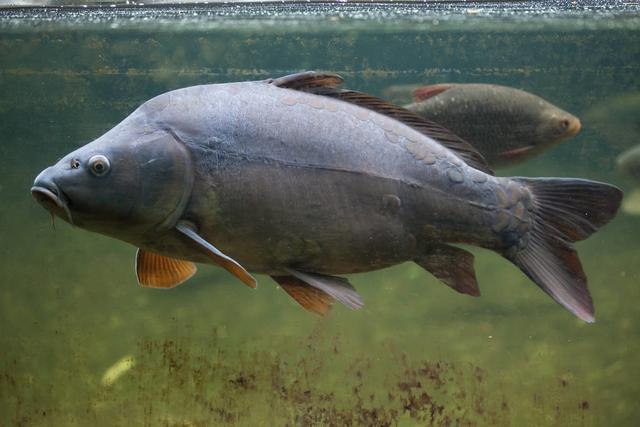
There are three types of mirror carp: shiny scale mirror carp, shape mirror carp and frame mirror carp. The body is the same as that of carp, but the skin is smooth and few scales, with a few irregular scales only on the lateral line and abdomen. The back is grayish-blue, and the abdomen is silvery-white. The meat is tender and fat.
Growth habit
Primary freshwater fish. It has strong adaptability, mostly inhabits the lower layer of water and feeds on muddy, sandy, calm water with rich nutrition. It has collective group swimming habits. It is an omnivorous fish, mainly feeding on small invertebrates and bottom-dwelling animals.
Reproduction method
Mirror carp is sexually mature at the age of 3-4 for female fish and 2-3 for male fish. The breeding water temperature is 17-25℃, the most suitable water temperature is 19-22℃.
3-42-317-25℃19-22℃