Crowned Crane
Balearica regulorum, also known as the Crowned Crane, is a small crane species. It primarily inhabits African wetlands and tropical grasslands. Due to its fluffy feathers, erect trachea, precise crown feathers, and exquisite facial markings, it is often referred to as the Crowned Crane. It is diurnal, preferring to walk along the edges of marshes, adept at foraging on ridges and in rice paddies, along ditches, and on grasslands, and often flies to nearby residents' yards to forage and play. Its diet consists mainly of invertebrates, mollusks, crustaceans, and other invertebrates, as well as plant-based food such as seeds and tubers. It is mainly distributed in southern Africa, and it is the national bird of Uganda, Tanzania, and Rwanda.
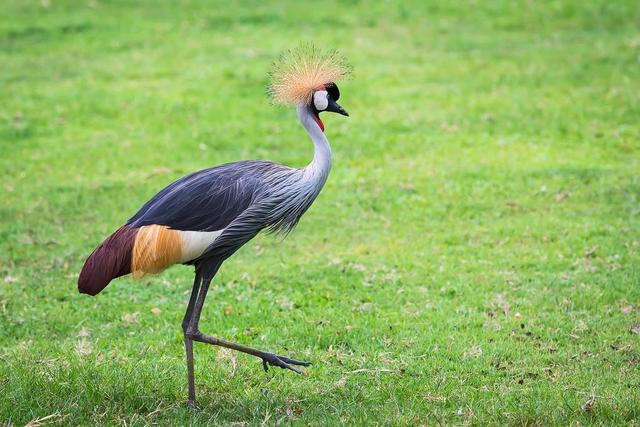
The Crowned Crane's head and body are 100-110 cm high, with a wingspan of 180-200 cm and a weight of 3-4 kg. Its upright legs, extending freely long neck, beautiful figure, exudes an extraordinary and otherworldly aura. Its males and females have very similar plumage, with feathers all shades of gray, the flight feathers white, wingtips and tail feathers brownish-gray, shining brilliantly. However, the most captivating part is its head, with the two dark cheeks inlaid with small red patches on top and large white patches below, and a pair of bright, perceptive round eyes, with a long, drooping red fleshy pouch hanging below the throat. The feathers on the top of its head are covered with a glossy black velvet, soft and smooth, while the back is adorned with a stiff feather-woven crest, golden and glittering like a crown, beautiful and majestic.
It is divided into 2 subspecies. The different subspecies vary slightly in size and morphology, with the subspecies living in southern Sudan having smaller individuals and darker plumage, while the subspecies living in Uganda, Kenya, and Eastern Zambia are larger and have lighter plumage, especially the crown feathers are most vibrant.
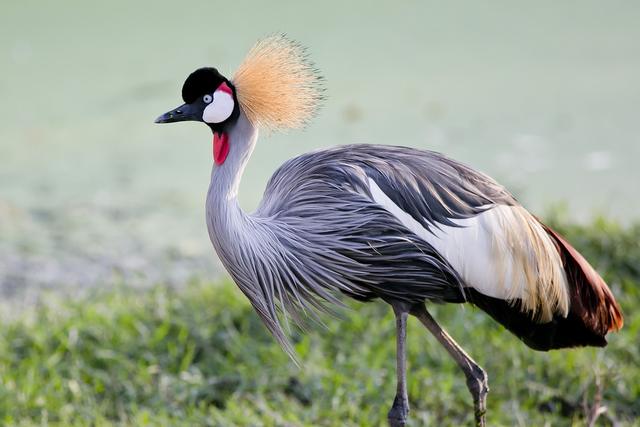
The Crowned Crane resides in wetland environments and semi-natural habitats in human settlements. Wetlands are generally divided into two types: one is papyrus marsh, with deeper water and papyrus as the dominant vegetation, approximately 3 meters high, forming large areas of a single plant area; the second is seasonal grass marsh, in the dry season the water level is very low, large areas may even be completely dry. The vegetation in the habitat mainly consists of reeds, wild grasses, pasture, legumes, and coniferous trees. The main crops in cultivated land are corn, with beans, wheat, and sunflowers intercropped.
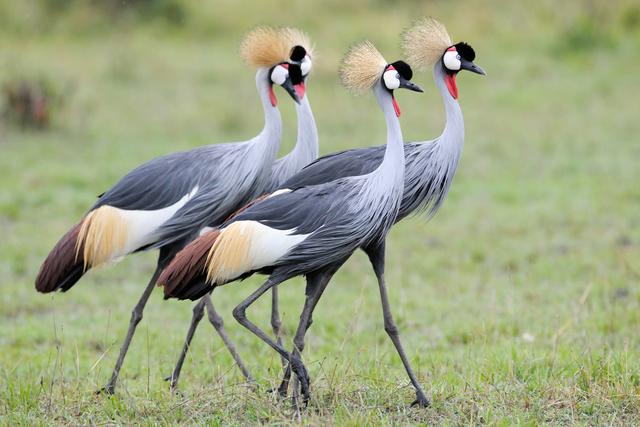
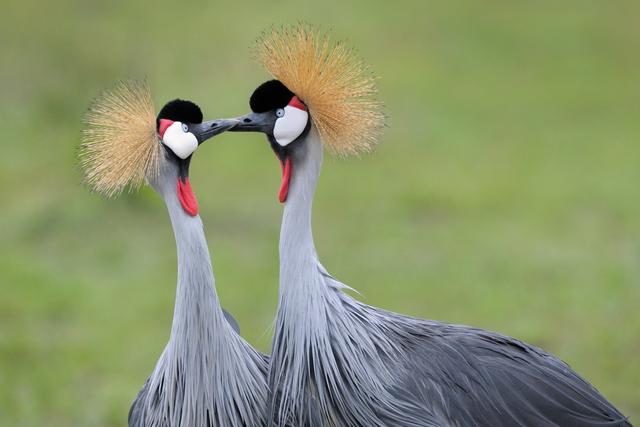
The Crowned Crane is diurnal, preferring to walk along the edges of marshes, adept at foraging on ridges and in rice paddies, along ditches, and on grasslands, and often flies to nearby residents' yards to forage and play. It starts foraging at dawn, takes a short break at noon, mostly flies to the river, marsh, pond, and artificial dams for drinking, and returns to the dry area in the afternoon to continue foraging until dusk. The foraging sites include dry areas, wetlands, newly harvested fields with crop residues, freshly tilled land, burned wasteland, grazing areas, and newly opened marshes. However, foraging in dry areas is more frequent because it can obtain a large amount of carbohydrates from the seeds, while in wetlands it can find protein from animal food. If food is scarce or disturbed, they will also go to forest clearings to forage. During foraging, they typically form groups, with the largest reaching over 40 individuals, sometimes in pairs, and when acting alone, they are very brief. The group includes adults and subadults, always gathering at one place, and very coordinated. If a large group splits into several smaller groups, the individuals in these small groups maintain close mutual communication through sound and sight. They often forage together with cattle, sheep, donkeys, etc., following these livestock to catch insects startled by them, similar to the Cattle Egret.
It is an omnivorous animal, with its animal food mainly consisting of invertebrates, mollusks, crustaceans, and other invertebrates, as well as small rodents, and plant food including seeds, leaves, and tubers unearthed from the soil. Because it has a diverse range of food, it can forage in various habitat types, thus fully utilizing the small food sources.