Common Marine Animals – Sea Urchin
Sea urchin belongs to the class Echinoidea, which is a class of invertebrates living in shallow marine areas. Its main characteristics are spherical, disc-shaped or heart-shaped bodies, without arms. The endoskeleton is fused to form a solid shell, and most species have a complex chewing apparatus within their mouths, called Aristotle’s lantern, which has teeth for chewing food. The digestive tract is a long tubular shape, curved within the body, feeding on algae, hydroids and worms. They are mostly dioecious, and during individual development, they pass through echinid larvae (long-armed), then transform into juvenile sea urchins, and it takes 1-2 years to reach sexual maturity. They can be divided into two subclasses: regular sea urchin and irregular sea urchin, with 22 orders. 900 species are identified, belonging to 225 genera. About 100 species are known in China, and about 7000 fossil species.
Sea urchins are distributed from the intertidal zone to depths of several thousand meters, mainly concentrated in the rocky seabed or sandy seabed of coastal areas, or with widespread distribution, or limited to specific areas, depending on the species. Sea urchins were among the earliest organisms used as models in biological science. Their eggs and embryos have played an important role in the development of early developmental biology. They are one of the longest-lived marine organisms on Earth.
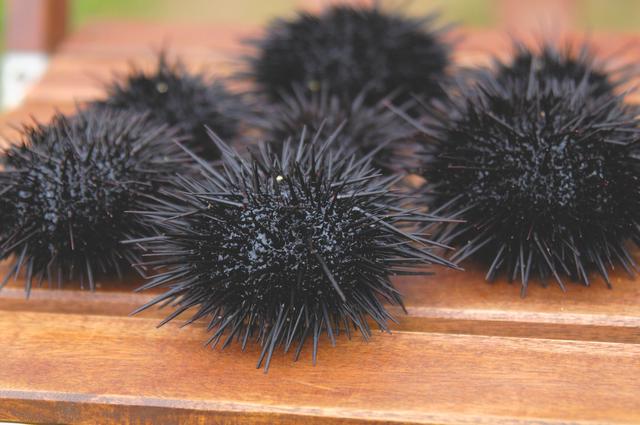
Sea urchins have a body shape of spherical, disc-shaped or heart-shaped, without arms. The endoskeleton is fused to form a solid shell, divided into three parts: the largest first part, composed of more than 20 rows of multi-faceted polyhedral plates arranged into 10 zonal areas, 5 tube feet zone and 5 strap zone between them, the other two parts are formed by strap zone; the second part is called the apical ring, located at the central face of the inverted mouth, composed of the periproct, 5 reproductive plates and 5 ocular plates; the reproductive plates have one reproductive pore each; the ocular plate has one eye pore; the periproct has an anus. The third part is the oral part, located at the mouth face, with 5 pairs of mouth plates arranged regularly, each mouth plate has a tube foot, around the mouth has 5 branches of gill, which is the respiratory organ. Most species have a complex chewing apparatus within their mouths, called Aristotle’s lantern, which has teeth for chewing food. The digestive tract is a long tubular shape, curved within the body, feeding on algae, hydroids and worms.
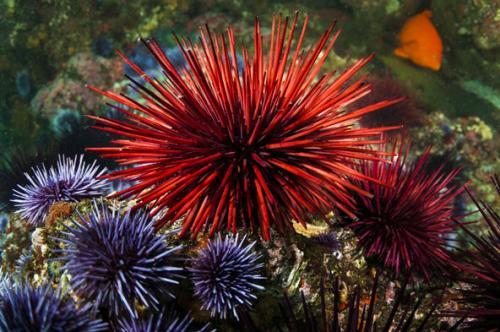
Sea urchins are generally dark in color, such as green, olive green, brown, purple and black.
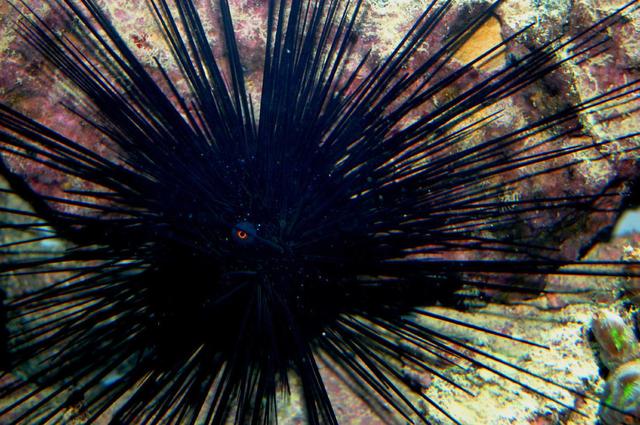
The body wall structure of sea urchins is similar to that of sea stars, but the epidermis lacks a muscle layer, so the plates are immobile. The body wall has a well-developed mesoglea. In addition to the wide body cavity within the shell, there is also a perivisceral cavity around the mouth, which is located behind the mouth, and is connected to the body cavity. The body cavity fluid is isosmotic with seawater, with a function of transporting nutrients and metabolic products. The body cavity fluid contains a large number of body cavity cells, some of which have pseudopods and have phagocytic function. The body cavity cells also have hemostatic function, which plays a role when injured.
Sea urchins have a wide range of diets. They can be carnivorous, feeding on worms, mollusks and other echinoderms; they can also be herbivores, feeding on various algae. Soft-bodied sea urchins and irregular sea urchins mainly feed on organic matter detritus, collecting organic matter granules around them with tube feet or spines, and then sending them to the mouth with the help of cilia. The mouth is located at the central part of the oral membrane (the mouth of the irregular sea urchin may be located at the front of the body), and the inside of the mouth is an eating structure, consisting of a series of plates, teeth and muscles, which is used to cut and chew food, called Aristotle’s lantern. It can partially extend out of the mouth, and its shape and structure is one of the bases for the classification of sea urchins. Generally, heart-shaped sea urchins lack Aristotle’s lantern.
Aristotle’s lantern contains the pharynx, which is followed by the esophagus, then connected to the stomach and intestine, and there is often a blind sac between the stomach and intestine. The digestive tract is long, it encircles the shell in the body, it goes around the mouth and the inverted mouth, then passes through a short short intestine and the anus of the perivisceral zone, and then opens to the outside. Many sea urchin intestines first circle (oral circle) have a parallel water pipe (siphon) on the wall, its function may be to quickly remove excess water from the food, the intestine is the place for food digestion and respiration, the blind sac can secrete digestive enzymes. Starch is its main storage material, it enters the body cavity and other tissues from the intestinal wall.
The water transport system is similar to that of sea stars, the inverted mouth has a screening plate (formed by the reproductive plate), which is connected to the mouth by a ring tube, the ring tube has 5 polyps, which are divided into 5 radial tubes, in the shell, the radial tubes are concentrated in the strap zone at the apex, and then extend into lateral tubes on both sides, connected to the sac, and then extend into tube feet. The tube feet penetrate the strap plate, have a suction cup, a muscle and a supporting bone plate. The tube feet of irregular sea urchins are mainly used for respiration and other functions. The blood system is similar to that of sea stars, it accompanies the water transport system, including the ring vessel, radial vessel and axis gland, and also has the perivisceral system, which plays a circulatory role in sea urchins, but its understanding is still limited.
Sea urchins have 5 pairs of gills in the oral area. The gills are branch-like structures protruding from the body wall, which is the main place for gas exchange. The internal cavity of the gills is connected to the perivisceral cavity, and it is filled with body cavity fluid. The Aristotle’s lantern plates and muscles contract to press the body cavity fluid into the gills for gas exchange. The suction movement is stimulated by the change in oxygen and carbon dioxide in the body cavity fluid, and then by the nerve controlling the movement of the plates and muscles.
Irregular sea urchins do not have gills, they use tube feet for breathing. The tube feet are short and flat, the movement of the cilia outside the tube feet creates water flow, which is opposite to the flow of body cavity fluid inside the tube feet, to promote gas exchange. Even regular sea urchins, the tube feet at the inverted mouth mainly carry out respiratory functions. The metabolic products are mainly ammonia and urea, which are carried by the body cavity cells to the gills and tube feet, and then discharged from the body.
The axis gland may also be a excretory organ, because its body cavity cells are also full of metabolic waste. The nervous system accompanies the water transport system, the most important is the outer nervous system, which surrounds the lantern in the throat to form a perioral ring, from which 5 radial nerves are emitted to penetrate the Aristotle’s lantern plates to the inner side of the shell strap zone, located below the radial tubes, and then emitted from the radial nerve branches to reach the tube feet and the body wall, spines and forks. The lower nervous system forms a ring on the perioral ring and emits nerves to the muscles of the lantern. The inner nervous system forms a ring in the perivisceral zone and emits nerves to the reproductive glands.
There are no special senses, the sensory cells are mainly distributed between the cells of the tube feet, spines and forks, which have tactile and taste functions. There are also spherical bodies with a balancing function. Sea urchins are also sensitive to light, mostly negatively phototrophic, the epidermis of the inverted mouth has eye spots or photosensitive cells.
Habitat
Most sea urchins live in rocky, coral and hard seabed, mainly relying on tube feet and spines to move, the movement is often related to feeding; when food is abundant, they can move over 1 meter per day; when food is scarce, the sea urchin may only move 10 centimeters per day. The movement of sea urchins is carried out by a large number of transparent, small and mucous tube feet and spines. The tube feet move by gripping rocks, and the spines at the bottom of the sea urchin can lift the body of the sea urchin to help it move freely. When the sea urchin is inverted℧, it can move quickly.
Sea urchins’ diet is very wide, carnivorous sea urchins feed on worms, mollusks and other echinoderms, while herbivorous ones mainly feed on algae, and there are also sea urchins feeding on organic matter, animal corpses and so on.
110