China's Unique Rare Animal – Tibetan God Deer, the ‘Masked’ Highland Spirit
In China's Qinghai-Tibetan Plateau and its surrounding areas, a precious Chinese native animal, the White-lipped Deer, lives. It is an ancient species that was once widely distributed in the central Himalayas. White-lipped deer are considered 'god deer' in their native land, and are associated with the Star of Longevity. The deer often accompany the Star of Longevity to wish for long life. To date, this precious species exists only in Sri Lanka and Nepal, with 1 pair each, all of which were gifted by China.
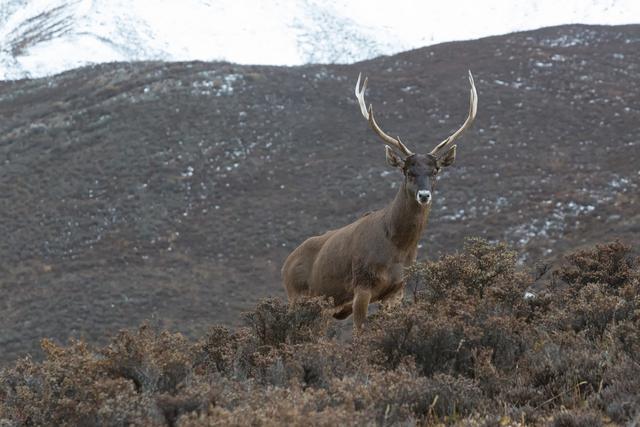
The White-lipped Deer is a typical high-altitude animal, inhabiting 3500-5000 meters of high-altitude coniferous forests and alpine meadows. The climate there is usually very cold, and it is mainly distributed in high-altitude grassland areas of the Qinghai-Tibetan Plateau and its surrounding areas, such as Qinghai, Gansu, western Sichuan, Tibet, and Yunnan. Due to its sparse habitat, it was not recognized until the 19th century in Gansu and Sichuan's Batang, which aroused great attention from the international animal science community.
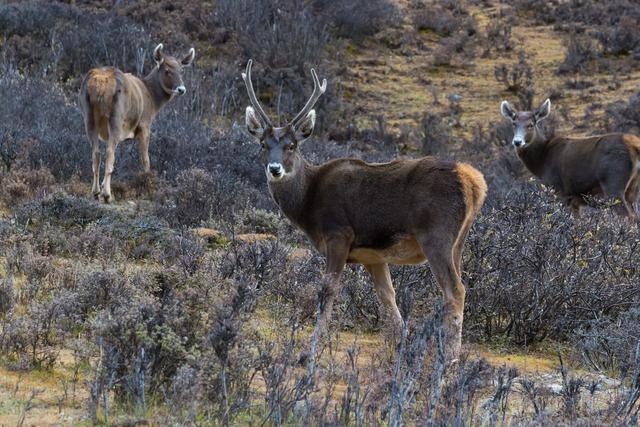
Encountering a White-lipped Deer from Tibet, a Grade I Protected Animal.
Among the entire deer family, the White-lipped Deer belongs to a large species, and after adulthood, the White-lipped Deer is like a horse in size. Its length is 100-210 cm, and its weight is 130-200 kg. Its main characteristic is that it has a pure white lower lip, which extends to the upper part of the throat and both sides of the muzzle, as if wearing a white mask. Therefore, it also has other common names such as White-nosed Deer and White-muzzled Deer.
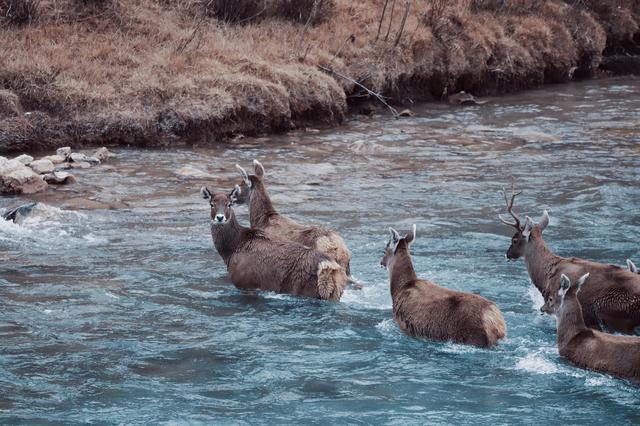
White-lipped Deer cross rivers
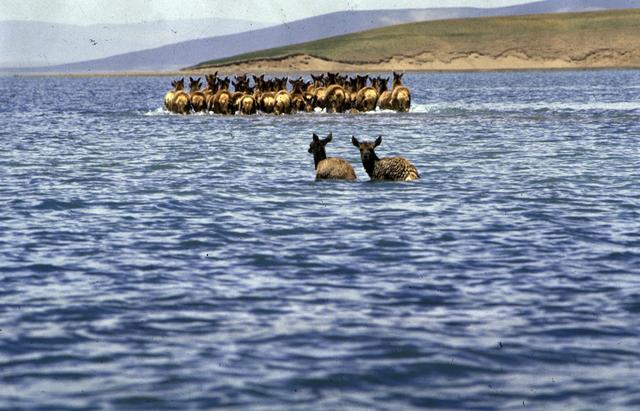
White-lipped Deer are herd animals, typically consisting of only 3-5 individuals, sometimes also forming large groups of dozens of individuals. They have long lived in high-altitude meadows, walking as if on flat ground on rugged mountain roads. Whether it is bare rock cliffs or dense bushes, the White-lipped Deer goes forward without stopping. In addition, it is also good at swimming and can cross fast-flowing and wide water surfaces.
Male White-lipped Deer have yellowish horns, with most branches arranged in the same plane. The breeding season of White-lipped Deer is from October to November. At this time, the males often scream loudly and run around. A male can occupy several females. Male-male fights are also very fierce, often causing horns to break.
The White-lipped Deer belongs to a monotypic genus, with the White-lipped Deer as the only species under the genus, without subspecies division. Therefore, the White-lipped Deer has become a precious animal unique to China. China had previously gifted Sri Lanka (now with 1 individual surviving) and Nepal with 1 pair each. No other country has obtained this Chinese native deer.
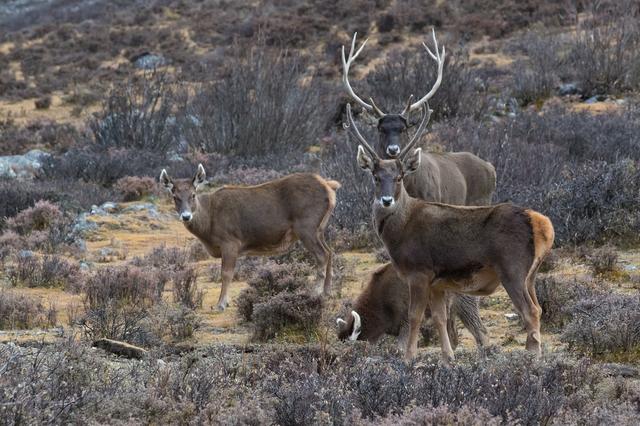
However, due to various reasons, the distribution area and population of the White-lipped Deer are decreasing rapidly. Because of its high medicinal value, the White-lipped Deer is often hunted by poachers. In addition, the distribution of the White-lipped Deer is becoming island-like, and the lack of gene exchange between communities is an important factor threatening the survival of the White-lipped Deer in the wild. Now, the White-lipped Deer is listed as a Grade I Protected Animal, and some regions have effectively controlled hunting. In the past ten years, nature reserves have taken a series of protection measures, and the White-lipped Deer's habitat has been gradually improved. In January of this year, a villager from Mamen Village, Baiyu County, Sichuan, photographed a group of White-lipped Deer drinking and resting by the stream. It is estimated that there are about 3000 White-lipped Deer in Baiyu County.