Who is the woman who brought back the pandas and how did the pandas fare? (Two pandas were captured and brought back to the United States)
Before the 20th century, Westerners basically didn't recognize the panda as a species. In the 1920s, two Americans ventured into southwest China, exploring in the wild for three months during their travel between the Tibetan and Kham borders. They eventually discovered a panda. The two Americans originally intended to take the panda back, but the panda was, after all, a wild beast, and they were not allowed to approach it. Unable to do so, they reluctantly killed the panda and peeled off the panda's skin to make a specimen.
This specimen was subsequently displayed in the Chicago Natural History Museum. And the mysterious species of the East, the panda, began to attract more and more Americans' interest.
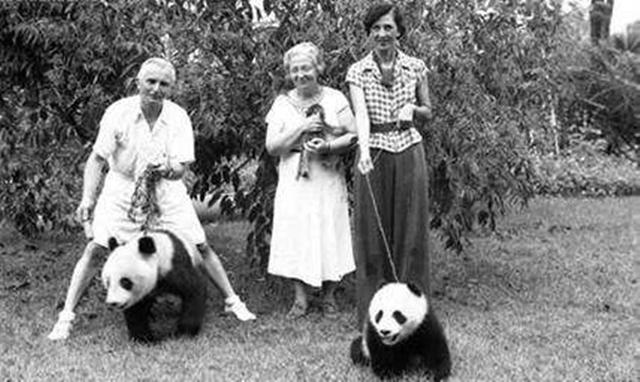
Westerner and Panda
In 1934, a man named Bill Harkness entered China. Harkness was an adventurer who had just married a woman named Ruth shortly before his trip to China. Despite the sweet life after their marriage, the image and appearance of the panda always lingered in the heart of the adventurous Harkness. Ultimately, with the support of his wife Ruth, Harkness began his panda hunt.
However, to everyone's surprise, Harkness stayed in China for a year and a half without finding any trace of pandas. More sadly, Harkness also died in Shanghai due to esophageal cancer.
Upon hearing this news, Ruth was very saddened. In order to fulfill her husband's unfulfilled wish and to see the mysterious animal that had fascinated him, Ruth traveled to China alone.
Upon arriving in China, Ruth did not blindly search for pandas. She contacted her husband's friend, a Chinese-American explorer, Yang Dezhi, and asked him to organize an expedition team. After making thorough preparations, Ruth and her team set out from Shanghai towards Sichuan Province. They arrived at the border of Sichuan Province two months later, which was the area where the panda was rumored to have often appeared.
However, despite Ruth and her team's perseverance and their prolonged search in the bamboo forests for two months, they failed to find any trace of pandas. Just as Ruth and her team were about to give up and plan a second search, they suddenly discovered a young male panda in the bamboo forest.
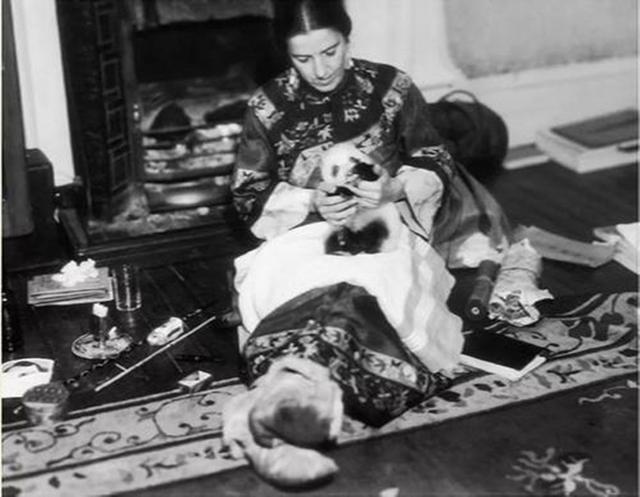
Ruth and Panda
Because they wanted to capture the panda alive, and because Ruth and her team lacked experience in capturing pandas, the expedition team's pursuit quickly alerted the panda. Although they went through a series of chases and interceptions, the panda finally disappeared from the expedition team's sight.
Ruth and her team were puzzled as to why the lazy-looking panda was able to suddenly burst out with the speed of a wild beast. Just as Ruth was reflecting whether it was due to insufficient preparation, a baby panda's cry suddenly came from deep in the bamboo forest.
The expedition team went to investigate the sound, and after passing through a patch of bamboo, they found a panda cub in a dead tree hole.
Ruth cautiously approached the panda cub and gently picked it up. It seemed that this was the young panda left behind by the adult panda she had just seen.
After a simple identification, Ruth believed that this cub was a male panda. To express her gratitude to Yang Dezhi for his support throughout the trip, Ruth named the cub 'Sulin', which was the same as Yang Dezhi's wife's name.
The panda was captured, but bringing it back to America was difficult. Although China's economy was weak at the time, there was a certain awareness of protection for these rare species.
Initially, the Nationalist government firmly refused Ruth's request to take the panda back. But as the matter became more and more sensational, the United States government began to intervene. In the end, the Nationalist government was forced to issue Ruth an animal export permit, and the animal listed on the permit was a 'peculiar-shaped Shiba Inu'
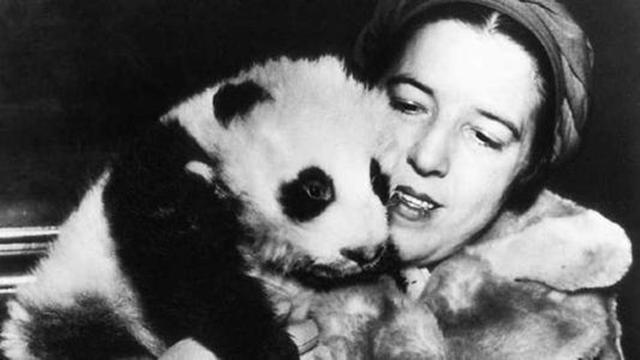
Ruth and Panda
Ruth put Sulin into a bamboo cage, and subsequently boarded a cruise ship to arrive in America. After returning to Manhattan, Ruth's story was widely reported in the American media. More and more zoos contacted her, all of whom wanted to exhibit this panda. After a period of negotiation, Ruth finally sold Sulin to the Brookfield Zoo in Chicago for $8750.
And when Sulin was exhibited, people from all over the United States rushed to Chicago. At that time, the zoo ticket was expensive, and American people were completely conquered by the charm of the panda.
Unfortunately, due to poor adaptation to the environment, Sulin soon became sick and appeared to be dying. The zoo immediately pleaded with Ruth to go to China to rescue more pandas.
Ruth went to China again. She organized another expedition team, and used similar methods to capture another female panda named 'Meimei'
In fact, Ruth intended to find a male panda, so that Sulin and Meimei could mate and give birth to new offspring in America. But when Meimei was captured, Ruth and her team could no longer find other pandas.
Just as Ruth was returning to America, Sulin died due to choking on a stick. After dissection, people found that Sulin was actually a male panda. And Meimei also began to have a series of illnesses as she went to America. After a few years, Meimei also died in America.
After Meimei died, Ruth never returned to China to hunt. She wrote her experience into a book called 'The Lady and the Panda', which was very popular in America. But for the people of China, Ruth's transfer of national treasures was not worthy of any praise.
Reference materials: 'The Lady and the Panda'