Bowhead Whale
Bowhead whale (scientific name: Balaena mysticetus, English name: bowhead whale), named after its large and distinctive arched head, is a type of whale. After growing up, the length can reach 21 meters (female is larger than male), the body is very heavy. The blubber is as thick as 70 cm, which helps to keep warm. It carves its own breathing holes. Its long whale whiskers are like sieves, used to filter out shrimp and other plankton.
The bowhead whale has a thick throat, and uses it to communicate with each other when migrating, feeding, and socializing. Some long and repeated whale songs may be mating signals. Some individuals can live to be 150-200 years old.
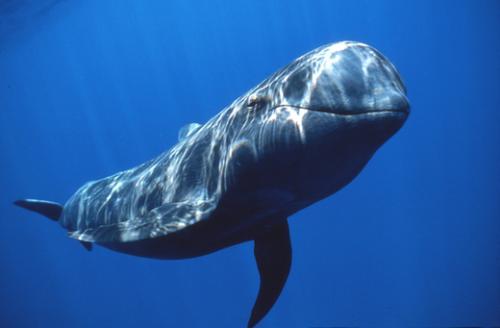
The bowhead whale lives in polar regions. It is commonly found in the cold waters of the Northern Hemisphere, and its habitat changes with the drift of ice. In summer, it also lives in bays, straits, and river mouths.
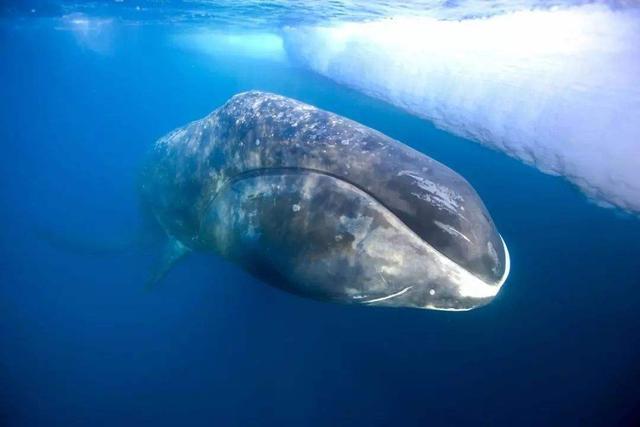
The bowhead whale's body is 21 meters long, weighs 190,000 kilograms, and females are larger than males. The color is dark, without a dorsal fin, the upper jaw is narrow, the lower jaw is arched. It has whale whiskers that can be as long as 3 meters, which is the longest among the same kind of animals. In the dazzling sunlight, the whale whiskers often reflect green fluorescence. Like the North and South Polar whales, the bowhead whale does not have whale whiskers in front of its mouth.
The lips are long and curved, the blowhole is back and arched, and the depression behind the blowhole is significant. The head accounts for about 1/3 of the body length. The back is round and without dorsal spines or ridges. The body is large and short and fat, and the black spots are arranged like necklaces. There are individual differences on the chin, and there are irregular white spots. The chest fins are large and paddle-shaped, and the skin is smooth without long skin flaps or tumors. The color is black, dark blue, dark gray or deep brown, and sometimes mixed with large gray spots. The tail fin is the thinnest, with two gray spots with a pale gray color on the nozzle. The nozzle is very open, and the bowhead whale's mouth is narrow, the chin is white and sharp, the back of the mouth is slightly inward, and the center is recessed. The fin of the tail fin is almost half the length of the body. The back of the tail fin may be white.
The skull is large and thick, used to crash underwater to breathe (according to reports from the Inuit, the ice layers it can pierce can reach 60 cm thick).
The blubber is 43-50 cm thick, which is thicker than any other animal.
From the side, most adult whales appear two obvious protrusions on the surface of the water. The triangular protrusion in front is the bowhead whale's head, and the subsequent concave part is the neck. The circular protrusion at the back is the extension to the tail fin. Note that the smooth back does not have a dorsal fin or spine. Young individuals are rounder on the side, from the rostrum to the tail fin, only one arc.
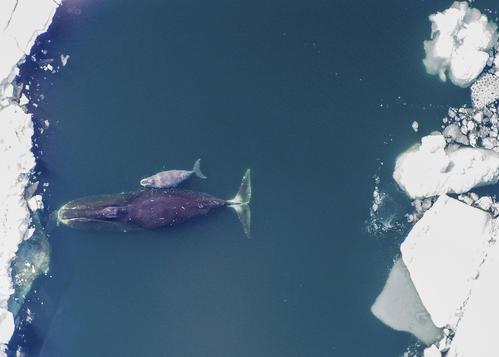
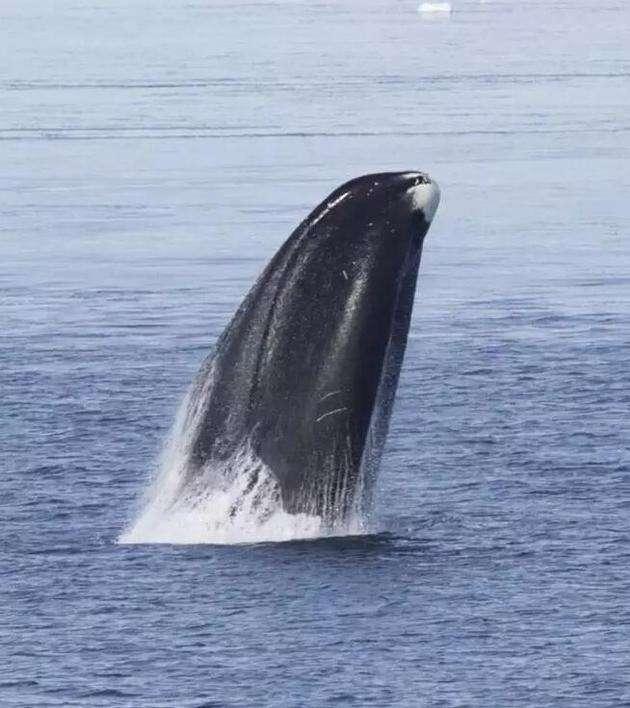
The bowhead whale swims slowly, usually alone, or forms small groups of up to six heads. Generally, it floats on the surface of the water for 1-3 minutes, breathes 4-6 times. It may dive to a water depth of more than 200 meters, and can stay in the water for up to 40 minutes, but it is not a good swimmer. The bowhead whale occasionally jumps and waves its tail, beats its chest fins, and floats. But once it starts, it may continue for a long time (there was a record of 75 minutes and 64 times). It is usually done alone, and the typical way is vertical, the back half of the body is usually in the water, and then the side enters the water. Most of the jumping waves appear in the spring migration. Vertical surfacing, 1/2-3/4 of the body can be seen, it is usually fixed to return to the water; the calf plays with objects in the water. It often accompanies bowhead whale, white whale, and lives in the polar region, which is the largest whale-dolphin in the north.
Feeding
It feeds on the surface of the water, underwater or along the seabed. It can slowly move its mouth on the surface of the water; sometimes it cooperates to feed. It preys on shrimp and plankton.
The bowhead whale reaches sexual maturity at the age of 10-15. Its mating season is from March to August, and the gestation period is mainly in March and May. The peak of birth is in May. The combination of mating can be one male and one female or a group of male whales with 1-2 female whales. Female whales give birth to one calf every 3-4 years, and the calf is about 4.5 meters long and weighs 1 ton. The calf can grow to 9 meters at the age of 1 year. The size of the calf ranges from 3.6 meters to 5.2 meters, which is 3.6 meters to 5.2 meters below the average length; in the first year, the length can become twice.
The bowhead whale is not many, and it lives in remote and cold environments, which makes research difficult, so humans know little about it. Some calves are pale in color when they are born (some are almost white), and then become darker with age, compared to adult whales, calves are generally shorter and more cylindrical, and the color is pale blue-black, sometimes through the water looks gray, and the back edge may protrude, and the tail fin is dark gray or black (the color of the tufts is pale.
It was estimated that the lifespan was 60-70 years, similar to other whales. But in 1993, 1995 and 1999, whale tusks were found in the whale's body, which triggered research on the structure of the whale's eyes, so it can be reliably concluded that at least some individuals can live to be 150-200 years old. Another study showed that female whales can still be fertile at 90 years old. Because of its long lifespan, female whales may also have menopause. This is confirmed by the lack of young calves on the large individual.
60~70 199319951999150~20090